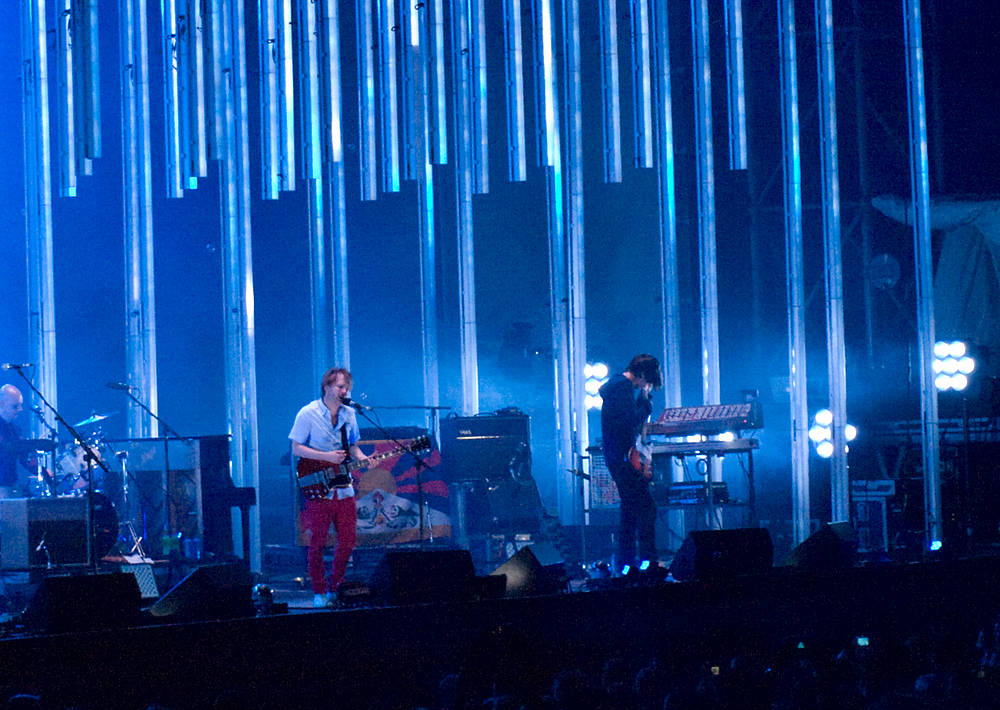
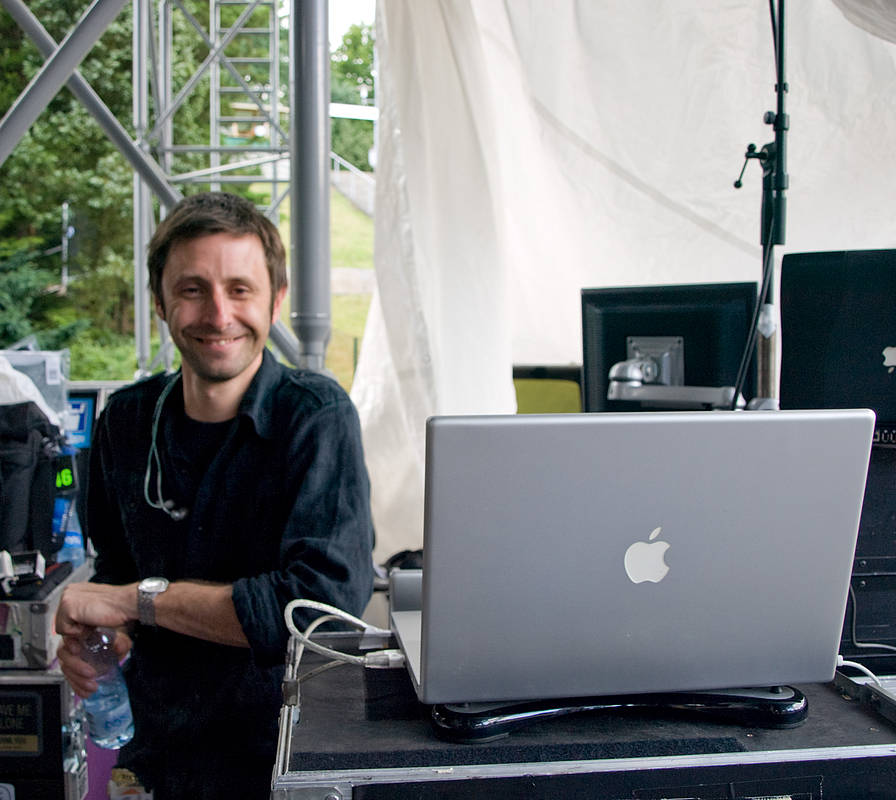
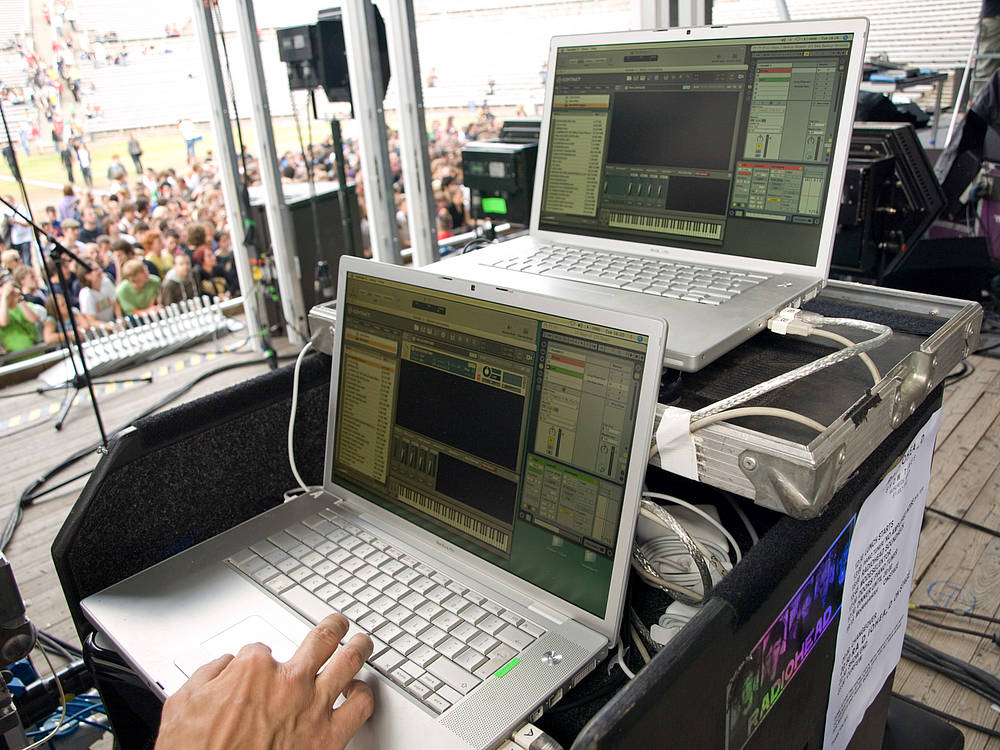
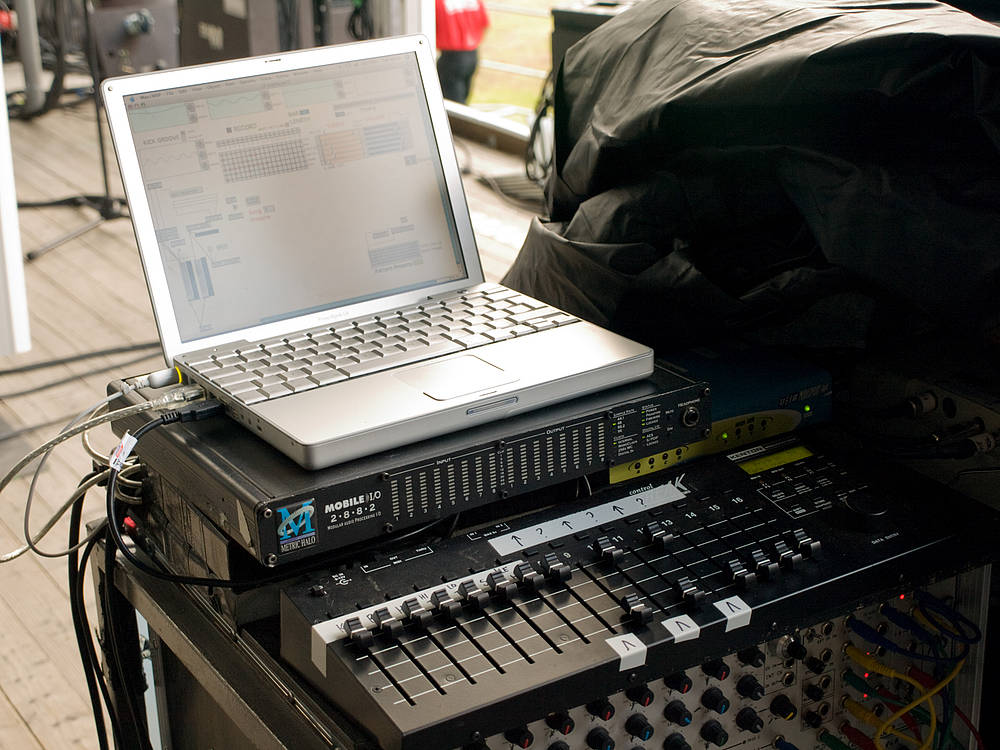

Interpol, the superstar, New York-based band (not the international anti-crime organization) have been touring the world with an intensive, live rig, powered by Kore. Our friend Jonathan Adams Leonard aka sleen, a technological superstar himself, put together their current digital setup, and sends along copious notes on the hardware and software rig. Jonathan has plenty more to share as far as how to make Kore work for live players, but first let’s have a look at the details of the rig itself.
And yes, prepare yourself for some serious hardware and software pr0n from one of the world’s best live bands. No DJ sets here.
(For our previous chat with Jonathan, see Free, Modular Power Tools for Kore 2: A Guide to the Reaktor Toolpack, covering his must-download Reaktor ensembles for use with Kore.)
The Hardware
Rack designed and built by Keyboard and Playback Tech Chad Miller(Lenny Kravitz) with assistance from Guitar Tech and Stage Manager Ally Christie(QOTSA, Mogwai).

It all starts with the controllers. Here are 2 Maudio Keystation Pro 88’s getting setup for a concert in Belo Horizonte Brazil at Chevron Hall.

Here is the rack for the keyboard system. It features 2 Macbookpro laptops 1 primary and 1 as secondary backup. Everything else is 2-fold and separated into distinct systems to the power supply. The items in the rack from the top: Furman Power Supply, Presonus Firepods, Sliding Shelf with Kore 1 controller, Glyph Drives, Motu Microlites, 3 sliding drawers.

This is the back of the keys rack. Inside are 2 USB hubs and a Radial Pro D8 direct out box for the 4 stereo keyboard outputs. The hubs accommodate dongles and drives. There are also numerous power supplies with different configurations.

Here is a shot of Kore 2 from the stage in Gdynia Poland. To the left is the keyboard tech for Jayz getting ready. I usually pulled up the performance preset for song ’scale’ to do line check. Further downstage is the Interpol Keyboard riser.

Here is the venerable kore1 controller showing the current performance preset, Pioneer, with the cued preset, Narc. This controller is on a shelf that locks in place. Using the wheel you can cue a preset and then hit enter to load. Its best to hit enter at least three times to ensure correct loading.

Here is a perspective shot of the three racks including the 2 playback systems I also ran and that were built by Chad and Ally. The keyboard rack is on the left, and then playback 1 and playback 2 racks. Between the playback racks in the distance you can see Bobby Schayer of Bad Religion holding up a drumstick to demonstrate correct line of site with the drummer, and further to the right Ally working on a guitar.

This is a picture of the keyboard and guitar risers for Interpol backstage at Gdynia Poland. This is a good example of outdoor summer festival production where setup and especially changeover times are limited. Your whole band including drums will be moved out on risers at once on one side of the stage, while the last act is emptying out the right. The keys are covered for protection against sun and dust.
The Software
Kore 2 by Native Instruments
Kore 2 Performance Programming and Design by jonathan adams leonard

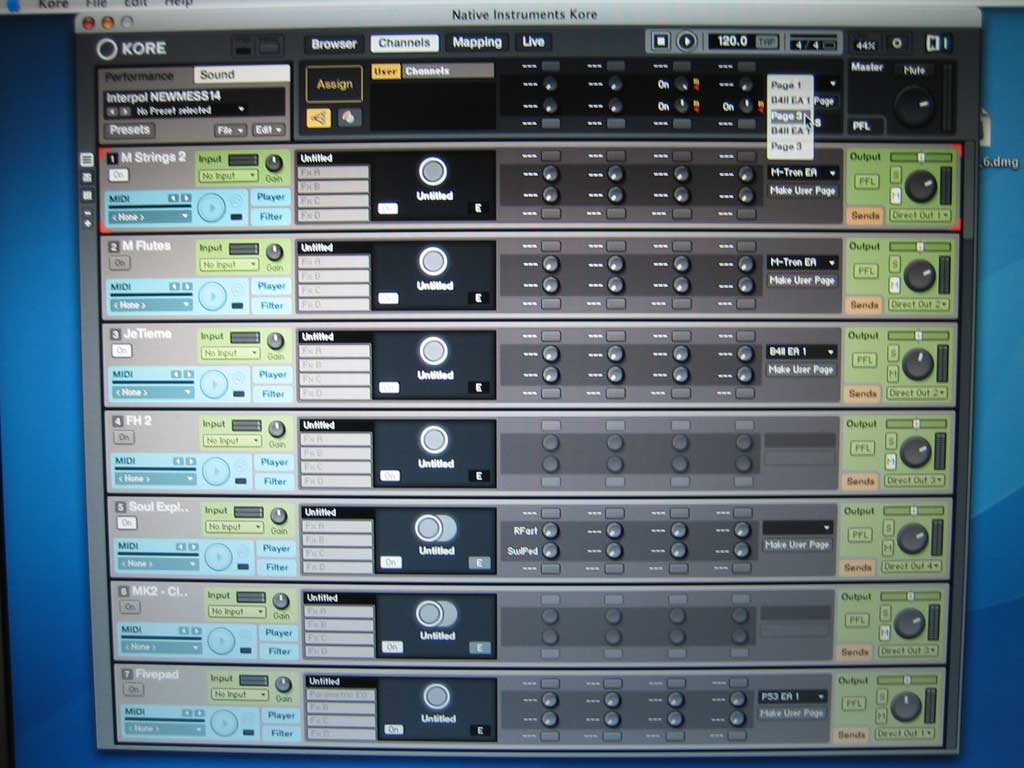
This shows the All Off performance preset which the performance loads into. This is also a convenient starting point for building new presets. In the Controller area at the top we see knobs for different songs that switch instruments dynamically by changing the channel bypasses. Next down in the matrix you seen source channels for the 4 kontakt output pairs. Only one instance of kontakt is used on the left, and the remaining represent outputs created by using the command, add additional output. On the right in the matrix are the kontakt dummy midi source channels for receiving, then processing before all going to the one kontakt instance on the left. The dummy channels have no audio connections and are midi only for recalling kontakt instrument settings.

Here is the Interpol performance preset ‘Pioneer’. It shows numerous source channels have become enabled with some still bypassed that will get switched dynamically with a knob.

A closeup of the kontakt dummy midi source channels. Each contains a midi filter, transformer and program change intergrated effect. By adding them to each channel, you can store all the effects settings and recall them in a performance preset. They may represent settings for internal plugins, or external hardware.

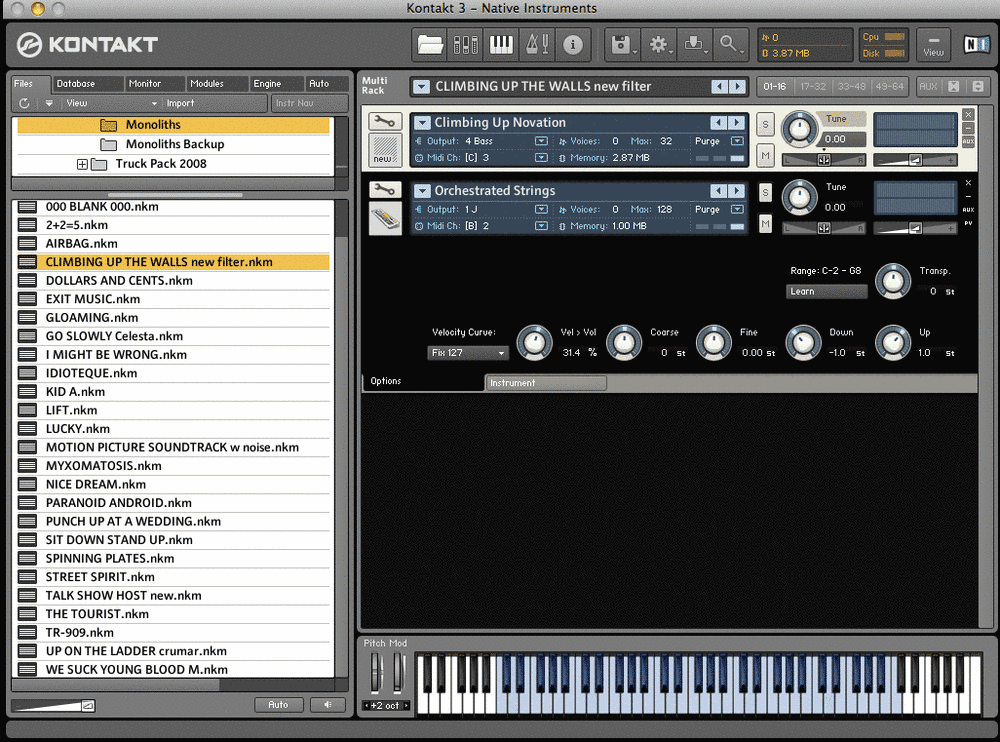
This is a view inside the kontakt instance handling all the sample based instruments for the Interpol Live show. The kontakt multi contains 6 banks each on different midi channels and receiving program changes from the dummy source channels mentioned above. By placing all the sampled instruments in a single multioutput instance of kontakt, the best memory optimization is used by minimizing samples and DFD buffers loaded.

This is a nested koresound containing all the required instances of Mtron needed by the performance presets. This sound is in the leftmost channel, in the third slot down. The next matrix level down shows its contents. Since the plugin could not support dynamic recall of all parameters, it was necessary to pre-load it explicitly for all the sounds needed. Each performance using a sound here will enable the appropriate slot by changing the bypass. Note how I am not using the source channel bypasses. Instead, I created a page of bypasses for each plugin shown above in the controller area on buttons. Kore by default does not provide or include the plugin bypasses in its recall scheme. By adding them, I allow them to be recalled in a performance preset. I use plugin bypasses because they work consistently on recall. When using source channel bypasses, the recall is inconsistent and causes ‘no output’ issues. Overall it is better to have only 1 plugin instanced and try to dynamically recall only its settings. But in situations where you have no choice you can at least keep the redundant instances from cluttering the top matrix by using a nested koresound.

This last one shows the fx busses and direct outputs to hardware. The gain staging of the performance design was planned by using standard decibel units and increments. Balancing was done to provide emphasis and power, without any potential overloads. The direct output pairs were organized in instrument groups:
12; Keys(AP, B4, EP)
34;Orchestral(Kontakt)
56;Synths(VSM,ProphetV, Mtron)
78; FX(Integrated, Guitar Rig).

|

Interview by Bela Canhoto
I’m just doing a few sessions really, keyboards for a new girl called Anna Kelley, an Irish girl, with a couple of friends of mine. We’ve been recording some accordion and organic stuff for a new album. I’ve done 4 tracks today and I’ll be back in tomorrow and probably do some more.
At the moment I’m doing 2 things. I’m writing music for motion picture and doing compositions for TV and films. I’ve been trying to move more towards films, which I do in my studio at home. I started out as a songwriter really, so now I’m moving more towards collaborating with people and doing some more composing in my free time. I did a thing called Hamilton Mattress for the BBC, which is the follow up to Wallace and Gromit. The company who did Wallace and Gromit is the same company who did Chicken Run. They’re an English company that moved to America, and the people who stayed here did other shows. It’s a half-hour animation. I did a thing for Nickelodeon called Edwurd Fudwupper Fibbed Big, which was a computer animated cartoon, a short. So no blockbusters yet, but you never know.
Throughout the years you’ve written music for artists of all ages and genres. Looking to the future, are you hoping to spend more time scoring and less time producing other talent?
I did a lot of pop music sessions through the eighties, so I never want to say goodbye to that really, although it’s changed quite a lot with the boy band, girl band kind of thing. It’s very dance-oriented, which isn’t so much my bag. But, there are still bands using real instruments like Travis. People like that who want that kind of skill around in terms of arranging and playing instruments. I like writing songs with people and with a lot of the people I have worked with I was doing the arrangements and keyboard related stuff so
I don’t think I’ll ever stop doing that sort of thing.
You’ve played live with Paul McCartney, Bob Dylan and many other great artists. How often do you play live and will you be touring again anytime soon?
I don’t really go on tours much anymore. I began working with Paul in 1989 and I did the 2 world tours and varying albums. Until now he hasn’t done a world tour since he stopped in 1994.
I went out about 3 years ago with Emmylou Harris and Linda Ronstadt. I played on a record with them and they asked if I’d go out and play and I thought, you know, it’s been six years since I’ve done any touring, so I went out with them for a couple of months and it was lovely. I do get called to do gigs quite often. I play keyboards in the house band for the Queen’s Jubilee gig. And I did a big thing with Bob Dylan Joni Mitchell Bon Jovi and a bunch of people from a Japanese temple outside of Osaka. So I get offered some big events, but I tend not to go out on a lot of the tours.
|

I’ve been using the B4 since it came out. I love it. I really think it’s great. Compared to lugging a real Hammond around! Although, luckily I don’t have to do the lugging about these days, but the B4 is very controllable with my little setup. I have a Titanium Powerbook dedicated to it that I use exclusively as a host for B4. I tried to do a lot more with virtual instruments to use live, but I couldn’t find a host that was stable enough, and because I really wanted to use the B4 on tour, I ended up giving it it’s own designated laptop. It comes out a MOTU 828 firewire interface and that’s all that laptop does, it’s just the organ. And to its credit, it never really let me down at all.
|

I’m also using Absynth, FM7, Reaktor, the Pro-52 I’ve been using for a while. I’ve been digital for a while. I use Logic; a lot of people use Logic over here. I’ve got 2 O2Rs linked together and they all go through Pro Tools, but I just want to simplify. I want to do more in the computer I just want to pull that down to one that will do surround for me, 5.1.
Has the software had a fundamental impact on the way you work at home or in the studio?
It changed it immensely because I have a digital system with total recall. If you’re working on a lot of different things that you do when you’re composing as well as writing, as well as playing on an album. You’ve got to flip between them and for me I don’t want to learn any more about engineering than I already know so I don’t want to sit there and have to reset the desk and bring all the faders up. With the software, it just comes back to how I left it, which is great. I want a quick means of being able to get the great sounds that I’ve discovered and mess with it in the studio.
Basically, I want something that will make this seem more streamlined and smaller. I’m a bit of a collector. Never throw anything away and it all sits somewhere. It must have been about 10 or 11 years ago, whenever they first brought that out the O2R and I could afford it. I didn’t have to spend a quarter of a million pounds on a digital desk. Just the programming of digital when the DX7 came out was incredible. I used to demonstrate for Yamaha. So I had that and the TX816. I was a hardware sequencer person before I got into computers and if you can deal with them and a DX7 then you have no fear.
I’m up for trying new gear. When I first started out I was a real purist. I played a real Hammond, real piano, but since my first synthesizer many years ago I’ve embraced technology and I’ve got a lot of old analog synths and like I say I’m going to pack a lot of them into storage and go naked, because I don’t think most people can tell the difference. What matters is what you do with it rather than the fact that it’s not an original Moog.
Do you do a lot of work when you’re on the road? Do you actually produce on the laptop when you’re traveling?
I just write and fiddle and play around with the plug-ins that are around. It’s amazing what you can do in a hotel room even on headphones or with just a pair of powered speakers, a laptop and a keyboard.
You seem to spend a lot of your time working in the UK. Are there any plans to work abroad? Is there anywhere you like to be creative aside from your hometown?
Well, we’re due to do some recording with Paul McCartney in September to October, so I’m basically going to take these next few months to work on a few things at home, sort my studio, finish a couple of little projects that are sitting in there that I want to do before I rip it all apart, have a little bit of a holiday and maybe take a trip. Twice a year I come over to Nashville and up to L.A. I’m not really ready to arrange a set of meetings in L.A. to try to put my foot through the film door there yet, but I have a lot of friends in L.A. So it gives me an excuse to go to Nashville and pretend to do some work and go to L.A. and pretend to do some work and enjoy the weather. (Laughs)
Wix, thanks for taking some time out of your session to do this interview.
Sure Bela, thanks for talking.
|



|
David and Marty Frasu (his technical engineer since 1991) believe that FM7, Battery and Kontakt are revolutionizing the way they program and produce music for film. The intuitive interfaces allow them to manipulate and mold their music on the fly, which is crucial to the fast paced rhythm of film scoring. If you listen carefully, you can pick out a B4, FM7 or Absynth sound creeping through the films.
In 1989, the soundtrack to the deliciously dark comedy "Heathers", with Winona Ryder and Christian Slater helped establish Dave as a prominent composer in Hollywood cinema along with the 1997 academy award nomination for his score of the animated legend "Anastasia". The success continues with his most recent project, the box office hit "How to Lose a guy in 10 days" as well as "Ice Age", "Death to Smoochy", "Bowfinger" and "Brokedown Palace".
Bela Canhoto recently sat down with Dave and Marty for a little Tech Talk.
Photos by Margaret Malandruccolo
|
Dave: The first movie I did was “Critters”, which was like a horror movie, but I didn’t really start a real studio until a movie called “Heathers” in I think it was 1988. I had an a-track Tascam tape machine when I started.
When did you officially open this studio?
Dave: Well, this is really my personal working space. It’s really not a commercial studio or anything like that. It just evolved because you have to demo stuff. When I first started you would just play on a piano or something, you wouldn’t demo anything but now it’s become really elaborate and you have to demo up everything. We’re using streaming samplers because we need these big huge files. I’m willing to pay any amount of money within reason for a product that works and a company that’s committed to all levels of the market, that’s committed to the professionals as well as everybody else. I think your company makes incredible stuff and they seem to be interested in the music aspect of it and the fun of it.
Could you explain your main composing set up?
Marty: Logic is the sequencer we use, and we have TDM options so he’s using ProTools hardware which takes some of the DSP off his Mac and puts it on the ProTools hardware, because Dave needs these things to get as big as it can possibly get. He might have 80 tracks or 90 tracks and that’s a lot of stuff going.
Are you using Mac or PC or both?
Marty: Mac primarily. We have PC because we had Gigastudio and that’s the only thing they run on and that’ll soon be replaced with Kontakt, which means we won’t be stuck with PCs, which I’m not fond of. Troubleshooting on them is difficult. We’re both sort of Mac guys, and particularly for music.
|

Marty: I bought Dynamo a long time ago and started playing with it and then it just sort of snowballed. You get one thing and you go ‘This is good!’ so you go and get more and then it got to the point where Dave said, ‘I want everything these guys make!’ We tried to get everything that’s come out since at least 2000 for sure.
Which NI products are you using at the moment?
Dave: You’re looking at it, we’re lovin’ the FM7, Absynth, and Battery, I’ve used the B4 too. I haven’t used Reaktor…yet! We’ve used Kontakt a bit. Battery I’ve been using a lot lately and it’s great, and all your soft synth stuff is absolutely great. You can see that I have a fair amount of hardware boxes but I hardly ever use them at all anymore. My only problem is running out of CPU. We have digital video that we use and we tend to run out of CPU power.
Marty: If you would have seen our setup 2 years ago I would say there was much, much more hardware, there wasn’t much software. It was in it’s infancy, but I’m finding now that you go to do anything and your first stop is getting into some of these soft synth sounds, because they sound great, they have some unique characteristics and the manageability.
Dave: You don’t even have to store this (points at FM7)! You can edit it and not even store it if you want. You can save it in the sequencer that saves all your settings. This stuff is almost idiot proof, I mean I’m a classically trained musician, I played the violin when I was 7 years old, I played in orchestras my whole life, I went to school for piano and violin, you know, I’m not techy at all. But now with film I needed to learn this stuff to do what I needed to do, and this is a way easier, better paradigm for me to use to whiten and sculpt sounds and for the music to do whatever I want to do.
Marty: And the tempo of the stuff that Dave does goes really fast, you’ve got to have a couple of things a day, you’re opening songs, you are closing songs, there might be a couple of cues a day that might be vastly different and just the managing of all this stuff means you’ve got to create methods.
Dave: What I have Marty think a lot about is just how to manage files. You get a product and what’s the first thing you want to dт? You want to save it and be able to get it back again, so it’s really complicated to do that because the people that normally program, it’s not an issue for them, they’re not doing that, they’re not racing through under pressure trying to get music made. They’re coding and things like that. So THIS soft synth stuff is just so much better with that, and it just sounds so much better, I mean it just seems so much more direct and it’s so much easier to manipulate. And your guys stuff sounds incredible! I’m sure you know that.
|

Marty: What we just mentioned would probably be numero uno: The recall ability! I know that’s not a sound feature but just by the very nature of soft synth. If you can make edits to a sound that can be saved within the sequence, that is such a huge thing. It sounds simple on the surface but when you actually start working with this stuff that makes the big difference. That’s why you start going for them first because you open up a song and there it is, the way you left it.
Marty: Not to mention lets say I had a DX7, or any synthesizer and it costs $1800. I’d have one synthesizer and it would cost $1800, where with these soft synths I could pull up another synth on this channel and onother one and another one.
Even though the graphics in your software are different, they all seem to operate the same. There’s a library of sounds you can just click on, even without an owners manual you can pretty much get by and get around on these things, where any of these things (points at the modular boxes/analog gear) they’ve got a manual so thick and you have to study a whole other mindset of the way that they do everything. But your software in a way is all similar in operation, you can see everything, it’s visible, there’s not menus you have to dig way down into to get it all. It’s pretty much available to you. The interface is great!
Dave: Yeah, the interface is a really important issue. Any moron could use it and you want any moron to be able to use it! What I believe about this stuff is there’s usually good and bad stuff in terms of teaching kids about music, but the easier this stuff is to use, the easier it is to get people excited about making music, they might write or play some music that they otherwise might not. Some of them will think wow this is really cool, I’m going to really learn about music and it helps out the more amateur music culture and therefore everyone becomes a little smarter about it and then all of us get to listen to better music instead of it being dictated by a few people who don’t give a crap about music. And you guys really care about it, at least that’s how it seems to us. I mean, I’m a pretty simple person and it seems to me that like they are really interested and use it and it’s fun for them, and that’s what’s exciting for me about all this.
How much creative freedom do they give you when you work on a soundtrack?
Dave: (laughs) Well, you know, it’s all relative. It depends on the movie and director but it’s definitely collaborative
and it’s a functional, quote on quote, art form. I mean, it functions to tell a story and make the movie better, so the
movie isn’t about the music although it can end up that way in certain instances. It’s definitely a collaborative job
and it’s definitely a big stressful deadline job, and a job where you have to think on your feet. And when you really
have to think on your feet is when you’re there with the orchestra. 90% of all the movies are basically 19th century
orchestra music meaning it’s very tonal, pretty and eclectic. So there’s a lot of pop elements in it and so a lot of
times you have to actually change things there too, so you have to be able to think on your feet.
What are some of the more difficult or maybe challenging films you’ve worked on so far
Dave: They’re all sort of difficult and challenging in their own way. Sometime it’s because of the people and sometimes
it’s because of the project, but it all ends up being about the movie. With some movies even if the people are or aren’t
difficult it ends up that some movies are just inherently harder to figure out where to put the music. Sometimes people
are very unobjective about their movie and don’t like a certain part or scene and it doesn’t need music or in fact music
would make it worse but they put music over it because they’re so scared of it that they feel they have to put music on
it. Or the producer or studio will want to put music over something and it’s a big huge hierarchy of the way it works
but that’s part of the job. It’s very well paid, you have incredible resources and you get to hear the music you make
played almost immediately and there’s nothing else like it in music, and it’s orchestra music. That’s what I grew up
with, I love orchestras, just hearing an orchestra tune is thrilling to me.
Dave: I would venture to say from a technical standpoint whether you are dealing with comedy, drama, dark comedy,
romance, it’s more difficult from a technical standpoint because there’s all kinds of giving away jokes and they want
crazy stuff, they want you to parody stuff sometimes, it’s all over the place and it also happens fast. I think rather
than in a drama where they’re looking out over the vista and you can play your big song there, I’d say that’s easy, not
from a purely creative standpoint like writing melody but just from putting it in sync into the movie. Hitting all of
these other things and making it all work as a piece of music is a technically difficult thing to do.
Is the process of working any different when you do animations to movies?
Dave: No it’s still just a movie, it’s a cartoon but still a movie, so if it’s a feature film you still use the same
resources if not more and they still use a big orchestra.
Marty: One of the things about animation that might be different is that because it takes so long to make the frames it
may be a very crude unfinished animation when you write the sound.
|

Dave: I mean, everything you guys do is really great. I'd definitely like to see KONTAKT blow away the other samplers on the market!
Marty: I think within the context of how David puts this stuff together, your synthesizers are like the spicing in the cooking! The orchestra might be the meal itself but then you want to spice it up and give it an exotic flavor and these do that really well, these synths provide exotic textures. Even in the movie ‘Scooby Doo’, there were a lot of beat loops and things like that.
You’ve mentioned a couple of times that you love the way these sound. So, do you notice a difference between the analog and digital sounds?
Dave: I wouldn’t be caught dead with analog! I think it’s a big bunch of crap now - analog (Dave sighs) - I mean, 96k 24bit digital is like…(pauses) I really don’t understand this whole analog thing. When it was 16bit then maybe you could make a case because it would be a trade off for clarity and warmth, but once we went to 24bit I was completely sold, and that was at 48k and now that we’re doing 96k, it’s unbelievable!
Marty: For us it’s not even an issue. For guys making pop records, what it does is that you’re using analog tape recorders and it compresses the sound and does some things that they like, it’s kind of like an effect. For us that’s a non issue, because we can take these digital files and copy them onto another drive and give them to somebody else and then it goes right out on to cinema for the dubbing stage…and so it’s a non issue. Digital is the only way to go for us. I can play you some stuff that was done on the finest million dollar console analog tape recorder from the 90’s and you tell me which sounds better!?!
Dave Newman’s Filmography
Death to Smoochy (2002), Ice Age (2002), Life or Something Like It (2002), Scooby-Doo (2002), The Affair of the Necklace (2001), Dr. Dolittle 2 (2001), Flamingo Rising (2001), 102 Dalmatians (2000), Bedazzled (2000), Duets (2000), The Flintstones: Viva Rock Vegas (2000), Nutty Professor II: The Klumps (2000) Bowfinger (1999), Brokedown Palace (1999), Galaxy Quest (1999), Never Been Kissed (1999), Anastasia (1997), Out to Sea (1997), Jingle All the Way (1996), Matilda (1996), The Nutty Professor (1996), The Phantom (1996), Big Bully (1996), Operation Dumbo Drop (1995), Tommy Boy (1995), Boys on the Side (1995), The Flintstones (1994), I Love Trouble (1994), The Cowboy Way (1994), My Father the Hero (1994), The Air Up There (1994), Coneheads (1993), The Sandlot Kids (1993), Undercover Blues (1993), Hoffa (1992), Honeymoon in Vegas (1992), The Mighty Ducks (1992), That Night (1992), Other People's Money (1991), The Marrying Man (1991), Bill & Ted's Bogus Journey (1991), Don't Tell Mom the Babysitter's Dead (1991), Paradise (1991), Rover Dangerfield (1991), Talent for the Game (1991), The Freshman (1990), DuckTales: The Movie - Treasure of the Lost Lamp (1990), Fire Birds (1990), Madhouse (1990), Mr. Destiny (1990), The Runestone (1990), Bill & Ted's Excellent Adventure (1989), Disorganized Crime (1989), Gross Anatomy (1989), Heathers (1989), Little Monsters (1989), R.O.T.O.R. (1989), The War of the Roses (1989), The Brave Little Toaster (1987), Malone (1987), My Demon Lover (1987), Throw Momma from the Train (1987), Critters (1986), The Kindred (1986), Vendetta (1986), Frankenweenie (1984).

|
You worked as journalist and were a member of the Blow Monkeys in the 80ies, how did you switch to producing other musicians?
My work with the Blow Monkeys, which was initially as a touring live keyboard player, expanded gradually into the studio during the course of their second and third LPs. This led me to do other projects with their producers at the time, Michael Baker, Stephen Hague, Leon Sylvers, and Julian Mendelssohn, and this was the beginning of my career as a freelance studio programmer.
How did your career as producer develop? Who was the first artist you worked with?
The first artist I produced – beyond the little bits of production I did for the Blow Monkeys – was a band called The Soup Dragons in the mid-eighties.
What attracts you most about working with an artist? How important is your musical taste?
I like to work with artists who have something to say and who have an individual way of saying it. Beyond that, there are very few areas I’m not prepared to go stylistically. I guess my tastes veer towards the stranger side of the pop music spectrum and that will now and then influence my decisions on whom I whould work with.
Whatґs your main impact on the records you programm for?
I don’t really do that much programming outside of my production and writing work these days. I guess looking back on it all the mark I left on the records I have programmed might have something to do with a willingness to explore sonic territories which might be considered to fall outside of the genres I’m working in. Plus an ear for a good groove and a good bassline inherited from my time with Danny D and Nellee Hooper, both of whom were very influential in this area.
|
I like the earlier stages of the writing and production process better, I think, when things are coming into being. The final mix is always a little stressful!
For “Moulin Rouge”, you were Musical Director and Co-Composer. What did your work mainly consist of?
Many things: helping Baz to choose and arranging all the musical numbers, working with the actors to record and develop their vocal performances, working with the screenwriters to integrate the music into the storytelling process, directing the musical performances on set, co-ordinating the inputs of all the various different composers and arrangers we had working on the project, helping to identify and working with the artists we involved in the soundtrack LP such as Norman Cook, David Bowie, Missy Elliott, and Beck…. It was a very complex job.
Looking back on “Moulin Rouge” what was the main attraction about this project for you? Would you do it again?
It was insanely ambitious, very complex and challenging. That was both the main attraction and perhaps the reason I’m not sure I would do it again! Maybe there’s only room for one in a lifetime.
On Vespertine I arrived quite late in the process and my contribution was mainly to do with helping her organise a lot of complex material gathered from a lot of different sources, and helping her preserve the tone that she was trying to set for the album, which was a very specific feeling of intimacy. What’s special about Bjork? Her uniquely poetic view on the world, her endless curiosity, her charm, her amazing voice. She’s one of those artists where working for them is a privilege that you know you will look back on in years to come as being pivotal.
How do you manage to get into so many different styles of music, eg for Madonna, for Massive Attack, for Melanie C or for the Robbie Robertson album “American Natives?
By being open-minded!
How did you get into contact with A R Rahman for the “Bombay Dreams” cast album? How did your cooperation look like?
Rahman and I have mutual friends and we met up as a result of this; we got on well, he had seen Moulin Rouge and Romeo and Juliet, and it was at this first meeting that he suggested I might like to help him with Bombay Dreams. Our co-operation was characterised by a very inspiring exchange of cultural influences.
How does your work as programmer for a record look like in the preproduction pahes? What do you have to prepare?
It looks like a pile of samples and sounds and melodic ideas which I think might have something to bring to the material; and a pile of CDs which I think might prove inspirational; and a pile of instruments which I think might sound good in the context.
How do you put together soundbanks? Which sound generators and samplers do you use?
I tend to organise my sounds on a project by project basis – I’m not a very talented librarian. Although every synth I use has a basic bank loaded into it of sounds that I’ve developed or become attached to over the years.
I use a number of different instruments ranging from old ARP and EMS synthesizers to more contemporary staples like the JV1080 and the K2600; and a lot of software synthesizers which I run on a separate computer to my sequencer; samplers are Akai S3200 and S6000s together with KONTAKT (newly added and doing nicely) and the Logic EXS sampler
Which sequencer software do you use?
Logic. Always.
Whatґs your opinion on software instruments and samplers?
I’ve been getting more and more excited by what they can do.
|
I use most of them! The synths are always on hand and I would say I use them as much as I do my hardware. I’m getting into the intricacies of Kontakt and it’s complimenting my other samplers nicely. BATTERY is handy – I have a few banks of my own sounds always at hand and the sample banks that NI do for it have been useful. I like playing with SPEKTRAL DELAY for those abstract moments, and REAKTOR is always an adventure.
Which NI program is your favourite and why?
I’ve been a huge Absynth fan since way before NI picked it up, and it remains one of my very favourite musical instruments.
What kind of software would you love to see from NI?
More of the same. I know you can design your own stuff in REAKTOR, but REAKTOR always seems quite processor-hungry, so ……a good polyphonic minimoog emulator? A virtual ARP2600? How about a VCS3? Maybe a good basic multitimbral S+S unit, as if there was a JV1080 in the computer?
What are you currently working at and what are your plans for the future?
Currently finishing off some tracks for Melanie C’s LP, Skin’s LP, writing with Natalie Imbruglia, just about to start an album with Rufus

|

For Depeche Mode he worked on the 1983 LP “Construction Time Again“, followed by “Some Great Reward“ in 1984 and then “Black Celebration“ in 1986. For last year’s “Exciter” LP he shared production duties with Mark Bell, and was already involved in the pre-production phase with Depeche Mode songwriter Martin Gore in developing the song basics. Consequently his contribution to the album goes from the actual recording to selecting and obtaining the equipment. Also surely of interest is his studio work for legendary German bands like Einstьrzende Neubauten, Ideal, or Paris Schaumberg during the 80’s, which took place in part in Berlin’s Hansa-Studio.
Gareth Jones is especially in-demand for his outstanding knowledge of Logic Audio, but is also extremely well versed with NI software like FM7, BATTERY, and ABSYNTH.
Interview by Joachim Landesvatter.
Whatґs fascinates you mostly when you record bands? The vibe!! - for me, it's about capturing performances, and creating a definitive version of a song by helping to create a special unique atmosphere
What is most important for your decision to work with a band? If they ask me and of course if I love the music/the attitude of the band.
I used to have 3 criteria:
1) lots of fun
2) a great learning experience
3) loads of money
Although the third reason is not so important any more. Sometimes you get all 3 together and that is great!
Is it essential for you to have a close relationship to their music or the band members? It is important (for me and the band) that I have a good feeling
about the music. Also the band and I have to feel comfortable with each other, otherwise it is no fun! Working a long time on a project where everyone is pulling in the same direction often creates close relationships.
How would you describe your influence on the records you engineer? Positive I hope. I am very interested in atmosphere - the feeling that a recording
occupies a certain emotional and physical space. I hope that is apparent in some of the recordings I have made.
Do you also have a creative input on arrangements etc.? Sure - arrangement is everything!
When working with Depeche Mode or Erasure do you become sort of a extra band member? Not at all! Bands have very special internal relationships. I am outside of that. I have known DM and Erasure for a long time however and we have become good friends over the years.
How do you choose in which studios you want to work with the bands? I prefer that the bands choose the studios. I will offer suggestions if necessary, but I am happy to work anywhere that the band feel is creative. Also of course the studio itself is less and less important at the recording stage - very often what is needed is a supportive enjoyable space and that can be built in a lot of ways.
What is the best way for you to approach their individual working methods? Listen to the songs and listen to what the band want. Listen a lot in fact.
You also worked with legendary German bands like Palais Schaumburg, Ideal, Einstьrzende Neubauten and artists like Holger Hiller and Rio Reiser. How did you get into contact with them and how did your work look like for them?
I met Palais Schaumburg thru' Thomas Fehlmann, who
enjoyed my work on "Construction Time Again", and I was able to help them record an LP
for Phonogram. We had quite a large budget so we were able to work in London, Hamburg and Berlin, and even used a
huge orchestra on a couple of tracks. It was a great experience for me and the start of my long friendship with
thomas.
I met the bass player from Ideal, Ernst Deuker, in Brixton a couple of times when I was living there, through a
mutual music business contact, and he invited me to meet the band and help record their third (and final!) LP. We
recorded in Wien and the band's management introduced me to Hansa Studio where I mixed the record. This was also
the start of another long friendship with the singer and writer, Annette Humpe.
After I discovered Hansa Studio I suggested to Daniel Miller and DM that we mix "construction time again" there ,
and that was where I met Einstьrzende Neubauten. My work with them felt like a great cross-fertilisation. I was
able to bring a working knowledge of sequencers and samplers to their world and their awesome power and work with
"found sounds" (as opposed to "conventional" instruments)
massively influenced my world. See "Yu Gung", "Halber Mensch", "People are People", "Master and Servant". Also we
had already recorded "Pipeline" in London completely with samples from a scrap yard, so there was a lot of synergy
and Zeitgeist in these relationships.
Working with producers like Mark Bell for the last Depeche Mode album, what was your job
for "Exciter" in comparison to his contributions?
I did everything of course, and tried, as much as I could, to prevent mark from ruining it, by putting too many
genius beats on it. :-)
Actually, for me, one of the highlights of Exciter was meeting and working with Mark Bell - a man of huge talent
and musicality and very warm, modest and witty with it. He had the massive responsibility of finishing the record
and he took what we offered him, and ran with it! All credit to him.
Were you mainly responsible for supplying/setting up the technology and recording the best
possible sound quality? That was part of my role - I was also responsible for planning co-ordination, data
management, incense supply, sound creation and programming, brown rice, candles, good vibes, emotional support
etc...
What happened in the pre-production phase? We helped Martin develop his rough demos
into something he felt able to play the band and the record company. this was an intensive extended and enjoyable
experience in his home studio in the UK.
|

Is the shift from hardware to more software based and more mobile systems one of the most important tendencies of the last years? It has certainly had a huge effect on my working life and methods
How do these developments affect your work as an engineer? I don't line up Multitrack Analog machines anymore, I have become a Logic Audio programmer!
What do you most like about using software synths? I like the portability, reliability, recall capabilities, price, sharing of patches on the Internet, automation capabilities and of course the possibility of really new sounds that emerge from genius creations like Reaktor. It all blows my mind.
Why do you prefer Logic to other sequencer software? It is just something that I am very comfortable with. When I moved to Logic (via Studio Vision and Cubase) many years ago a lot of problems disappeared from my life. And now it has become a much loved tool that has accompanied me on a great musical journey. I don't really know what other sequencer software has to offer anymore - Logic's stability and reliability, as well as the constant stream
of great updates has captured my attention. It has helped me earn a living too.
What do you most like about NI software? The sound!!
And what do you use them for? I love the new sound worlds that Reaktor has opened up for me - this is still a really exciting journey, as I am a Reaktor novice. And also I find Battery a fantastic sampler - as amazing as my original AMS sampler actually and just as much fun. (I look forward to Kontakt). I never really enjoyed my Yamaha DX modules, but FM7 is great for me because I can easily adjust some of the parameters, which makes it very tweakable. NI's emulations of the Pro5 & B3 are really useable too. I look forward to trying my new tonewheel sets for my B4 when they arrive.
I have used them in order to be able to lighten up my life - I have sold a lot of hardware synths over the last few years.
Do you create Reaktor ensembles? no I don't - I take premade synths and create my own sounds with them. tho' that might change now I have got Len's book ;-)
Do you also use Reaktor as a sampler? 6dex has had a lot of use, yes.
Which ensembles do you like most? Also I love newskool, but I think there is much for me still to discover.
What are your plans for this year? As always looking out for new and interesting projects where I can play a useful/creative part.
Whatґs happening with the new Erasure album? Recording is finished, we are looking for person/people to mix it right now, release next year.


|
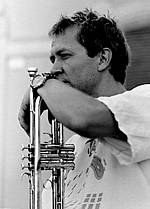
Molvaer had already released records on ECM with artists as diverse as the more folk-esque singer Sidsel Endresen, the Modern Jazz formation Masqualero or the percussionists and specialists in modern experimental music Robyn Schulkowsky, and had always been interested in the fusion of electronic and acoustic sounds.
After playing in harder Rock bands in the 80’s, mostly in the style of neo funkers Defunkt from New York, it seems like he’s still following in this style on “Khmer”, but on a more engineered level.
“Massive beats and throbbing grooves underpin the Norwegian trumpeter's fiery solos in a project that forms a bridge between ECM's improvised soundscapes and the brave new world of trip-hop, drum'n'bass, ambient/illbient, techno, industrial, electronica and samples. Nils Petter Molvжr may be best known for his jazz work … but he also has vast experience as a rock sessioneer. Khmer brings jazz's freedom and pop/rock's sound potential together.” (quote from www.ecmrecords.com)
As an almost logical consequence of the advanced use of technology, the remix album “Recolour” was released, for which Rockers Hifi, Matthew Herbert, The Herbalizer and many more processed the “Khmer” material and made it even more suitable for clubs.
As an outstanding Jazz musician and as a user of the NI software REAKTOR and ABSYNTH, Nils Petter Molvaer is a very interesting conversational partner. Joachim Landesvatter interviewed the Norwegian trumpeter.
I started to play when I was 6 years old,and after a period (9 to 15 years) when I was more interrested in football and rockґn roll,I started to study
the trumpet on a on a more serios level when I was aproximately 17 years old.I still like football and rockґn roll though.
What were important influences for you back than and what still influences you?
Good music. Sounds. Voices.
How would you define your style of playing the trumpet? Do you improvise a lot? What is essential for the feel to it?
Improvisation is the essence,and the sound...or voice if you like.
How did the idea for the "Khmer" project develop after you played other
styles of music with different artists like Robyn Schulkowsky, Sidsel Endresden or the group Masqualero?
Iґve always liked different styles of music, as long as I think itґs good. When I started to think about doing a solo project, I wanted to do something else. More like a production, but based on improvisation and a feeling of the things that has been infuencial to me since the beginning of the 80ґs. Brian Eno, Bill Laswell, Jon Hassell, Michael Brook a.o.
What was your concept behind "Khmer"?
It was basically to make a record with music I like.
How did the contact to the remixers for the "Recolour" album come about and how were the remixes done? What excited you about having your material remixed? What is your favourite remix and why?
I sent them CDs ,and then I called them, or in some cases Universal contacted them. I donґt have any specific favorites. I think they all have different qualities that I find inspiring.
Isnґt it "hard" to be somehow placed between the Jazz and the club music scene or do you think the listeners and the music industry are more open minded these days?
I donґt think itґs "hard". Sometimes itґs difficult to play for a hardcore "straight jazz" audience, so I try to avoid that. The music industry seems to be very openminded. At least the label Iґm signed to: Universal.
How important is the use of modern technology for your music? Isnґt it difficult to play your highly engineered material live?
I think modern technology is a tool. A great tool,but it doesnґt make music. It helps the musician to create music, and you can create sounds and colours that you canґt do acousticly. I like to mix acoustic and electronic sounds. To make it an organic whole. Also I would like to say that concerts and studio is two different things. I use some samples from the CD live, but it changes over time,so after 20 concerts...the song is different.
Live on stage you're playing also with a laptop musican and a DJ. Can you describe what the two are exactly doing live? What kind of records/sounds is the DJ playing with?
Raymond Pellicer is the sample and laptop man. Heґs playing samples, loops and electronics. DJ Strangefruit is more ike a free agent. Heґs playing everything from Danish Yoga records from the 60ґs, to Coltrane.
|

In the studio I have both Reaktor,Pro 52 and Absynth. Live with my band we are working to integrate Reaktor 3.We just have to find a system where we can link up all the other stuff also. For our tour
next year we will use it. Now I sample stuff,and put it into a Roland SP 808. I think itґs also good to have knobs to turn and twist. I look forward to it. I have used Reaktor as a standalone on several ocations though. With Bill Laswell for example. Thereґs a lot to get into. I also like Absynth alot.
.
What are you using Reaktor for and what are your favourite ensembles?
I donґt really have any favorite ensembles. Н use reaktor mostly for
rythmical things. In the lower register.It has a beautiful FAT bottom. If I should mention anything the DSQ is interresting. Also the random stepshifter, but there is alot to discover.I havenґt been through all of them yet.
How big is the impact of audio software in general or a programm like
Reaktor on modern Jazz music? Is there still a bride gap between playing an instrument and programming sounds?
For me it feels natural to mix these things. Both Eivind Aarset (git.), Raymond Pellicer and Audun Erlien(bass) are using computers. For me this is as natural to use in my music as the trumpet.
What are your plans for the future?
Finish my new CD. It will be released this spring,and I will stay home until May 2002. Try to live as normal familylife as possible. Learn more about
music software...and hardware.
Interview with Aromabar
They come from where the flavour is
|

Aromabar is a vital part this scene, even if their sound is somewhat poppier and -- especially on their forthcoming second album-- more song oriented than many releases by their fellow producers from Vienna. The band itself consists of singer Karin Steger, multi-instrumentalist Roland Hackl, and Andreas Kinzl aka DJ Scott. On their first album, “1”, they showed the versatility of their talents. Their crossover sound between dance and vocal tracks was quickly described with the term “Pop Couture”, and the new album “Milk and Honey” takes this concept even further while also refining the “pop-meets-club” appeal of the first LP.
Aromabar uses almost all NI tools both live and in the studio, but their music is reason enough for us to interview Karin, Roland, and Andreas. Joachim Landesvatter did just that.
Andreas: We see a fundamental difference between songs and tracks: with songs the whole production must be matched to the mood, the content and the message. During tracks it’s the functional that stands to the fore. However we’re certainly always trying to combine these aspects, though the weighting differs according to the current production.
Karin: It’s difficult to put into words but that’s perhaps a good clue. Our way of writing and shaping songs is something like a combined musical search for the things that trigger euphoria in us.
Roland: For me it’s important to have as many ideas as possible for a piece before we’re in the studio. Mostly there are so many possibilities available in producing a certain song, in relation to tempo, rhythm, harmony etc. For us, these things make up the ‘outer dress’, the packaging of the song. We hold on to the ideas we have for a short while whilst we subsequently develop different versions of the song. Only later on do we decide which beginning we’ll then produce-out.
|

Karin: Whoever listens to our new album will be accompanied through the most varied moods. There are pieces that are almost soul, and then again cool, electronically worked tracks. There are fun numbers tempt you to dance and there are very melancholic, sad songs with lyrics that I write only because that’s exactly how I am at the time and that’s just what I’m feeling.
How do you divide up your work?
Karin: That’s changed a lot. Two years ago, Roland and Andreas used to make instrumental layouts, I’d then listen to them, take them with me, think for a while and then somehow write something to accompany them. We’d record that and of course that’s exactly how it sounded. Roland also used to change the original instrumental track a little but that would be it. Since then you can be confident to hear a new Aromabar title without the feeling of listening to two pieces at once- a vocal and an instrumental track that somehow, by chance, have connected themselves. For a long while now we’ve been very song orientated, and composing is, in most cases, a very intertwined process between Roland and I. We work in turns, then together and then in turn once more- Roland continues and I pull-back and write new lyrics, text passages, missing fragments and melodies, then we join-up again pull something new together and experiment further… and wait, like I said, for that magical moment in the studio…
Andreas: Influences come really from all areas, both consciously and unconsciously. In the end it’s about giving individual moods the strongest possible expression.
Roland:<hv> New musical directions always change listening habits, and you react to that internally - that’s then reflected in the details of a production. For example, the choice of sounds/sound-design. During the mix, new ways of working like the use of software synthesizers, make an important contribution. Without them many of the new sounds wouldn’t be possible.
Karin: Yes, for sure, but that was the goal we set ourselves. We wanted to write more songs. In the context of a CD-Album, pure Club music is, in our judgement, sometimes a bit problematic, despite the unclear boundaries. But we simply wanted that our music could extend out of the club scene and be sung along to. That’s not our concession to the so-called evil - commerce - but rather the simple wish to develop this project further, and, in our eyes, to become better. The authenticity with which we go about things has not changed, quite the opposite, it has, I think, become stronger.
Roland: Beside that we wanted a more direct and compact sound for “Milk and Honey”, as if we were getting a step closer to the listener. An organic mixture of ‘natural’ and purely electronic sounds was also important for us, in the sense that we’ve set natural sounds in an unnatural context, more an intertwined than a side-by-side combination of wood and plastic. We’ve also got Leonard Richards on the new album as a guest singer on three titles.
|

Roland: Principally we arrange the beats in Logic Audio. During the production of the new album we were constantly shifting the sounds from Akai-synthesizers to software-samplers because of the better timing. Regarding the beats, I’m now really happy working with NI’s Battery, because it provides optimal access to all the relevant Drum/Percussion parameters. Above all I value the visual control of sample start-points and the waveforms. As soon as I have set-up an organic group of drum sounds, I transfer the individual elements to individual channels within Battery, so I can fine tune the sound direct from there. The drum sounds themselves are manipulated single-hit samples as well as self-created electronic sounds that are later layered together. In this instance we use a real mixture of sources, for example Reaktor (the Drumatik-ensemble), the Oberheim Matrix 6 or a Yamaha DX7.
|
Roland: That’s a many-sided aspect too. Fundamentally I try to use whatever equipment is available. It doesn’t make a difference if it’s analog, digital or virtual-analog. I like to build the overall texture of the music out of many smaller parts. For that reason I work a lot on the arrangement and less on the individual sounds. How a component in the production sounds depends strongly, from my point of view, on how it is employed within the texture. In our pieces there’s not really a special sound upon which the whole mix depends. On the software side we use NI Reaktor, NI pro-52, the Emagic ES1 and on the hardware front, the Matrix 6, a MAM MB33, Roland JD990, Roland DS50, Korg MS20, Yamaha DX7II and the Akai-Sampler in conjunction with simple waveforms.
Which of the Reaktor Ensembles do you particularly value and why? Do you create your own Ensembles/Instruments?
Roland: The sound and the sound-manipulation possibilities are really good in all the ensembles. I took an instant liking to the Plasma-Ensemble, with that you can generate excellent surfaces with a surreal touch. The Nanowave synthesizer for chords is very warm but it can still push to the front. Often I will take really simple structures. Since I’m used to programming sythesizers, I’m quick to find the sound I’m looking for even amongst different user-interfaces. We’ve seldom needed to program our own ensembles from scratch, preferring to make small modifications to the existing ones. I find it great that the possibility to build your own instruments is there, and in the future I’m sure I’ll look in to it, but for me actual use in the production has priority over experimentation.
Roland: The bass on “Cupid and Orlando”, for example, came from the 3-Osc Ensemble. Before version 3.0 Reaktor wasn’t optimised for Logic-Audio so we simply recorded the notes and then used the Emagic EXS-24 Sampler to play them out. On the new album we have used many orchestral textures. In these textures I mostly integrated manipulated layers that were created with the Rampler or Plasma Ensembles in conjunction with multi-samples of classical instruments, for example in “All I Want” or “I Promised Myself”. I sometimes used the Formantor Ensemble to make layouts for backing and harmony vocals that Karin then sang later. On the vinyl version of “Some Didn’t Even Know My Name” we kept the Formantor Ensemble in the mix because we really liked it’s electronic vocoder sound.
|

Roland: Apart from Reaktor, Battery, Pro-52, Dynamo on a second computer and B4. We used Reaktor/Dynamo a lot and also Pro-52 and Battery. I can’t remember in which songs anymore... The B4 we haven’t used until now.
How do you present yourselves live?Is everything played by the band, or do parts and sounds come from computer?Roland: There are definitely parts that come from computer because it’s the only way that we can present important components of our sound when playing live. We’ve changed our live concept around quite often. At the moment as well as Karin [Vocals] and Andreas on the decks we’ve also got our percussionist, Frederic. Myself, I play a Korg MS20 live.


In the beginning the Air Liquide sound was influenced by Techno and Acid House. Since then it has slowed down and become more intense and varied. Their style could be called electronic downbeat, but their beats and sounds always have a rougher edge than their competetorsґ stuff. Air Liquide deliver neither lame TripHop grooves, nor worn out jazz samples and standard beats.
On their newest LP “X” they once again deliver a large variety of styles. Massive basslines, trippy percussion arrangements and vocals by Mary S. Applegate and Sketch create a unique flavour. Highlights include Tolgaґs Ragga toasting and an intimate French cover-version of the Air Liquide classic “If there was no gravity” by Stereo Total.
Air Liquide was interviewed by Joachim Landesvatter.
Pictures by Markus Schulze & Walker.
|

Cem: It’s the spirit, the mission and the fun we have with each other. It began like a hobby and more and more it’s become a career.
How did you start to produce music and what were your important influences back then?
Ingmar: At the age of 14 I heard electronic music for the first time and knew right away that I too had to do something like that. I recorded my first record when I was 16, an ugly Italo Disco 7” on blue vinyl.
My most important influences were: HipHop (Public Enemy/ Eric B & Rakim/Ice T/NWA) and UK Synth Pop (Heaven17/Human League/ABC/Cabaret Voltaire/Eurythmics) and of course Holger Czukay and Can, especially their production techniques.
Do you make your music without worrying about what’s cool at that moment?
Cem: I wouldnґt say so. We’re listening to music all the time, and are influenced by it. Maybe our style of music is a little more timeless.
Ingmar: We donґt follow trends, we just make the Air Liquide sound.
Cem: We weave our own sound in and always make our own experiments.
How was Air Liquide founded? From where do you know each other?
Ingmar: We met in a sound studio in Frankfurt (Frankfurt-am-Main, Germany). We were sound-engineers for commercial Hip-House productions. At night we used the down-time to experiment and push the equipment to itґs limits.
|

Ingmar: The first Air Liquide record was “Neue Frankfurter Elektronik Schule” in 1991, which was made during those night sessions in the Artlab Studio in Frankfurt. Back then, we wanted to produce a psychedelic tripout sound with lots of surprising moments. That’s still true today.
Has your way of producing changed over the years? What is your prefered approach?
Ingmar: In the past, we had more machines running synched together and we used many more instruments. Nowadays we are more focussed. Now we rarely do a jam session for 90 minutes and then edit that down to a five-minute track: we produce tracks with a clear goal.
What’s the excitement about having your older tracks remixed, like for your single “Space Brothers”?
Ingmar: We make very personal music. We made these tracks during very important phases in our lives. Probably weґre just too sentimental to let them go, or we simply want to make them again and again. That’s true of our favourite tracks, which we update every few years.
Ingmar: Yes, thatґs true, although it didn’t happen quite like that. For example, we did a commission for the soundtrack for a documentary called “Verhьllter Reichstag” (“Wrapped Reichstag”).
Then thereґs the new European media law: when a TV series is made, they can simply choose your music and use it. You get paid for it, of course, but you canґt turn it down. The strangest things happen - like Air Liquide being used on “Wolffs Revier” (German TV crime series on the Sat1 channel).
Cem: One of our tracks was also used in the background for “Gute Zeiten, Schlechte Zeiten” (soap opera on German TV station RTL)!
Ingmar: We also produce music for films and would love to do a science fiction movie, where we could really let loose. There was a request from the director Emmerich for “The 13th Floor” but EMI lost that.
|

Ingmar: Craig Anderton (creative director of www.musicplayer.com and author of our Battery seminar) is a good friend of mine. We`ve played live together a few times and made a couple of records together.
Apparently people lacked the opportunity to talk in a certain way. In the forum thereґs little talk about music instruments and much more about the lifestyle; the forces behind it, ideas, and ways of looking at the world. These are the things that are relevant in today’s world. You can make music in so many ways, but the reason why youґre doing it and how you do it is much more important than talking about technology.
You often play live. Whatґs so special about that for you?
Cem: The attraction is the direct contact. Itґs important for us to experience what we are doing and the sense it has. You notice that when playing live because the crowd reacts to your performance, and thatґs essential. It would be an immense restriction for us if we couldnґt play live.
|

Ingmar:Thatґs a very complex question. With the production techniques available and software engines like Reaktor, you can optimise your working environment to suit your own ideas. It took me a pretty long time to put a set-up together thatґs completely suitable for my way of working.
Do you think that despite more becoming possible technically, music is not getting better or richer in variety?
Cem: That’s a law of nature. It’s not a question of variety. What is missing sometimes is a certain quality, a spirit, an idea. And that’s what is essential.
What about the possibility of having a complete studio in a computer?
Ingmar: It’s a really good idea. As production equipment becomes cheaper, more talented people are able to present their sound to an audience. Today two thousand Deutschmarks are enough. Buy a PC and a soundcard and you can start to make music right away. In the past you needed studios, today you need almost nothing. We’ve reduced our own equipment considerably and are now using only the few machines that have proved themselves over the years. We donґt take part in the ‘arms race’ any more. Naturally, new, good, audio software is coming out all the time and we use it, but we no longer buy any new machines.
What do think about the idea of switching from hardware to software instruments completely?
Cem: It is possible to work as minimally as you want, but we still have our studios. Sometimes you really want to expand the possibilities. Some tracks are so complex that itґs fun to be able to realise everything you have in your head.
Ingmar: I once had 240 synthesizers but recently sold 200 of them. You always end up using the same machines anyway, those that are the best and suit your style of playing. My passion for collecting in this field is over. I prefer to collect life experiences now rather than synthesizers.
|

Live we use:
Akai MPC2000 with 32MB Ram
2 x Jomox XBase09, one original, one with TR808 samples
Yamaha DX200
Future Retro 777
Technosaurus Microsyn 2
Clavia Nord Modular
Roland JP8000
Line6 Delay Modeller
Boss Delay Pedal
Yamaha RX5
Elektron Machinedrum
A few other small pedals
Ingmar: In the future Iґll also take along a Sony Vaio Laptop with Traktor.
Ingmar: Pro-52, B4, Battery, Traktor, Spektral Delay, Reaktor and Dynamo. Iґll produce my next solo LP completely with plug-in synths on the computer. Battery comes pretty close to the extreme demands I make from drum programming. There could be more groove features, and a pad controller that can be plugged into the computer is definately missing. I love my MPC 3000, but I will mainly use Battery for the drums on my new album. Traktor is easy to use – right now Iґm doing an Air Liquide megamix with it.
What do you wish for in the field of audio software?
Ingmar: Iґd like to see more phat controllers. Making music with the mouse is a pain. In our Syncom crew we came up with ideas for a few controllers, but itґs really difficult to find a company that will build them…
Keep on Surgeon
|

Long-held friendship with former Napalm Death drummer Mick Harris (Scorn) introduced Harrisґ name to Techno fans with a heavy dark hand in three notorious remixes of Surgeonґs Tresor material. Recording and performing in their band “Certain Beyond All Reasonable Doubt” marked a sway towards Tonyґs non-dancefloor work, releasing the Anthony Child / Dr. Andrew Read and Certain Beyond All Reasonable Doubt (live in Berlin) albums, raising ears and eyebrows across 1998.
In January of 1999, recording his third Tresor album, Surgeon reinforced the theories gained in the previous yearґs experiments drawing carefully on the parallel between loud musicґs ability to cross cultural differences and the opposing swing toward experimentally contemplative music played quietly to produce a different perception. Sentimental with a high emotional content while sometimes simultaneously brutal, "Force and Form" brewed a powerful physical experience at club level decibels. (shorted version of text by Marc Snow on www.tresorberlin.de) Surgeon was interviewed by Joachim Landesvatter.
How
did you get into Techno?
I've been drawn to electronic / processed music for as long as I can remember. I got more
interested in techno when I heard records like the
first LFO LP and the first Aphex Twin releases.
What still excites you about this style of music?
I still feel that so much more can be done with Techno, there's no point in
releasing the same thing again and again. Techno can be anything you want it to be, I think
too many people restrict Techno by giving it a very narrow set of rules to follow, I like
impure Techno.
What used to influence and still influences your sound, where do you
get inspirations from?
I get inspiration and influences from everywhere, music, films, books. I still get excited
by the music of people like Coil, Throbbing Gristle, Suicide, Faust, Soft Cell etc.
How did you get into touch with Tresor Records?
It was when I first played at Tresor Club (1996 I think?) After that we stayed in contact, I
liked the way they worked so I released some records on their label.
Listening to your three LPs on Tresor, it seems that you are
departing from the "classic" harder Techno style more and more. Do you find thatґs true?
I just wanted to bend to boundaries of what you "can" and "can't" do with a Techno LP. I was
also trying to make a record that would work both at home and in a club.
Whatґs happening on your labels "Dynamic Tension" & "Counterbalance"
at the moment?
Dynamic Tension is “sleeping” at the moment. Counterbalance is up to it's 6th release. The
first release on, it's by Gennaro Le Fosse (he's from Brooklyn, NYC and has been producing
Techno since the early '90s) The 7th Counterbalance release will be by DJ Pete from Hardwax,
Berlin. I've just finished the 8th release which is called 'Screw the Roses'. It's a very
dark record.
Whatґs are the main differences between your solo stuff and your
project “Certain Beyond All Reasonable Doubt” with Mick Harris or your project with Regis
and Female? My solo work can take on many forms. “Certain Beyond All Reasonable
Doubt” was a live project with Mick Harris, it was very heavy, dense soundpressures. My work
with Regis and Female was constructing track using their samples and loops.
Tell us about your remixes for Coil!
I'd say Coil have been my favourite 'band' since about 1987, they have always been one of my
main influences (in an indirect way). There was talk of me doing a remix for them a few
years ago, but it never came to anything. It was just a case of waiting for the right
project at the right time.
Do you take a special approach when youґre remixing acts that are
situated outside of the "clubby" Techno scene?
Those are my favourite kind of remixes because I really feel that I can let my remix go in
whatever direction it “wants” to go, there's just a lot more creative freedom. I've also
done remixes for Matmos and Scorn (Mick Harris) which I really enjoyed.
What are the most important aspects for you when youґre producing a
track?
Creating something that has a life of it's own and then nurturing it until it can stand on
it's own (metaphorically).
What kind of equipment are you using?
Mainly -
Macintosh G3 with Audiowerk 8 soundcard
Tascam M-2600 desk
Ensoniq ASR 10
Nord Lead
Yamaha TX81Z
Eventide H3000 D/SE
Lexicon PCM 91
TC electronic finalizer
|

Does software play an important role in your setup?
Yes, but I really like the hardware / software combination the best. The amount that I use
hardware vs. software varies from track to track.
For which types of sounds or arrangements do you use Reaktor?
I find the sample/sequencer ones the most useful, great for manipulating my own samples and
loops.
Which are your favourite Reaktor ensembles?
Homemade ones!
Has your style changed in certain ways after youґve begun to use
Reaktor?
I think it's just opened up more possibilities and made certain tasks a lot quicker and easier
than they were before.
Do you use Reaktor for playing live?
No, but I did use it running the 6-Pack ensemble on a G3 Powerbook in Japan a few times. I
just mixed it in and out of a Dj set, it was fun.
Interview: Joachim Landesvatter/ NI

|

Manuela: Oh- That is a long story; it was actually a total coincidence. I had previously spun completely normally, I mean records and CDs. Then, at the expo, we made an exhibition based in the WMF. There there was a bar, video-installations and so on, and we also set up a juke-box. For this event I had digitalized a really insane amount of music and then the thing ran practically non-stop. This way I had put the entire specifications, my entire music, contained on a hard-drive and I thought – super! – I don’t need to carry around the CDs and records anymore. At that point I had just an iMac of all things, and had always carried it from the 7th story into the club. The only program for Mac that was halfway okay, was TACTILE. I worked with it for quite a while. In the beginning I always mixed it up, which meant that I had to drag everything all over, including the iMac. Then I left out the CDs and at some point kept only a backup-record on hand. You can see I already liked this system quite well.
In the same year I had so many gigs in foreign countries – that started with a thing in
Tel Aviv, where I obviously would need to drag my Mac with me. I needed some kind of a
emergency solution. I had heard about TRAKTOR and so we called NI and got a test-version.
Club Radio then was kind enough to loan me a laptop PC, which I didn‘t even own, so that I
could try it out.
It was so much fun and so exciting, that after that I never touched TACTILE again. I
borrowed some money, bought a PC-notebook and changed systems immediately. Since then I
have been an enthusiastic TRAKTOR user.
Manuela: Oh yeah – My name is Manuela Krause and that’s also what I call myself as a DJ. Nothing ever occurred to me that sounded cooler than Manuela Krause (laughs). I am 30 years old and come from Hamm. I make music myself and am a singer. I just finished an album with my band from Copenhagen, named ELEKTRAZZ. It’s a mix of Elektro and jazz, difficult to explain, somewhat experimental. The album will appear from Multicolor, sometime in the fall. It’s called Robobrain – logically enough.
A band from Copenhagen?
Manuela: Yeah, I’m always going over there, and they sometimes come here. Together with me there are four members: A scratcher, who also does drums, the bassist and jazz bassist also did all of the arrangements for the Senior Coconut Band and went with them on their tour. He also did a couple of things together with Cheap. And then there‘s another one with us who does the sounds and visuals.
I also did another thing with Pole, which has just been released under the title “Manuela Krause and Pole,” on POP 2001. There we actually do a dub version of “Mein Freund der Baum” (My Friend the Tree). (laughs) That will come out as a single in September, from Monika Records. Musically it’s really a very good time for me, there’s actually one more thing that‘s coming out: Under the name “Olimpia” I have finished off a project on Superstar – that will be called “Mechanisches Mдdchen” (Mechanical Girl).
|

Manuela: That depends. Sometimes it can be quite contagious. I just infected one of our dance-floor DJs in the WMF. He played around on my machine, jammed out for a while and finally bought himself a PC. He has already set the thing up on the dance-floor and thinks it’s really cool.
Then there are some who say, “Yeah okay, but you don’t have to do anything for yourself anymore. You can just install everything.” Those are just the technicians, but it doesn’t matter to me.
I have noticed that you are always surrounded by curious party-guests. What do they say about it?
Manuela: The first thing that is striking is that it’s always only men who try to come up and chatter at me. At one of the last parties here, all of the boys who were spinning on the main floor had all of the girls dancing in front of them. I also had quite a few dancing people around me, but then a whole pack of boys gathered around me, and just stared at the machine. They wanted to know exactly what software it is, if I am doing anything there myself or if the software does everything. But on the whole, the feedback tends to be on the positive side and sometimes there are even very precise questions about the particulars of what one can do with the equipment.
Manuela: I think it’s right, that it’s partly something you have to get used to. A lot of people think it’s actually cool, because it sounds somehow funny; others find it a bit too shrill. I personally simply favor the sounds that come out of the computer, for example the C64 stuff. There are a lot things which just sound a hell of a lot better as MP3, because it somehow really gets to the point that way. I like this computer sound – I find it satisfying.
I was also pretty impressed by the basses which you were able to produce.
Manuela: Ya – they’re okay. You can, on the one hand, go through the external mixing-station, as one usually does, which allows one to readjust a bit, but with the TRAKTOR one can above all still regulate things. That is really something. We naturally have a great system with big subwoofers; one has to add this here. If you try to spin on a shit-system, then of course it will immediately sound completely different.
|

Completely apart from the program, it‘s really nice not to have to cart records around with me anymore. You have your Notebook and you can just pop it open at any party and make music. You don‘t even need a mixer, because it’s also included as a part of the program.
I find the program to be amazingly transparent and I also love to be able to have an orderly archive and not a box anymore, where you have to dig around in it the entire time with your hands, without being able to find precisely the record which you need. I simply am able to locate things much more quickly in the index-folders, and it is somehow completely intuitive, but really differently intuitive – one allows one’s self to be lead by different things.
And I have to admit that I was never an especially good beat-mixer (oh God) – but one can admit one’s weaknesses, right? (laughs) I am simply completely lazy and never had the interest to work really hard in that area, because it never interested me. Records are so flat, they don’t feel good. On a keyboard, on the other hand, it’s much better. That’s really fun. Then you have to press the keys in rhythm. I think it’s simply great, the tactile way in which one is able to handle the thing rhythmically.
Manuela: I would wish for a few extra effects, for example a delay-control. The current spectral delay is very extensive, but it would be a great thing if there were just a little spectral delay, with the complete filtering possibilities, installed as a rack. But also other effects, like distortion and reverb – above all because I would wish for another rack, where I could plug in my microphone externally, so that I could then also sing at the same time. Then of course I’d like to be able to record it, and then play it back again, and then sing over it again, and so on. Also in general I would wish that I was able to work with the thing in a way that’s more like a studio.
Oh yes! I have one more: what would really be the hammer would be if there were another little synthesizer inside, with a few sounds that one could play across the whole keyboard. You can play things in bits, alter them, and at the same time play along on the synth and sing! The modern one-person show (laughs).
Fantastic! I can really see it now. Thanks so much for the interview.
Interview with kindly permission of the German music magazine Mushroom

|

Mouse On Mars completed a World Tour in July. Bass guitar, drums (played by Dodo Nkiishi), laptop (running REAKTOR), and lots of electronics helped them to generate an exceptionally tight synthesis of acoustic and electronic instruments.
NI talked to Mouse On Mars about their recent tour, the new album and how NI software influences their sound.
Andi: The latter.
Jan: The imagination for a new album arises from the stuff you’ve already made. Itґs not that we wanted to go somewhere in particular. You know where youґve been and think about where there’s room to go. For the new album we wanted a more compact sound, something aggressive.
Andi: Thatґs not oppositional to us. Acoustic instruments are equitable to processed sounds for us.
|

Jan: Yes. But on the track “ilking” we didn’t alter the recordings. The strings were recorded on a 24 track tape recorder, so we preserved the arrangement. Otherwise we dissect everything and also process parts from that.
Andi: That happens more often to vocals, which have been recorded to totally different rhythms and enviroments and have been cut afterwards. That was the case with “actionist respoke” for example. The calm track was a house tune first. In most of the cases the tracks change completely.
Jan: We donґt have a special approach. We work in our studio and have endless technical possibilties there. Sometimes we start a track with with an acoustic instrument or a sample. Or while opening the NI-Spektral Delay a whoosh turns up. Itґll be recorded when itґs interesting. Often we work on tracks separately but are together in the studio. One of us deals with the vocals and the other one works on the arrangement or samples certain parts out the acoustic recordings. We frequently send the parts to each other.
Jan: We always remake all the sounds, because thatґs the part of the work which interests us the most. It would be more effective if we had a pool where we could take our samples from. But there wouldn’t be much point. If we could say: thereґs going to be a 12” released and weґd knew for which club it is meant, the weґd exactly know which sounds to choose. For an album we proceed little by little and we have to develop a certain attitude, which only emerges if you do the production spontaneously. Itґd be no problem to put something together and to produce a track in really short time, if we would always reuse the same samples. But chances are, nothing exciting would happen. Quite often tracks develop naturally in unintentional directions. We always want to have new sounds, which we can observe or be forced to understand. A certain tension emerges out of this situation, because we never exactly know what it is that we have and how we have to deal with it. Thereґs always a certain cautiousness to it and thatґs what makes it interesting. Thereґre so many possibilities to generate sounds and in the end itґs always obvious that you made them. You donґt have to worry about leaving your path.
Jan: Weґre more the sample types. We process a lot and then we cut the samples. We always do the cutting last. Most of the modular interfaces are quite lethargic. Weґre more interested in having direct access. Therefore acoustic instruments and the comprehension of how to work with interfaces like that are more interesting for us. Most of the modulation matrixes which are available for synthesizers are not intuitive enough to me. Itґs not so simple to construct something yourself. Many of the newer software solutions are much better for that. You can do interesting things with those software synthesizers. Thatґs what I like about REAKTOR, which I use live— I have fast access and can work intuitively. At the same time, I can concentrate on listening, because I know excactly what each knob is doing.
|

Andi: On the whole nothing has changed much.
Jan: The principle remained the same: To work with fragments. Then we can receive all those pieces, put them together again and see what kinds of combinations are possible. The number of parts always grows. When you factor in the software, the possibilities multiply. We mostly like it when a lot of pieces are in it. But still enough air has to remain. Quite often we think about how much we can put into a track, without losing the airyness.
What do you use predominantly in the studio?
Andi: We donґt have that many pure sound generators. Our studio has an old 24 track tape recorder und lots of outboard effects, mixing desks. Most stuff happens through two synthesizers, samplers and software. Their sounds are still edited analog. We record lots of stuff over amps, guitar and bass are on board as well.
Jan: Actually everyone we can get. Pretty soon itґs obvious if we can get ahead with a software or not. Native Instruments makes software that can be used easily. There’s so much software that sounds the same.
Andi: When this software thing started, I was disappointed, because the early software still sounded like DSP sounds. That changed when we received the Native software. It started with Native, I think their stuff possess its own personality. We soon get used to using Native software, because that still remains a principle.
Jan: I also liked Hyperprism. My first thing was Alchemy, you canґt do a lot with it, itґs more sound editing. Concerning granular synthesis, Metasynth is pretty much ahead. And of course REAKTOR, which is pretty opulent and very good. We think itґs very important that sounds come out of many different machines and are united in the mixing desk. That constitutes quality of sound and a richness of colours. Several software applications and 8bit, 16bit, 24bit sounds and incredibly expensive stuff, but also bad stuff inbetween. Grain sounds and then again a stupid synthesizer that only plays a sequence. I think that constitutes an interesting sound. The pure, clean, digital desktop sound doesnґt appeal to me. I like tracks by Randomiz though.
|

REAKTOR appears here and there on the new album. The electronic drums from “doit” were mostly made with Impaktor. Thatґs rather an exception because we avoid presets. The usage of “doit” resulted from nothing special. The computer voice from “doit” and the harmonies were made in part with the REAKTOR ring modulator, a few resonance distortions. The organ in “actionist” that carries the refrain was edited with REAKTOR filters. Here and there small details appear, granular gimmicks, filter and mutilations of sounds.
Can you imagine that the production of music will completely come out of the laptop computer one day?
Andi: I think that the development will go in that direction.
Jan: But thatґs not our aim, we want to retain the old stuff and donґt want to get rid of it. If you combine the old and the new, when itґs not important if something sounds “new” and the other one sounds “old” or everything has become very simple and sounds very clean. I like the trouble in combining the mechanical with the digital stuff.
What do you think about the current state of software synthesizers?
Andi: Most of the software synths only try to bring the same idea to the desktop, to me thatґs boring and uninteresting, thatґs the weak point. Maybe itґs got to be like that at the beginning, you have to go through that to develop something new. Or it only serves the selling, instruments that are already popular are easy to sell. There are probably economic constraints.
Jan: This culture of emulations is quite strange as well. Thatґs a kind of cultural delay.
Something I also donґt like: In the studio, you have a system of plugs to connect and software is pretty complicated to connect. You have to store a sample, the open it again. Sometimes itґs not even possible to open it simultaneous on different systems. It annoys me that thereґs no additional level where you can connect everything. Always a copy of a copy of a copy arises and thatґs a stupid form of culture. And itґs not even fun to go through the mountains of files. It should be easier to cable all the elements.
Jan: F.X. Randomiz has been involved time and again and mostly helps us out concerning software. Vert (Adam Butler) contributed to the second part of “Presence,” to this “Rimskij-Korskakow” part. He also contributed sounds in a session. At this time, he was mastering his album “Nine Types” in Dьsseldorf. We made a track with Matthew Herbert for “DJ Collapse” on the b-side of the 12” and he played piano for another track. That was recorded and advanced without him. The string players came to our place for every recording. There were outlines for the tracks, which they accompanied. We worked out the arrangements and they changed them to the necessary keys. We put a lot of work into how it can be played.
Harald Sack Ziegler came a few times and we explained to him what we wanted. He is very free, develops his arrangements himself and offers lots of detailed propositions. He contributes a lot of own stuff. We worked on three tracks with a bass clarinet, with exact specifications. We even had a skiffle band, that had quite a different perception of timing. Therefore we had to cut the recording merciless to put them where we wanted. Dodo was there mostly for the vocal parts.
|

Jan: Before every concert we think about which tracks we want to perform, but sometimes things get a little confused and then we change some stuff. A lot of arrangement parts are fixed and we stick to that, but then we also have many free parts as well.
Whatґs the proportion between your live gigs and the work in the studio? Is there a big difference between your live setup and your studio setup?
Andi: Yes, partly. This time we use live a “rock” setup with drums, guitar, bass guitar and electronics. The tour happens normally after the production is finished. A tour is a further development, or modification, of the record and we have lots of fun rehandling the material.
Jan: Thatґs a kind of interpretation of the tracks on the album. You canґt repeat it live, because a lot of the stuff is calculated and arranged very precisely. Therefore we came up with different ideas that translate the album more or less and try to explain the album on a different level again. Just like we quasi-make up different bands in the studio, thereґs also a live band.
Andi: Itґs much more accessible with a band live.
Jan: The band energy comes across, but thereґs a totally different richness of sounds. All three are working and the electronics are able to make more. Youґre almost doing something with your feet, your hands and then you also give your ears something to do.
|

Andi: In the studio nothing is determined, but live it depends on the equipment. We all make beats, though.
How does your live setup look like and do you use laptops live?
Andi: Yeah, on a laptop you always have such a concentrated face expression.....
Jan: On the powerbook for example REAKTOR, Metasynth, Hyperprism – and Eudora (laughing) is running. Of course we only use stuff that works in real-time. On the G4 we have Logic Audio, where the sequences are running, all of the MIDI tracks and the samples. There are also accents, for example bass accents, not whole bass tracks but additional moments. We also have a Unisono and “Emerson, Lake and Palmer” passages or polyrhythmic parts – and accents from the computer, e.g. brass samples. All the MIDI dumps for the clavia units, modular and nord lead, come from the G4. I use the laptop with the MIDI faderbox Phatt Boy, plus the MIDI interface MT4 by Emagic. The MIDI keyboard connects together the controller, the MT4 and the laptop.
Andi: Everything is connected over MIDI in an old-fashioned way. The drum-kit also has additional MIDI pads and a sound module, itґs therefore acoustic and electronic. I use two sequencers, a TB 303, a smal Korg sampler and the Modular. Thatґs pretty ideal live.
Jan: You can use the Modular as a filter bank and then Andi can play bass guitar or guitar through it. The bass sound changes form track to track immediatly, because through sysex you can access different sounds or filter settings. The bass often sounds pretty hybrid and a little synthetic. We add a ringmodulation filter and an envelope, but itґs still played live and therefore very vivid with much better sounds. In a live situation you canґt exactly differ anymore, but we like the mixture of acoustic and electronic instruments.
Jan: I use a REAKTOR sample ensemble that I created with F.X. Randomiz. Heґs my private hotline, he exactly knows how to cable modules together....I pretty much like that you can build instruments for your own needs. In a live situation I use it for simple applications, like formant changes, granular synthesis, processing with ring modulator and filter, for sounds like guitar, sequences, voices, scratches, noise, harmonies and melodies. I play the ensembles over the amp. Often that sounds guitar-like, very fat.
Andi: Better than a guitar! The funny thing is that Jan is our guitar player. Not the one who has it around his neck, but rather as a live sequencer.
Do you already have ideas for future projects?
Jan: First of all weґll finish the tour.
Andi: We might do something with Matthew Herbert, but thatґs pretty much a time problem.
Translated into English by Native Instruments
More information on Mouse On Mars you can found at sonig and on the Mouse On Mars website


|
SE recently outed themselves as Reaktor users and for this reason we invited them to some tech talk.
NI: How did you come across Reaktor?
SE: When you're really interested in audio software, you just can't overlook such an interesting and comprehensive product like Reaktor. We work with MAX/MSP (www.cycling74.com) for some years now. MAX is a programming environment for MIDI in which you can combine objects in a modular way to create your own patches. It ist somewhat similar to Reaktor. MSP is an audio extension for MAX. When we heard of Reaktor it seemed to be an ideal complement. We tried it and bought it.
NI: What exactly makes Reaktor the ideal complement to your setup?
SE: The possibilities, the synthesis functions, and the sound. And the included basic modules, of course, for example the filters. We weren't really satisfied with that in MAX/MSP. Besides that, Reaktor has the great advantage that the whole handling is very inspiring. The setup with the three components MAX, MSP, and Reaktor is the basis of our work now. Additionally, we use Logic Audio, for example to put together audio tracks or to edit Reaktor sessions.
NI: Does this mean you use Reaktor mainly as an improvisation and sound design tool?
SE: Yes, we still stick to the idea of classical sequencing; at this time, it's still the fastest and most covenient way. By improvising and experimenting with Reaktor and other Software we create a pool of raw elements which are then brought to their final form with the sequencer.
NI: Are your demands too complex in order to be realized by Reaktor in realtime?
SE: Yes, also, but that's not the point. Having two people in the group does not necessarily mean that you always sit together in the studio. Sometimes, each of us prefers to work alone - and it doesn't matter where. Later on, we meet in the studio and try to put the results of this work together. In this context, Logic is a very good tool. But we also work with different composition techniques, besides normal sequencing. They allow us to work with more complex structures where the sound generation is only a part of a self-contained system - a system from which audio tracks can be mastered directly.
NI: How should we imagine the way you work in production? Do you use two networked computers? Does each of you sit in front of his own sceen?
SE: Well, it depends. When me meet in the studio, it looks similar to that. But thanks to the power of modern computers we don't really need a "real" studio and can both work alone at home as well. But sometimes we still meet and listen to what we have produced at home (laughs).
NI: Do you concentrate on the oscillator based synthesis when working with Reaktor?
SE: No, we use all the possibilities. We really like the sampling and resynthesis modules with which we have a lot of fun. Often, samples are bringing us new ideas and motivate us to work in a certain direction. But samples for us are just the starting point, they're not samples, but the source of something new.
NI: How did your equipment change over the years?
SE: Our first instrument was a Fairlight, and later we bought many synths and lots of hardware in addition. From early on we used a Powerbook for MIDI control but also had additional things like step sequencers and so on. The "classical" sampler was our main instrument during most of the time in the 90s. We worked with several models: the classic Akai, Kurzweil's flagship and also the MPC. But this huge setup someday got on our nerves, especially when playing live beacuse we had to travel with all that stuff. It was just not up-to-date any longer. Today, we use two Powerbooks and are quite happy with that.
NI: Isn't there a great risk of crashes with Powerbooks, especially live?
SE: We didn't have any bad experiences yet, on the contrary! We once had a gig in Denmark, in a gravel pit, when a hefty sandstorm came up. As a result, the electricity broke down four times and we had to make a reset and load everything again for four times. The only instrument that wasn't affected by this was our Powerbook - because of its internal battery. A very special experience.
NI: How important ist the Internet for you and your work?
SE: Well, we are software freaks, and the net holds a lot of nice and interesting shareware tools for all purposes - also for audio processing. We wouldn't want to miss that. Besides, we are thinking of putting some tracks on mp3.com. So, we are very open-minded concerning the Internet, but we are keeping cool and don't get hysterical about it like some other people.
NI: What do you think about the possibility to sell music over the Internet?
SE: Regarding that, two things are very important for us: first, it has to sound great. Second, there has to be a way for accounting. Both isn't really given with portals like mp3.com and others yet. Nevertheless, we think that this way of dealing with music will become more and more important. Releases like we know them now, on vinyl or CD, will become obsolete. In our opinion, all those complaints about "faceless" products are nonsense. We heard them all back then already, when the CD was introduced. Time has told us, however, that there are plenty ways to design a CD pleasently and attractively. The same will be true for the Internet; we will have "real" products there also. You can make a lot of things, just think of the sceensaver as a complement to your new single. And with flatrates and constant connection to the net over dedicated lines there will be no difference between 'online' and 'offline'.
NI: Does the daily confrontation with the Internet have any impact on your music?
SE: Yes, definitely. Our sound has changed due to the work with all those audio programs.
NI: How do you deal with that huge amount of software tools from the net? Do you really manage to get to know them? Do you have some kind of system for dealing with that kind of "overload"?
SE:Just sort it out! Some tools are explored very quickly, so you don't have to waste much time. Either you like it, or you dump it. With comprehensive tools like Reaktor on the contrary, you work for years. The granular synthesis in Reaktor alone already guarantees constant renewal of variety in sound - and this on a very covenient level.
NI: Compared to the early days of computer music, native sound generation nowadays offers a much more intuitive and musical way to work. The borders between improvisation and production fade away - if you want. Is this also an aspect for you?
SE: Definitely! We already had a time when improvisation and production went hand in hand - working with analog syntesizers often wasn't possible any other way. These were very essential experiences. In those days, our studio setup was very similar to our live setup. With the extensive use of samplers however, it turned out to become more and more of a programming job. And still, making music today is too "academic". There has to be more improvisation again. We think that working with computers must become even easier and more intuitive. And native sound generation in conjunction with the right controllers will be of great help here.
NI: What albums of other artist did you like lately?
SE: We liked Plaid (www.warprecords.com) very much, for example. Also Carl Craig's last album, Innerzone Orchestra. It it quite jazzy and has a strong crossover touch, but it is great.
NI: How about a crossover with the mainstream? Could you imagine making some music like that?
SE: We're not trying to catch a hit. We always preferred to realize our own ideas and to deliver our own interpretation of current trends and sounds we liked - and to ignore the mainsteam. We could not fit or subordinate to a certain music style because we are not good at imitating.
NI: When can we expect new music from you?
SE: We completed several new tracks which we like very much - audibly a new chapter in the history of SE. There is no release date yet. Those who want to stay in touch should regularly visit our homepage.


|
I was born in Moscow in 1971. My father is a mathematician and theoretical physicist. In fact I finished the same department of Moscow State Uni as he did. My mother is a very cheerful woman, she was scientist as well, but she liked all sorts of arts like drawing and singing and music, and I suspect I inherited this artistic part from her and more mathematical thinking from my father. My parents were always into music so I knew and heard a lot of good music because they had a huge collection of tapes. I did martial arts since I was 8, and later I got onto the national team. I became a champion of USSR several times and won some international competitions. My sport career was interupted in 1992 by a car accident where I almost lost my life. It took me 2 years to recover. The doctors somehow assembled me back using some weird constructions, some of which are still on my bones. So, I always produce funny sounds in airports. I did some competitions in 1995 and 1996, but it was more to fulfill my dream to be back in sport, rather than to get results. At the moment I live in England as I am trying to do PhD in computer science here, but I feel I get distructed more and more by playing live either here or abroad. I cannot complain as I quite enjoy it.
When and how did you start making music?
When I was 3 I heard ‘Popcorn’ and this was when I liked electronic music first. Later i listened to Jean Michel Jarre's ‘Oxygen’ and Giorgio Moroder's ‘From here to eternity’, which is still one of my favorites. I like writing music, but it is a small, although significant, part of me. I used to do a lot of things and I was always a bit obcessed with what I was doing. I like to write music because then I can listen to what I want. I remember I always could not get the music I needed, which was in my head. I liked Kraftwerk and Cabaret Voltaire, but they were a bit too slow. F242 were too dark, etc, etc... So I started experimenting with synthesizers myself.
Around mid 80ies, when I was in school, I got into break dancing with my friends and we had problems with music. Our favorite was ‘Reckless’ by Ice T (i think). But there was not enough such music and at that time I tried some noises from a Russian synthesizer called ‘Maestro’. Later I got a very simple FM synthesizer from Yamaha. Around that time I wrote my first tracks. I did not have a sequencer, so I had to play everything by hands and record in several layers onto tapes. It was horrible quality, but it was the only way. I could not play all by hands (i never took any music lessons), so I had to keep most of the ideas in my head till I got a computer.
When I was recovering between '92 and '94 I had much more time to spend with my computer and this is when I wrote most of my music. I also got into the internet and I hooked up with some interesting guys discussing analog synthesizers. I had no books about synthesis or electronic music, so the internet was a good source. I think the fact that I studied physics and maths helped me a lot.
I played my music to my friends and they were asking me to record it on tapes for them. This is how my first album appeared. At that time Dan Nigrin from America asked me on the internet to send him a tape. When he received it, I think he got very excited and wanted to release it on vinyl on his label called Defective Records. I have to say I did not know anything about most of the techno labels as you could not buy any records here. I only could read about them and imagine what kind of music they produced. So, I liked the name ‘Defective’ and thought that would suit my music as I used to distort my drums putting them through the Altair (russian analogue synthesizer, its picture is on my first record). When they released these records in the United States in 95 and 96 it produced some buzz in Russia, because no-one expected this. You have to be born behind the iron curtains to understand that. There was no independant labels, no scene, no radio stations, no MTV, nothing. Everything was coming from the West and Russian musicians releasing in the West sounded like fiction. So, it was a bit of a surprise for local DJs to find records pressed in Detroit, but written and recorded in Moscow by somebody who lived just next door.
So, after the university I spent few years teaching martial arts and being a techno star in Moscow (ha-ha). I even managed to play live in London and Vienna, which was also a bit tricky bearing in mind all the hassle with visas and work permits. I also discovered a lot of new and interesting music for me and got new friends abroad. I met the Rephlex guys in 1997 at the Glastonbury festival and it was fun experience as I really enjoy what they are doing. Grant told me later that they liked my tape I gave them, but I did not know about that. Later I signed with Worm Interface who were very kind to come over to Moscow for it. I knew about Worm Interface because of their Tom Jenkinson's early records, which I liked. I also bought a lot of good music in their Ambient Soho shop. I was never looking for lablels and it all happened a bit by chance. Actually, I try not to care too much about where my music is released and whether it is released at all. I don't want my life to depend on my music, because I am afraid it would be a really scary life.
|
What about your own label ‘ArT-Tek’?
I started ‘ArT-TeK’ to release my own music, but then I did not have to spend my
own money on it as I could get released somewhere else. So, later I thought I had
to help other musicians. I had some friends who started as electronic music fans
and then began writing their own music. I thought of ArT-Tek as a sort of center
for many musicians to exchange music and sound ideas. I met J-Toons on my concert
in Moscow and I liked the tape they gave me. We used to spend a lot of time
together, doing some small and private parties. I also got to know DJ Compass
Vrubell, we used to do a lot of gigs together. He is one of the most incredible
persons I have ever met. I like everything he is doing - either music, paintings
or verses. So, we released some tapes by these guys and we started receiving a lot
of demos. Now we run the label together with my friend Youry Moorush, who is also
a part of Tandem Project. Last year we released Artefacts compilation on CD and
this year the album ‘Vortex’ by LazyFish. We have to sort out a lot of
organisational things now as we have lot of interest in Europe and America, so we
have to be more like a proper label and not like a bunch of disorganised computer
freaks.
Is there a lively computer music scene in Moscow?
I think there is now. The problem with it is that it is very isolated from the
west and it is never released. I don't want to say that everything should be
released, not at all. Actually, I think there is too much music being released all
around so that the whole value of a record has diminished and you can't follow it
all. But in Russia everything is quite opposite - almost nothing is released. I
can only think of a couple of labels including our own that dared to release some
electronic music. But it is almost impossible to sell as distributors there work
only with pop music and there is no culture for selling independant music. It is
like an investment in the future, we hope it will get there some day. I think
these musicians here in the UK and in America, they do not realise how lucky they
were when they could cut their tracks in the beginning of the 90-ies and that they
had shops and media at their disposal. Another difference is that there is much
less information on music. There are few shops there now who import records quite
regularly from Europe and America, but they did not exists in the 80ies and 90ies.
So, I always surprise my new friends here in England when I say that I have never
heard of Juan Atkins or the like. But today Internet changes everyting.
|
Writing music for me is a way of releasing some energy and I always had a lot of it (according to my friends). For me writing music is very similar to martial arts: you accumulate and release some energy, and then you get it back transformed and multiplied. The only difference with martial arts is that in music you can express all spectra of human emotions. When you are starting a new track it is in your head in a form of some emotional energy, which needs to be released. You first record beats and tunes and then the computer starts reproducing them. The computer transforms electric current into sounds you have just heard in your head. I think this feedback is the crucial point of the music creation process. The faster you can realize your ideas the better. That is why I used analogue synthesizers a lot before computers became realtime. I could program Csound and then wait for hours to hear the results. That was very annoying. I remember dreaming of being able to manipulate the sound in realtime in the computer. It always took so many steps with the computer before you could hear the result. And the main thing is that you have to be able to adjust the sound and music simultaneously.
Being just a student in Moscow I never had enough money to get all the synthesizers I would want. So I just tried to go by some other way, using computers, software and cheap soundcards. My first soundcard was a Gravis UltraSound, which let you use your own samples. This was a great achievemnet in 1992 for just 200$. I sampled sounds I created on my old soviet analogue synths and put the tracks together in the computer. I had a friend who wrote some software synthesizer and we were thinking of a progam emulating analogue synthesis in realtime. Later I got the AWE32 soundcard, which had filters and a digital output, so you could record directly to DAT. I always laugh when some snobs say that you cannot become a proper electronic musician and release music with these "gameblasters" and computers. I did exactly that! My first record was done completely using just UltraSound on a 386 computer.
|
I found out about Generator a long time ago, I think in 1996 or 1997. Actually, it was Dan Nigrin from Defective Records who gave me the URL and I downloaded the demo. At that time some first realtime applications began to appear for PC, but I was a bit skeptical about them as most of them were either very slow or sounded really crap. Or they were not realtime. When I tried Generator I immediately liked the interface, its elegance and power. But what surprised me most was the sound. I opened one example with a Minimoog replica and compared it with my Altair synthesizer (russian"Mini"). It sounded reasonably good. I liked the range of modules Generator offered and honestly I could not belive it worked in realtime on my machine. My last album on Worm Interface was recorded between 1996 and 1998 using just Pentium, AWE32 and Generator software. Well, for clarity I have to say that I used the real Korg MS-20 and some of my russian analogue synths, but now I am not using them at all because I modelled them in my computer.
|

What other software do you use?
I worked with CSound a long time ago. There exist a lot of different programs and languages for sound and music manipulation and I think I tried most of them out of curiousity. I did not work with MSP/MAX and SuperCollider as I am not a Mac user. But there is a lot of intereting stuff for Unix and I use jMax sometimes, which is the latest thing from IRCAM. I tried it on a Silicon Graphics computer and even was on the jMax beta-testers list. Last summer jMax was released for Linux. I run it on my PC and it is quite fast. It is more academic thing and not as handy and user friendly as Reaktor, but it is a very powerful language and allows you to do anything if you know how to use it. But I have to say I use Reaktor more as you can realize your ideas and build the interface very quickly without programming.
There is always a compromise between possibilities and usability and I think at the moment Reaktor achieves a very good compromise. Of course I have my personal wishlist what else should be done there. But being Generator/Reaktor user for a long time already, I am still sometimes amazed how powerful and easy at the same time it is.
Also I am interested in algorythmic composition, although I cannot say I am a great fan of it. There are some interesting tools for algorythmic music using Lisp language. Lisp is my favorite programming language, I use it for my research in AI. I used some chaos programmers in some of my tracks (like ‘Shoot my heart’ from the last album), but in many cases I prefer to achieve what I need by programming notes myself. For example, ‘Russian Roulette’ was written (in 1996) without any such tools. It took a lot of concentration to put every little sound to its position, but as a result the track is very unpredictable, but there is a lot of order in it as well.
I have to say that I was thinking a lot about the nature of music and emotion and it is related to my research a bit. People are always trying to predict when things happen and to find some structure in time. I think this is what happens when we listen to music: our brain unconsciously solves this problem trying to find the structure and predict how it developes. Some music is more predictable, some is less. If it is too easy, we may get bored too quickly. If it is too complex it may sound as noise and not recognised as music. Different people prefer different levels of complexity, but in any case there still should be some order. This is what makes music different from chaos.

After the big drum&bass hype has been ebbed away, there’re still booming clubs, labels and DJs, that push the breakbeat sound even further. One of the most important in Germany’s drum&bass culture is DJ and Producer Kabuki from Hanau. In 1997, he founded the label “Precision Breakbeat Research” together with Mainframe, MC Glacius and MC Ronin. Since then, over 20 singles and albums have been released so far.
Sufficient reason for Native Instruments to interview the precision mastermind. The more so, as he makes use of our Pro-52 in the studio and presented our DJ software TRAKTOR at Musikmesse Frankfurt in March.
|
I started playing the guitar when I was six years old and took it more serious at the age of 14. I studied classical guitar at Dr. Hoch's conservatory in Frankfurt, I started giving guitar lessons when I was 16. After I’d learned everything I wanted to learn and realised that there wasn’t a great future for classically trained guitar players, I moved to Vienna to go to the AIM institute (American Institute Of Music), which was an offset of the MI (Musicians Institute, Hollywood). I attended lessons by Les Wise, a real star in the field of Bebop. I learned a lot of stuff that wasn’t necessarily related to instruments, for example in lessons called “ear training”, “harmony & theory” and “Indian rhythms”. I even attended lectures of the drummers that were important to gain a certain spectrum.
Is this musical background and knowledge helpful for your drum&bass activities?
When I like something, it’s easy for me to say what it is exactly. For example a parallel modulation of two minor7 chords. That’s really important to me, because I can directly use a lot of those influences. I prefer to comprehend structures: Ok, the chord change was made from this level to that one. I take this and go to a different key.
Even knowledge which is not related to instruments I got out of rhythm lessons by an Indian in Vienna, who explained the tabla teachings to me, is very important.
Thereby I hear a lot more: Allright, the beat works like that. I had to notate lots of scores and that’s something that has approved itself with the effect that I understand music better and more easily.
|
Through my enthusiasm for Jazz I started dealing with HipHop. The used samples made the Jazz influence evident. That was the first time that I was confronted with sampled music. The concept of taking parts from records and then combining them was a pretty revolutionary idea for me. I was used to pieces of music with different chord sequences, which had to be composed. The most exciting part of Hip-Hop for me was the used break-beats. Drum&Bass first hit my ears when I listened to a pirate radio station. I went to records store and looked what they had to offer. There were the first white labels, which were privately imported form Great Britain. The sound was totally new for me and very radical. The bassline was so deep, I’ve only known that from Reggae. The beats were pitched and I didn’t know how that was done. I liked Hip-Hop but never really identified with the whole scene. Drum&Bass made me wanting to be a part of it and concentrating on it intensively. Drum&Bass doesn’t refer to certain contents and is free of values. It was possible to come from different influences and still regard it as your own music.
How would you characterize the sound of “Precision Breakbeat Research”? The fundamental idea of the productions is that each sound stands for itself and takes its position in the spectrum. It’s important for us not to simply stratify loops upon loops. Each element has to have the right to be there. It has to be cuffed and tuned to find its place in the spectrum of sound, concerning the frequencies and the rhythm. That’s a lot of microscopic work to do.
Would you say that drum&bass beats nowadays are built from different samples rather than just sampling one loop?
Quite often you have one loop and extract as much sounds as possible from there. You might get several kicks, hihats and snares and that’s the basic material you have. Then there are situations when you think: I have some cool synthetic sounds, let’s programme a loop out of them! You might take an example like “Cold Sweat” by James Brown and have a look at the structure. Then you try to rebuild it with your sounds.
Simply sampling whole beats is a little outdated and the whole drum&bass scene is following that trend. You have to live up to a certain standard to be able to exist next to the ruling tunes. There’s so much know-how: You have to know where to put the bassline, how beats are working and you have always to be careful to keep pace. There are many producers following different ideals of sound these days.
|
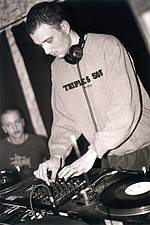
Back then it was important for us to be independent from the English scene and to make our own thing. There weren’t any German drum&bass labels in those days. Ok, there was Bassface Saschaґs “Smoking Drum”, but if you’d already released something there, you had to come up with something new. It was logical was for us to say: We wanted to be the first German drum&bass label to release a to-date-sound. The label basis still consists of us four guys from Hanau, two MCs, Mainframe and me. I cooperate with Mainframe for every track. Artists on Precision are also people like Miguel Ayala, who is as important as the rest of us and Monophase, who sent us the classic demo tape. We signed Tsuneari Fujii over the Internet. He posted some tracks on his website which we liked a lot.
Right now we have finished a big LP project for Megashira that will be released on Infracom in August. At the moment we have to work off different releases which we’ve promised to several friends. There’ll be a 12inch by me on Precision, the next one will be by two friends of ours from Japan, two well-known sound designers for playstation who made the soundtrack for “Gran Tourismo”.
Can you imagine having your complete studio in a computer?
My hardware power is the only thing that prevents me from doing that. One year ago we still worked 100% sampler- and synth-based. Then we had a project that was 100% audio which was my first contact with doing everything in the computer. First I completely had to change my way of working. Then I realized how much more comfortable and functional this way of producing can be.
Unfortunately we don’t have a fast computer in our studio, we have a G3 at 230 MHz. When you have an idea, you have to bounce between the different systems, that also works. We still have an EMU in the studio and an Akai 5000, that’s our sampler range. We like to use our JD800 for bassline, because the editing is hands-on. We have also different Roland effects: SRV, SDX and SSV. Right now 60% of our elements are already native-based.
We work with Logic. In my opinion that’s the more personal platform, you can adjust it the way you want it and are able to define keyboard macros. For me that’s a practical solution. We do our mixing externally and have a Mackie 8dB mixer for that.
Which NI products do you use in the studio?
We like to use the Pro-52, because it’s simple to edit. You can create very unique sounds really fast. The hardware Prophet still stands next door. You’re able to run several Pro-52s simultaneously. We often use up to four pro-52 tracks in one piece of music, each one is only playing small accents, but you’re much more flexible. Everything is easier concerning saving and editing. In my opinion that only brings advantages. It’s always in tune as well. We ran a Super Jupiter and a Pro-52 at the same time and noticed the considerable volume and tone pitch fluctuations. How can you still work with an instrument like that?
We just received BATTERY, which seems perfect for our way of producing. Because for the first time a drum sampler has been reasonably realised. I look forward to work with this tool, because we used to archive decentralised. You always knew: There was a cool snare or a cool break somewhere. Now we want to reorganise our archive with BATTERY to get one central access.
|
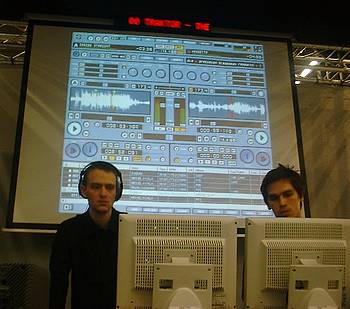
You can’t listen to an old recording and say: There’s crackling.
You’ve got to see what’s special about everything.DJing in a club with
vinyl is a different situation. It’s simply hands-on. You got the
music under your hands and can exactly decide, where to drop the
needle. That’s a minimal source of error, especially in a situation
like that: It’s dark and so hot, that sweat is dripping from the walls
and the fog machine is running non-stop. In such a situation I’m glad,
that there’s is rudimentary equipment like the Technics1210 and a
simple mixing desk with triple EQ and gain. When the turntable falls
off, I’ll notice that pretty quickly.
Using TRAKTOR you got to be more alert. You have to be careful not to
activate the wrong deck and load a track, whilst it is running. You
have to concentrate much more, especially, when you’re used to work
like a DJ and have to deal with something new like that.
On the other hand I must confess: TRAKTOR really is a very functional
tool. I never imagined it could work like that and best of all it was
produced with the necessary know-how. As a quintessence of it, you can
say: When you can DJ, you can also work with TRAKTOR very well. We
were surprised, how good the beat-matching was working. You use that,
but still correct manually, as I do it when I’m spinning. Ultimately
TRAKTOR is making it much easier for me, I don’t have to cue the
record, just adjust a little bit supplementary. If you know how to
spin, then this is a super tool.
The loop function is also working very well, the more you get into it.
We even managed to put a one bar loop a record in the mix and the
second record, that was running was looped on a half note. You can do
stuff, that wouldn’t be possible with normal records. All those
additional elements wouldn’t normally be possible.
|
I’d be afraid of an abnormal system end or that someone spills beer over my computer. That would be my biggest worries in a situation like that. I’d prefer that to a live act situation, because you’re only playing your own stuff there. You’re not limited with TRAKTOR. If those technical worries would be removed and a good interface would be at hand, I can’t imagine an argument against TRAKTOR.
Where is Drum&Bass going?
The worst trainspotters have vanished out of the clubs. Those who weren’t real fans have switched to other styles of music. Now the music is the most important thing again and not only hardcore partying.
I think the musical influences will get stronger again and we’re also trying to work in that direction. You’ve got to be sensible for what’s working in the clubs, but with the demand to deliver harmonic content. We don’t want tracks that are based on one sample hooks and when you don’t hear that you don’t now what you’re listening to at all. For me it means to work more musically, every track gets its own identity, apart from samples, due to the harmonies. Still tracky for the clubs, but nevertheless song-orientated, that even normal listeners can get into it.
Interview: Joachim Landesvatter/ NI
Nocturn - Compact Intelligent Plug-in Controller (Features SOS NAMM Movie)
Sound On Sound previewed Nocturn during the show.
Novation’s most affordable hardware controller to date, Nocturn
promises to unleash the full potential of all your favourite
instrument and effect plug-ins.
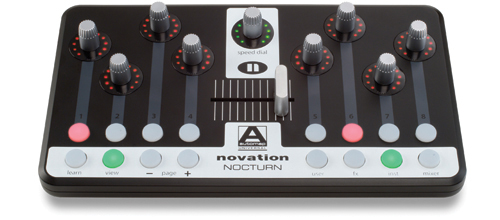
Featuring the latest Automap Universal 2.0
software, exclusive to Novation controllers, Nocturn provides
automatic, instant and intelligent control of all automatable
plug-ins within every major sequencer, including Pro Tools*.
Nocturn features eight touch-sensitive rotary encoders, each
equipped with a bright eleven-LED ring (ideal for laptop DJ’ing
in a dark club environment). These are accompanied by eight
user-assignable illuminated buttons and a smooth, professional
45mm cross-fader. The finishing touch is Novation’s unique
‘speed dial’; a touch-sensitive rotary encoder that instantly
takes control of whatever your mouse is focused on!
Featuring a revolutionary new 'heads-up transparent control
GUI', Automap Universal 2.0 places a transparent control map
across your computer screen, to be recalled or hidden at will.
Little or no user setup is required and plug-in control can be
exactly the way you want it, no matter what music software you
use. Just boot up the plug-in and you’ll see at a glance how the
parameters are automatically assigned to each of Nocturn’s
controls. An instant click and control ‘learn’ function is also
available for quick re-assigning of controls, or for creating
your own controller map in seconds. Multiple page options mean
that you can assign a potentially infinite number of parameters
for each plug-in.
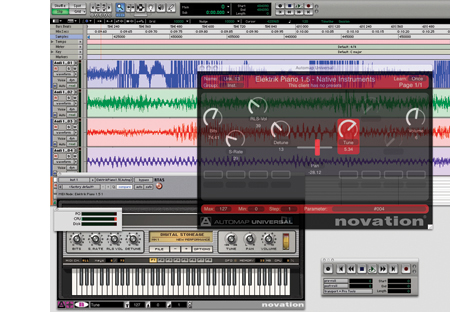
Automap Universal 2.0 also categorises all
your control maps. A simple browsing facility lets you review
all open plug-ins, then quickly switch to control and one of
them. Automap Universal 2.0 also supports standard MIDI
protocol, providing the same heads-up display for quick and
simple assigning of MIDI parameters. This ensures Nocturn can
also turn its hand to controlling a hardware MIDI device, any
non-automatable plug-ins, or mixer control in your sequencer.
Once a ‘MIDI map’ is created, it can be saved and recalled via
the same map browsing facility. A growing number of maps will be
available to download from www.novationmusic.com
Nocturn’s spacious and tactile control layout, side mounted USB
socket and ultra-low profile allow it to sit neatly in front of
your QWERTY keyboard. Large, rugged rubber grips hold it steady
whilst you let rip with your favourite music software.
Combined, Automap Universal 2.0’s heads up transparent control
GUI and Nocturn’s touch sensitive dials remove the pain inherent
in controlling multiple instruments and effects, allowing you to
flow intuitively from one plug-in to the next, leaving you free
to focus on what matter most – your music.
Nocturn is due to ship worldwide in February 2008. For pricing
details, contact your local Novation distributor. A list of
international distributors is available online at
www.novationmusic.com.
* Mac only with Pro Tools at present, PC Pro Tools compatibility
to follow soon
More famous artists join Novation’s blog party – and now you can join the fun too!
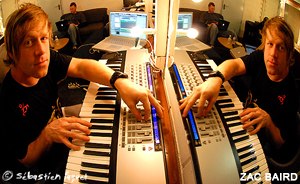
Two more high profile Novation users offer their unique insights into the lives of pro musicians on the road and in the studio, and now you have the chance to interact with them!
Bloc Party’s Gordon Moakes was the first famous user to kick off Novation’s on-line blogs, and he has just been joined by another couple of high profile players. Zac Baird, Korn’s keyboard player, is currently on a world tour with the band and has recently added this comment to his blog…
“I wanted to take something small along so I could write if the mood struck,” he says. “I’ve tried a lot of different controllers on the market but the ReMOTE SL has to be the best combination of synth feel and piano reality. It’s very easy for me to play hip-hop leads or get the real touch for soft synth pianos. The keys are just super-smooth and very expressive.”
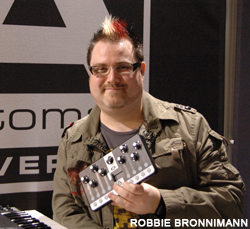
Robbie Bronnimann has
produced and written for artists including The Sugababes, Howard
Jones and Andy Hunter and remixed for the likes of Chicane, Ferry
Corsten, Art Of Trance, Mogwai and Young Punx not to mention his own
artist albums and 12"s under the names dba & tektonik.
He notes in his blog: “I find myself between the comfy surroundings
of my studio producing two albums simultaneously & flitting all over
the world playing as an electronic duo with Howard Jones. I’ve been
using the Novation ReMOTE range which has been the backbone of my
touring work for a few years. And it’s with this particular aspect
of my current work that I will now be giving the Nocturn a full
workout alongside my trusty ReMOTE 37 SL.”
So why not see how Robbie and Zac get on and head on over to the
BLOGS PAGE now and
comment! More artists will also be offering their experiences very
soon!
Chris Vrenna, Marilyn Manson’s keyboard player, chooses Novation
Grammy-winner Chris Vrenna has played with Skinny Puppy, Nine Inch Nails and is currently on tour with Marilyn Manson playing a Novation ReMOTE SL37. “Thank you Novation – you make my life easy!” he says.
“We were after a very sleek look on stage,” he says of his SL buying decision. Since using the keyboard intensely, though, Chris has fallen in love with many of its other features, not least the fact that it is buss powered. “When you are in the throws of battle up there you never know what’s going to happen. It’s been doused with water a couple of times so with no AC power up there it’s totally awesome!”
“The second really important thing about the keyboard is the backlit LCD which I cannot speak highly enough of,” Vrenna continues. “With the projections and smoke on stage it’s hard enough to see anything but I can always tell what’s up on the keyboard. That’s vital for a live thing – most other keyboards don’t tell you as much information.”
Chris’ set-up is totally software based including soft synths, samplers and Reason, so the SL’s Automapping feature certainly comes into its own.
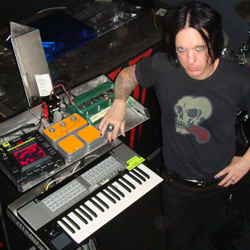
“Between the Automapping and the templates [the
SL] comes with, it is the easiest set-up ever. The knobs are
assigned and you know exactly which one you are going to be
grabbing. It kind of programmed itself actually!”
Chris uses the keyboard’s many controllers for several live effects,
which enhance his own performance.
“I like to map the X-Y pad to do different effects and I can just
grab different things right on the fly,” he says. “I do some live
filter stuff and I like to throw things into delays. The trigger
pads have been really cool. There’s the eight across the bottom
which you can fire off different sounds with so I’ve been doing that
and since I’m also a drummer it feels a little more natural to do it
that way! It gives more of an angle to your performance so it’s not
just the same thing night after night.”
“The keys just feel great,” Chris concludes. “They have enough
weight on them that you get it, but they are not weighted. To me
it’s the perfect mix. I hate it when keys are flimsy – a keyboard
should take a pounding. It’s been great, just a solid piece of gear.
It’s the only piece of gear I haven’t had a problem with, let’s put
it that way!”
“Thank you Novation. You make my life easy!”
Vrenna will be touring with Manson until the end of the year and
will be producing more of his own music (under the name Tweaker)
next year.
May 08, 2008
Breakbeat pioneer, Rennie Pilgrem, uses Novation X-Station
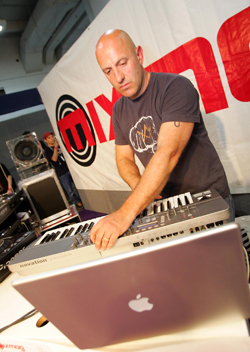
The Novation X-Station has been the centre piece
of Rennie’s performing and producing rig for some years now, with
its audio interfacing capabilities streaming out beats from Ableton
Live, whilst the synth is used for fat basslines and jazzy melodies.
His Breaks band ‘The TCR Allstars’ have caused a massive stir with
their successful fusion of live musicians (Rennie on
X-Station/laptop, Rich Thair on drums, William South on bass, Imogen
Brown on violin, and MC Chickaboo and Bella Saer on vocals) and
sequenced beats. The band has achieved worldwide recognition now,
having toured in the UK, including playing at Glastonbury Festival,
and across Europe.
Rennie’s third artist album, ‘Skin’, will be sold in nightclubs via
an SMS code that enables gig goers to download the album for a mere
Ј3. The price is then added to their phone bill, with no need for a
creditcard!
Twelve tracks of mainly ‘dance floor heaven’ lean heavily towards
the live sound he has been perfecting with ‘The TCR Allstars’. After
only 2 years and only a handful of gigs, they have joined the ranks
of such luminaries as ‘The Chemical Brothers’, ‘The Bays’ and
‘Pendulum’ as one of the ‘20 best live electronic acts to see’ (iDJ
magazine).
‘Skin’ will be officially launched on Friday 9th May 2008 at STIR, a
psychadelic, breaks-fuelled night for the Glade festival community,
taking place at Heaven in Charing Cross. The secondary launch is
then happening 8 days later on the 17th May at Bumper in Liverpool.
Moldover
Brooklyn based artist Moldover is redefining the art of live sample manipulation and bringing the concept of controllerism to the world at large. For those not familiar with controllerism Moldover explains, "it's just like turntablism, but instead of using turntables and a mixer to make music, I use software and a controller". A simple concept indeed, but to see it realized with Moldover's carefully honed techniques on a piece of hardware resembling Frankenstein's Monster, is a remarkable experience. Electronic music performance may never be the same.
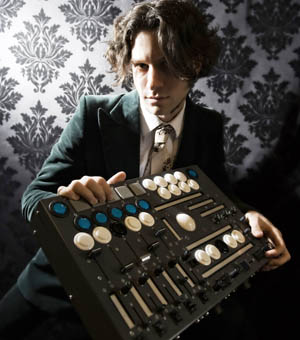

Moldover is frequently billed as a "live mashup DJ" or "sound collage and cutup artist", but to use these common terms is something of an understatement. In the first few minutes of a typical set, Moldover sets out to destroy your whole concept of what recorded music is. Grabbing chunks of sound from hundreds of songs in countless styles, he transforms triggered samples into complex and expressive musical gestures. In Moldover's own words, "I've been meticulously sampling my favorite bits of pop culture for years now. Every sound bite I play comes from some piece of music or film that I feel truly passionate about. Everything is played in it's original, unedited form. I'll let you hear a few bars of a classic tune and then rip it apart, twist it around, layer it with a bunch of other elements and slap it back together before I move on to the next thing. Absolutely all the blending, chopping and tweaking I do is happening live". Download one of the free mixes posted at moldover.com and hear for yourself.

For someone who invests so much time into digital audio manipulation, the choice of controller is crucial. For several years now Moldover has been performing with the Novation Remote-25SL. Following his ethos of leaving no tool unmodified, Moldover attacked his Remote with soldering iron, epoxy resin and rotary-grinder to create a one-of-a-kind performance instrument. It seems that bending hardware to his own designs was the next logical step in Moldover's approach to controllerism. He explains, "I've gotten deep enough into music software that I can create pretty much any virtual instrument (mixer, whatever) I dream up. But after the virtual side of things gets to a certain level, you realize it's time to start tweaking the hardware to match. The Remote is a great piece of gear for modifying. I don't think there is any other controller on the market with the sheer number and variety of sensors that it has. I added a little here, took a little away there, and wound up with a totally unique controller that seamlessly integrates into my software setup". Like something out of a post-apocalyptic cyber-punk future, Moldover's Remote25-SL is hot-rodded for extra ruggedness, expressive control and intuitive layout. Check out the videos and forum on controllerism.com for details on how to make your own customized Novation Remote-25SL.
Kaiser Chiefs on Novation
Nick Baines, aka Peanut, is Kaiser Chiefs’ keyboard player and previous wearer of pork pie hats. When you’re playing with one of the best bands in the world, you need the best gear, so it’s no surprise to find him using Novation keyboards.
“We all had a history of being in bands around Leeds for many years – Nick [Hodgson], Simon [Rix] and I since school,” he says. “The five of us have now been playing under one guise or another since summer 2000.”
The band recorded some demos in 2003, which the label Drowned In Sound picked up on and put out the single Oh My God. They then embarked on the 2005 NME tour, which was the kick-start they needed. Now they can count huge sales, Brit Awards, sell-out gigs and top 10 hits in their lists of achievements. Oh yes, and owning some pretty good keyboards too…
To compliment their unique sound, on the
Kaiser Chiefs most recent tour, Peanut has been playing a
custom-built ReMOTE 25 SL: The standard black casing having been
replaced with a new white shell.
“I have the Novation ReMOTE 25 SL and the new XioSynth,” says
Peanut. “When I need a combination of organ, piano and
Wurlitzer, but not all spanning 73 keys then the ReMOTE 25 SL
comes in handy. The semi-weighted keys feel sturdy and not like
they'll be knackered after one tour.”
“And the added bonus of the many controller knobs, buttons and
faders on it is that I can send program changes and control
effects from it too, hopefully meaning less fumbling around in
the rack between songs! The fantastic Automap feature really
speeds things up as well.”
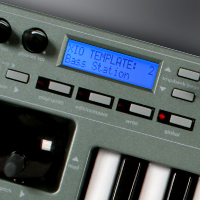
“As for the XioSynth, well, I'm in the middle
of creating some patches to be included on it (if they're good
enough!) so I am having fun with that. It seems a very powerful
synth for such a small size. Again, there's not too much
scrolling through menus to edit things. It's instant and
hands-on – I like that.”
Peanut and the rest of the Kaiser Chiefs look set to get even
busier over the coming months and there’s even some new
material…
“We are currently on tour in Europe, testing out the songs for
our new album, which is released in February,” Peanut explains
and then adds: “The ReMOTE 25 SL is going to become part of my
live set-up for triggering the sounds I've used on the new
record. And before Christmas we'll be making a video for the
first single and finalising mixes and artwork. Then next year we
travel the world, playing people the new record!”
Roots Manuva - Inspired to make Xio patches
When MOBO winner and Mercury Music Prize nominee Rodney Smith, aka Roots Manuva, got his new Novation Xio, he was completely blown away and even decided to program a new bank of sounds for it…
We’re pretty sure he likes it then, and if anyone knows about good sounds, it’s Rodney. He’s been making music as Roots Manuva for over a decade, and in that time he’s put British hip hop on the map. In 1998 he won a MOBO award for best hip hop act after releasing his mesmerising debut album Brand New Second Hand. His profile then went through the roof and he featured on Leftfield’s Rhythm & Stealth album before producing Run Come Save Me, his second album, which has sold well in excess of 100,000 copies. From that came the track Witness, which was voted best hip hop track of all time by Hip Hop Connection magazine.
Throughout his career, Rodney has pushed the boundaries in music. He freely admits to spending too much time experimenting and picking up useful pieces of gear to help him in his search for the perfect sound. So when his new Novation Xio arrived, he decided to push it to its limits and soon became so attuned to it that he decided to program his own sounds…
“I’ve had it for about three or four
months,” he says. “I’ve never had this amount of time to
muck around and get to know a machine. I programmed a few
bass sounds, a few strings and a few synthy sounds. How
would you describe them?… kind of novelty, quirky sounds.
I didn’t try to do much like a real violin or a real
guitar or anything, apart from some strings. I mainly
programmed nice little synth sounds, dubby synth sounds.”
“Every frequency on that machine is absolutely killer.
It’s like, Jesus, man! I am using it at Alaska Studios in
Waterloo and when I’m doing bass or top end I can shake
the whole building. It’s louder than anything else there!
It’s got a lovely sound. I didn’t realise how different
one keyboard could be from other keyboards, but whoever
put it together really knew what they were doing. It
doesn’t need to be mixed at all – you just need to level
it and that’s it. You don’t need to put loads of
compression on it or anything, it’s just a nice sound on
it right way.”
Despite all of his success and once stating that Awfully
Deep, his third Roots album, would be his last, Rodney
still has as much ambition as ever both in and out of
music…
“It’s nice to be recognised as a pioneer for UK hip hop
but there’s a massive world out there that hasn’t heard of
me and I’ve got to make more records, I’ve got to do more
touring – and other things besides music like set up my
own production company – to make an impact worldwide.”
So we can expect a lot more from Rodney, Roots and his
Novation Xio…
Rodney’s sounds feature on the latest
Xio release and the latest Roots Manuva album,
Alternately Deep, which is out now.
Mylo - Scotland’s answer to Royksopp
Mylo’s first album ‘Destroy Rock &
Roll’ is a refreshing and startling debut; a long-player
that rivals the likes of Air’s ‘Moon Safari’, Daft Punk’s
‘Homework’ and Royksopp’s ‘Melody AM’. Now almost platinum
in the UK and spawning several massive radio and club hits
(4 top 20 singles), it has been cited by many, including
Sir Elton John, as the ‘album of the year’. And Mylo’s
remixes for the likes of The Scissor Sisters, The Killers,
Kylie Minogue, and The Knife have defined clubland,
confirming Mylo as one of the hottest remixers around.
Unlike performing with his band, in which he plays with a
quartet of sonic pioneers, in the studio Myles works
alone. In the centre of his rig sits a
ReMOTE 25 SL, which he uses to navigate his way round
Propellerheads Reason and Ableton Live. Myles was blown
away by the simplicity of
Automap and the amount of time he saved not having to
assign parameters on his
MIDI controller;
“I'm not very technical so I'm always full of wonder when
things just work. It's magical! I couldn't believe how
easily the ReMOTE SL connected up with both Reason 3 and
Live 6. Tweaking parameters was always such a hassle
with the mouse - not any longer. I think I'm going to make
an acid-house album…”
Amongst his arsenal of software plug-ins lives a
Novation Bass Station and
V-Station, which now form much of the primary
ingredients in his new album material. About the
Bass Station, Myles comments;
“I wish I'd had this when I was making the first album!
It’s fantastic! Hundreds of fat, squelchy bass sounds and
a simple and intuitive interface. What more could you
want?”
Mylo’s eagerly awaited new album should hit stores early
in 2007, packed full of Novation sounds. To find out more
about Myles and his label Breastfed Music, visit his
website.
Muse Live
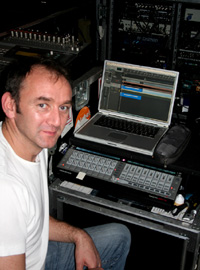
When it comes to touring there is probably no one out there with Des Broadbery’s range and depth of experience. With 23 years in the business – 16 of those as U2’s keyboard tech – this man has probably come across every type of on-stage technical issue that you can imagine. He is currently facing some of his biggest challenges on a mammoth world tour with Muse, but is overcoming all hurdles with a system based around Novation’s SL range of controllers.
After that Des established himself as one of the best keyboard techs in the UK and for the last three years has been working with the mighty Muse, most recently on their sell out world tour.
“I am their MIDI programmer and I take care of all of the electronics and keyboards on stage,” Des explains. “It’s fantastic. In the last two years they’ve won awards for best live band and other awards right across the board.”
“On stage we’ve got a ZeRO SL and a 61SL. This particular tour we’ve taken another keyboard player with us, Morgan Nicholls. He is the bass player from The Streets – a very accomplished musician – and came out to do some replacement bass playing for Chris [Wolstenholme] when he broke his wrist. He plays keyboards as well and is now keyboard player for this tour.”
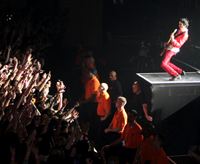
“I’ve built and designed the system that
he is using that consists of Logic, software instruments and
playing these instruments live. We needed something to
control that in our particular crazy way, and the controller
we decided to get was the
Novation SL.”
“It’s the way that we can control an entire system as
opposed to just instruments. It’s using the
Automap function but we’ve taken one template and
altered it dramatically so that it works with what we do.”
“It really is fantastic. The way that we’re running all of
this stuff just makes it very, very streamlined and very
fast. We’re running another piece of software with it called
\'On Stage\' written by Paul Eastman [programmer] from Snow
Patrol. It’s a little program that allows you to load a
Logic song via a program change. What we’ve done is designed
the Novation to spit a program change number at it so it
listens to it and pulls up individual songs.”
But it’s not just the controlling side of the
SL range that Des and Morgan find appealing – the actual
keyboard itself is very playable too…
“The
61 SL is fantastic and what I use most and Morgan loves
it too. It’s a cross between a waterfall keyboard and a
normal ‘keyboard’ keyboard. For what he uses it for Morgan
said, ‘right this is the one and it is the one that actually
feels right’.”
“We set the keyboard up and then Logic in a the way that we
wanted it to respond to the keyboard. It’s the only keyboard
that I have come across that can do that and so far it’s the
most flexible. Matt [Bellamy, Muse singer, pianist] is one
of the most challenging people that I have ever worked for
technology wise. But there hasn’t been a situation yet where
he has come to me and said ‘can it do this?’ where I have
had to say ‘no’.”
Which is just as well, really, as the band still have a long
way to go on their tour and many countries to visit.
“We’re doing our full production tour between the end of
October and December 19th. That’ll be in Europe and the UK.
We have some time off until January 10th and then set off to
Asia, Australia, New Zealand and Japan. It’s terrific,
absolutely full on. I’ve probably had just five days off
since January as we’ve been so busy with it all. It’s been
full on and very successful so far and hopefully will
continue to be.”
Stephen Bennett, a.k.a. Electroknight

Stephen Bennett, a.k.a. Electroknight, has written and produced various forms of music and sound since the late 1980's. Unsigned and determined, his objectives are simple – to understand what we consider normal everyday audio and, from it, produce something distinct and different!
Much of Stephen’s work today is sample-based, with audio derived from a whole host of diverse sources. His overriding principles are to maintain simplicity throughout his compositions, and this extends to his user-friendly hardware, the most favoured of which is his classic Novation Bass Station.
Stephen comments;
“I consider it an evolutionary sample based process! Different samples or entire Bass Station tracks are typically pushed through a number of different types of audio processing tools (hardware and software) at different points in their composition cycle. This is a part of the process that has no real set formula and provides track deltas (differences), which can be stacked allowing the composition to achieve a somewhat random and varied feel. This method of composition can demand a lot of effort and time, as results are unpredictable and many times prove to be unusable, but it is a great way to move away from normal composition techniques and arrive at something new!”
“Modulator 26 is a good example of this process. My goal was to see how far a sound could be deltoid, with the idea of trying to virtually bend the sound around a listener.”
The end result of such compositions has lead Electroknight onto his next challenge - the use of multi-channel surround sound systems to further immerse the listener into sonic heaven!
Anodize
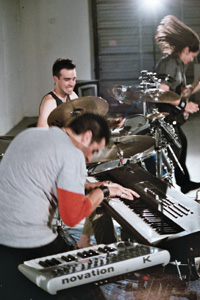
Anodize are a US band from the South Beach area and are proud owners of a K-Station. They incorporate the synth into their own blend of electronic-tinged rock, as you can hear in their powerful track, “Chase Your Traces”.
“I find the large amount of user presets to be an important aid in our live setup. Since we prefer not to use any type of sequencer or playback device on stage, we need an easy way to switch between sounds on the fly. With 200 user slots at our disposal we can program the sounds we need, in the order we need them, and just simply scroll through during the gig.”
“The factory presets have been an essential tool in both inspiring and creating the melodic hooks comprised in our songs. The built-in effects have saved us tons of money in additional outboard gear. Plus, there's less stuff to lug around. The K-Station fits just about anywhere and weighs next to nothing.”
Recently, Anodize have begun remixing their straight-ahead rock songs into trance, drum-n-bass, or pure industrial versions. The K-Station again has been an integral part of the process since these versions are even more synth-heavy than the originals. Their aim is to occasionally switch up live shows by playing remixes instead of original versions, thus lending themselves to more clubs in the trendy South Beach area.
Subsource
Subsource are an exciting live dance act, just breaking in the UK. Reminiscent of The Prodigy, their hard-edged sound is currently rocking venues across the south. In addition to 3 laptops, Subsource are armed with a MIDI drum kit, guitar and electric double bass on stage; enough to scare the wits out of most front of house engineers they encounter!
“As trained musicians, the controllers we choose to use are as important as buying just the right piano, guitar or any other instrument. We’ve gone through a variety of different equipment and the Novation controllers that we’re currently using are by far and away the best products on the market at the moment. I first bought a ReMOTE 25, which is great in terms of playability, functionality and durability… but Novation just keep pushing things forward and making life easier for us. The X-Station is an absolute godsend and has drastically reduced the amount of gear we have to carry around with us… and not only are they brilliant on tour, but just as well suited for when we get back to the studio.”
With their debut digital-download single, “Making Voodoo” just released on squaremusic.com (and soon to be released through iTunes), Subsource tracks are also to be featured on the upcoming video games, “Moto GP 06” (Xbox 360) and “Juiced” (PSP). In addition, they have had airplay on Radio One, XFM and Ministry of Sound Radio.
Use the links below to check out Subsource’s upfront breakbeat sounds, or for more info visit the band website.
Bovaflux
After beginning his Bovaflux project in 2000, Eddie Symons has worked his way up from sending out demos and running his own labels (Struktur, [d]-tached) to now working with some of the finest (though perhaps smallest) electronica imprints in the UK. A regular live performer, he has appeared on line-ups alongside the likes of Isan, Leafcutter John, Posthuman, and Tunng.
Eddie comments;
Now I’ve finished my EP, and I'm just waiting to confirm a release date, I'm starting to work on the new album. I don't try to set a theme too much, I'm just seeing what comes really, and letting it flow naturally. This is where the Novation SL has really smoothed things out it my studio. Not having to memorise what every knob does for every virtual synth is a god send, and makes every other control keyboard seem… well, just broken really.
Even ignoring these unique aspects of the SL, just the overall quality of the unit leaves the others standing. Having a wide variety of controller types, from the two different styles of knobs, the sliders, the touchpad, and so on, means that whatever VST instrument you're using it with, every parameter will find a good place. It's the vital link in my studio, perfectly bridging the gap between hardware and software. Apart from using it to control VSTs, I also have a configuration set up for manipulating many aspects of my tracker-based set up, letting me get into all the details of a sound with no messing about. Overall, it's hard to see how a controller could be done better!”
2006 saw a spate of exclusive tracks released to more high praise, with his contribution to Highpoint Lowlife’s Analog for Architecture described as “as beautiful as the genre gets” (Textura) and his debut tracks for AI sister label SRL labelled “his best works to date” (The Milk Factory), plus the completion of a 7 track EP due for release early 2007.
|
||
|


 The
most common new trend in
technology products at the
show was for hand-held
portable recorders, with
current products from Zoom
& Sony receiving
competition this year from
TASCAM DR-1, Yamaha
Pocketrak 2G, and even
Olympus??? (WHAT THE?)
LS-10.
The
most common new trend in
technology products at the
show was for hand-held
portable recorders, with
current products from Zoom
& Sony receiving
competition this year from
TASCAM DR-1, Yamaha
Pocketrak 2G, and even
Olympus??? (WHAT THE?)
LS-10.
 Korg
were showing Special
Edition versions of the
MicroKorg (with reversed
colour keys) and X50 (in
camo colour). These look
great and will obviously
help all those wanting to
create music while taking
part in skirmish
parties!!!
Korg
were showing Special
Edition versions of the
MicroKorg (with reversed
colour keys) and X50 (in
camo colour). These look
great and will obviously
help all those wanting to
create music while taking
part in skirmish
parties!!! From
Novation, a new desktop
controller, Nocturn
features 8 touch-sensitive
rotary encoders, each
equipped with a bright
eleven-LED ring plus 8
user-assignable
illuminated buttons and a
smooth, professional 45mm
cross-fader.
From
Novation, a new desktop
controller, Nocturn
features 8 touch-sensitive
rotary encoders, each
equipped with a bright
eleven-LED ring plus 8
user-assignable
illuminated buttons and a
smooth, professional 45mm
cross-fader.  Vestax
showed a range of new
decks, controllers and
mixers, including the
VCM-600 (as seen in this
picture to the right!),
which is designed to work
with Ableton. Vestax are
always bringing out
beautifully looking pieces
of metal and this year was
certainly no different.
Their VCM-100 also looks
great with a matching
MacBook Pro ☺ and even
better if you choose the
similarly sized 15" model
for your mobile studio.
Vestax
showed a range of new
decks, controllers and
mixers, including the
VCM-600 (as seen in this
picture to the right!),
which is designed to work
with Ableton. Vestax are
always bringing out
beautifully looking pieces
of metal and this year was
certainly no different.
Their VCM-100 also looks
great with a matching
MacBook Pro ☺ and even
better if you choose the
similarly sized 15" model
for your mobile studio. Arturia
were showing a model of
the Origin keyboard (as
seen left), one of the
more stylish-looking
products presented this
year, plus their Analog
Factory software/hardware
package.
Arturia
were showing a model of
the Origin keyboard (as
seen left), one of the
more stylish-looking
products presented this
year, plus their Analog
Factory software/hardware
package. Akai
presented…….wait for
it……the MPC-5000. What’s
different? A 20-voice VA
synthesiser engine with
awesome filters and smooth
waveforms, plus some
fantastic new effects,
mute features and direct
to HD recording.
Akai
presented…….wait for
it……the MPC-5000. What’s
different? A 20-voice VA
synthesiser engine with
awesome filters and smooth
waveforms, plus some
fantastic new effects,
mute features and direct
to HD recording.  Numark
announced the NS-7, a
dedicated Serato
controller (bundled with
Serato), with a prototype
under glass to get the
turntablist juices
flowing.
Numark
announced the NS-7, a
dedicated Serato
controller (bundled with
Serato), with a prototype
under glass to get the
turntablist juices
flowing.
 Synthesiser
legends, Moog, introduced
the Minimoog Voyager OS -
Old School...with the
analog sound engine of the
Voyager, but without the
digital controls. Sounds
great and looks…..old
school, I guess.
Synthesiser
legends, Moog, introduced
the Minimoog Voyager OS -
Old School...with the
analog sound engine of the
Voyager, but without the
digital controls. Sounds
great and looks…..old
school, I guess.
 A
very unexpected release
from high-end mixer
specialists, Euphonix, was
the MC range of affordable
controllers (their last
DAW controller was around
$50K). The MC Mix ($1,000
USD) and MC Control
($1,500 USD), as well as
looking amazing, feature
Euphonix unique EuCon
connection protocol, which
uses Ethernet to control
Logic, Nuendo or Pyramix
software.
A
very unexpected release
from high-end mixer
specialists, Euphonix, was
the MC range of affordable
controllers (their last
DAW controller was around
$50K). The MC Mix ($1,000
USD) and MC Control
($1,500 USD), as well as
looking amazing, feature
Euphonix unique EuCon
connection protocol, which
uses Ethernet to control
Logic, Nuendo or Pyramix
software. Yamaha
introduced the KX Series
USB MIDI Studio (re-using
the KX prefix which hasn’t
been seen on their
products for over a
decade), featuring a
high-quality Yamaha
keyboard, numerous
creative control features,
and advanced integration
with Steinberg DAW
products.
Yamaha
introduced the KX Series
USB MIDI Studio (re-using
the KX prefix which hasn’t
been seen on their
products for over a
decade), featuring a
high-quality Yamaha
keyboard, numerous
creative control features,
and advanced integration
with Steinberg DAW
products.

Novation win prestigious Queen’s Award

Every year a select group of British companies are recognised by the Queen for their outstanding contribution to industry, and this year Novation, a division of Focusrite Audio Engineering Ltd., is one of them. Chosen for their ReMOTE SL musical keyboard controllers with Automap Universal technology – an innovation that has radically enhanced the creative experience of electronic music creators – Novation are proud to be recipients of the prestigious Queen’s Award for Innovation.
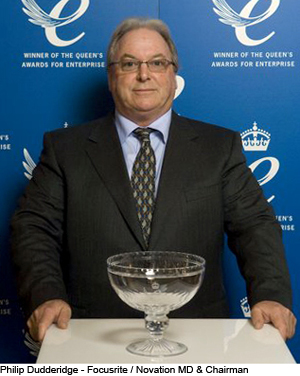
Phil Dudderidge, Focusrite & Novation’s
Chairman, said: “We’re delighted to be winning this award for
Remote SL with Automap Universal software. The Remote SL is the
first in a family of keyboards and controllers to benefit from
Automap Universal, our proprietary software that enables users
of modern music software to control parameters of that software
from their controller without having to manually assign controls
to functions and have to remember what does what.”
“We are very pleased that the Queen's Award Office judges
recognise the innovative nature of the products and appreciate
the importance of innovation in the musical instrument (MI)
industry.”
About ReMOTE SL and Automap: Used in conjunction with Novation’s
ReMOTE SL controller keyboards, Automap technology has
revolutionised the way we interface with software in the modern
studio and on stage, allowing for automatic mapping of sequencer
and instrument parameters. As soon as supported applications are
selected, all mixer parameters, transport controls and
instruments appear instantly on the faders, knobs, buttons and
pads, with all parameters and track names being displayed
clearly.
Automap Universal allows users to instantly control absolutely
any automatable plug-in, in any sequencer, automatically, and
without ever having to refer to a manual or worry about complex
MIDI data and assigning. Parameters can be 'learned' and saved
at the touch of a button.
Automap Universal renders old school MIDI control obsolete,
bringing an end to MIDI control nightmares.
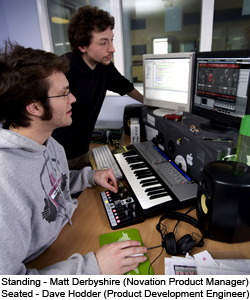
About Novation: Whether putting classic synth
and drum sounds into the hands of the masses, combining
synthesisers, controllers and interfaces into compact and
forward-thinking keyboards and interfaces, or making life easier
for musicians the world over with their acclaimed ReMOTE SL
controllers and Automap Universal technology, Novation have
always pushed the boundaries of music technology.
About The Queen’s Award: The Queen's Awards for Enterprise are
the UK's most prestigious awards for business performance. The
Awards are made each year by The Queen on the advice of the
Prime Minister, who is assisted by an Advisory Committee that
includes representatives of Government, industry and commerce,
and the trade unions.
The awards are
given to
businesses that
demonstrate
“substantial
improvement in
business
performance and
commercial
success, to
levels that are
outstanding for
the size of the
applicant's
operations.
The Crystal Method
M-Audio Gear at the Heart of a New Studio, New Album and New Tour
When
it
comes
to
electronic
dance
music,
The
Crystal
Method
is
nothing
short
of
iconic.
In
the
fifteen
years
since
crafting
their
first
beat
together,
Ken
Jordan
and
Scott
Kirkland
have
been
featured
in
countless
films,
TV
shows
and
video
games—and
scored
a
Grammy
nomination
along
the
way.
The
duo
recently
replaced
their
legendary
Bomb
Shelter
studio
with
their
sparkling
new
Crystalwerks
facility
and
emerged
with
a
new
album,
Divided
by
Night,
plus
new
world
tour
to
match.
As
you
might
expect,
M-Audio
gear
is
at
the
heart
of
it
all.
M-Pulse
caught
up
with
The
Crystal
Method
at
the
Los
Angeles
warehouse
where
the
legendary
electronica
artists
were
putting
the
final
touches
on
their
live
stage
show.
Performing
Live
with
Axiom
Pro
The
Crystal
Method
are
known
for
high-energy,
dynamic
live
sets
that
often
incorporate
live
remixes
and
mashups
of
their
most
popular
tracks.
Instead
of
playing
a
simplified
DJ
set
like
some
electronic
groups
do,
Ken
and
Scott
actually
perform
their
songs
live—triggering
samples
and
playing
key
synth
lines
over
dense
sequenced
backgrounds.
"The
live
show
has
always
been
a
mainstay
of
The
Crystal
Method,"
explains
Ken.
"When
we
first
started,
we
wanted
to
be
taken
seriously
as a
band
and
make
sure
we
weren’t
misrepresented
as a
DJ
team.
So
of
course
for
the
first
new
album
in
five
years
we
had
to
bring
out
some
new
gear,
a
new
stage
and
put
on a
great
show."
In
preparation
for
the
upcoming
Divided
By
Night
tour,
the
duo
acquired
two
new
M-Audio
Axiom
Pro
49
MIDI
controllers
to
serve
as
the
centerpiece
of
their
stage
rig.
"Every
control
is
mapped
to
something
different,"
reveals
Ken.
"We
use
the
faders
to
control
filter
resonance,
delay
feedback,
and
volume
levels
for
each
instrument—allowing
us
to
adjust
the
mix
from
stage.
The
trigger
pads
are
used
to
fire
samples
from
our
computers.
The
Axiom
Pro
really
simplifies
everything
so
we
can
concentrate
on
our
performance."
Over
the
years,
The
Crystal
Method’s
live
rig
has
continually
evolved
to
the
point
where
now,
nearly
every
musical
aspect
of
their
performance
can
be
controlled
from
stage.
As
Scott
jokingly
puts
it,
the
group
has
"come
a
long
way
from
using
hollowed-out
DX7s
and
tossing
them
around
the
stage."
Thanks
to
the
Axiom
Pro
controllers,
the
duo
has
been
able
to
reduce
their
onstage
rig
and
get
closer
to
the
crowd.
"With
the
Axiom
Pro
keyboards
set
up
at
the
front
of
the
stage,
the
audience
can
see
everything
that
we
are
doing,"
relates
Ken.
"Being
able
to
visually
connect
with
the
audience
makes
our
shows
a
lot
more
enjoyable
both
for
us
and
our
fans."
Getting
Ready
for
the
Road
Preparing
for
the
Divided
by
Night
tour
involved
a
lot
of
pre-production
studio
work
for
Ken
and
Scott.
"We
basically
remixed
and
reproduced
all
of
our
tracks,"
states
Ken.
"We
stripped
out
the
live
parts
and
sequenced
the
background
elements
so
we
could
play
everything
back
from
our
system
on
stage.
We
try
to
breathe
new
life
into
our
songs
when
performing
live,
while
still
keeping
the
basic
elements
in
place.
That
helps
convey
the
excitement
of
the
original
tracks."
Scott
continues,
"In
the
past,
recreating
our
tracks
was
always
difficult.
Now
we’re
a
lot
better
about
archiving
patches
and
documenting
our
sessions.
Thanks
to
Pro
Tools|HD,
we
now
have
unlimited
tracks
to
play
with
and
total
recall
of
our
settings.
It
makes
pre-production
a
whole
lot
easier."
Evacuating
the
Bomb
Shelter
For
years,
The
Crystal
Method
made
music
out
of
the
"Bomb
Shelter"—a
recording
studio
built
into
the
garage
of
their
Glendale,
CA
house.
From
there,
the
team
produced
some
of
their
most
successful
releases,
including
Vegas,
Tweekend
and
Legion
of
Boom.
Before
getting
started
on
Divided
By
Night,
however,
Ken
and
Scott
decided
to
make
the
move
to a
new
facility.
"Our
old
studio
was
very
‘cozy,’"
laughs
Scott.
"Over
time
we
started
to
feel
more
and
more
claustrophobic.
Plus
we
accumulated
a
huge
mess
of
cords.
It
got
to
the
point
where,
instead
of
crawling
back
into
the
spider
pit
to
re-patch
a
faulty
cable
we
would
just,
well,
run
another
one!"
Moving
into
a
new
location
and
building
a
new
studio
gave
Ken
and
Scott
the
opportunity
to
switch
over
to
the
latest
Pro
Tools
system.
"Once
we
learned
all
the
new
plug-ins
and
workflow
tricks
it
didn’t
take
long
to
make
progress
on
the
new
record,"
relates
Scott.
One
of
the
first
songs
that
started
to
come
together
was
the
title
track,
"Divided
by
Night."
Ironically,
it
was
the
last
one
we
ended
up
finishing.
We
knew
the
track
had
potential,
but
we
struggled
trying
to
find
the
right
direction.
Our
good
friend
Jon
Brion
came
by
with
his
little
Casio
keyboard
and
sang
the
vocoder
line,
which
really
helped
that
song
take
off."
More
to
Come
With
a
new
studio
and
new
M-Audio
gear
firmly
in
hand,
fans
don’t
have
to
worry
about
there
being
an
end
in
sight
for
The
Crystal
Method.
After
the
Divided
by
Night
tour,
they
plan
to
return
to
Crystalwerks
to
do
remixes
of
some
material
that’s
been
calling
them
for
awhile,
hit
the
road
again
for
a
few
more
tours
and
then
start
working
on
their
next
album.
For
Ken
and
Scott,
the
future
is
crystal
clear.
For
more
info
on
The
Crystal
Method,
including
tour
dates,
visit
thecrystalmethod.com.

DARREN PRICE - (UNDERWORLD)

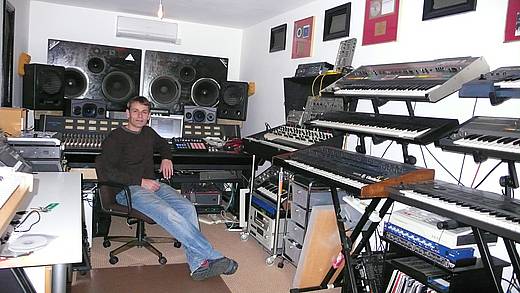
Having
existed in one
form or
another for
nearly three
decades,
Underworld
first rose to
prominence in
the UK's post
acid house
scene of the
1990s, with a
string of hit
records that
successfully
straddled the
twin
disciplines of
dance music
and rock
culture.
Darren Price,
the band's
keyboard
player, studio
mixer and live
assistant
since 2005,
spares a few
minutes to
discuss the
latest
innovation in
Underworld's
studio-
MASCHINE.
What has
been happening
in the
“Underworld"?
We have been
building a new
live set up
which involves
new equipment,
computers, and
swapping our
main sequencer
software,
which takes a
lot longer
than it
sounds. We
managed to get
fifteen of our
songs ready to
play last
weekend as we
had a show in
Malta on
Friday and
another in
Spain on
Saturday but
now we are
back at it
doing the
remaining 45
songs.
How does
Maschine fit
into your
setup?
We love
Maschine,
there is no
other piece of
gear out there
that does what
Maschine does.
It is very
easy to work
with and I
love the way
you can
program a
whole song
without even
touching a
mouse. For the
first month we
ran it in
stand-alone
mode which is
great and I
got to learn
most of its
features while
playing around
and making
some grooves
for the live
shows.
How do you
plan to
integrate
Maschine into
the Underworld
live setup?
After reading
more of the
manual, I’m
now running it
in controller
mode with
Ableton Live
which takes it
onto another
level. I can
write a whole
track using
Maschine and
Ableton
without even
looking at my
computer
screen or
using the
mouse. You can
still use
Maschine as
normal, but by
the click of a
button you’re
in Ableton
control mode,
launching and
muting clips,
scenes,
effects,
activate
recording…
well
everything!
Then click
again and
you’re back in
Maschine mode
writing new
parts. It’s
going to be
great for live
use and we
already know
it’s an
excellent
writing tool
in the studio.
What are
your top
five
Maschine
features?
It’s very
hard to pick
just five
features, as
there are so
many
features
that are
great
depending on
the way you
use them.
But if I’d
have to come
up with a
list, I’d
include
first of all
the grooves
and the way
it quantizes
- like old
classic drum
machines.
Then the
effects - a
great bank
that’s
perfect for
live jamming
and
recording.
The step
sequencer is
also a
favorite;
easy to get
to and fast
and fun
writing.
Another
feature
that’s
important
for us is
the ability
to
categorize
our own
sample
library. We
have several
gigabytes of
samples on
various
drives at
the studio.
Since we’ve
added them
to Maschine
it’s easier
than ever to
find a
sound.
And one of
the main
features for
us is that
it’s fun and
easy to use
and we don’t
have to use
the mouse!
Maschine is
definitely
the best
piece of
studio gear
we have
played with
for a long
time. I
could go on
and on about
it but I
have songs
to program
so I must
go.
Thanks so
much for
your time,
Darren!
ON FIRE WITH TRAKTOR SCRATCH

Dubfire is one half of the Grammy Award winning and four-time nominated Deep Dish. The Washington based electronic duo achieved considerable mainstream success with a string of high profile remixes for artists such as Madonna, Michael Jackson and Tina Turner, yet balanced this with strong street credibility through genre-bending productions and collaborations with underground dons such as Carl Craig. Currently criss-crossing the globe on his own, Dubfire talks to Native Instruments about DJing, the Berlin minimal sound, his conversion to TRAKTOR SCRATCH, and what the future holds for him and Deep Dish.


For years you've been one half of the US underground house duo Deep Dish. Now you're both taking some time to do your own things. What brought about this decision and what kind of new freedoms has this granted you with respect to your creativity in production and DJing?
Well, Deep Dish has always been a shared vision with many compromises made over the years on both sides. Having gone solo after 15 years together has given me the freedom to explore a musical direction or idea that was not necessarily appropriate for Deep Dish. The same holds true for my solo gigs. I am able to really put my focus into expressing my own vision and agenda and that has been very liberating after all these years. But I think that it will ultimately make Deep Dish a stronger unit when we are able to come to the table again in the near future with a fresh perspective on how to up the ante with our music and gigs.
Clearly the Berlin minimal scene has had a profound impact on you lately. When and how did you discover this sound and what about it drew you in so much?
This music is nothing new to me and it has always been a part of my influences and DJ sets ever since I can remember. But within the musical boundaries of Deep Dish, i had to keep my personal preferences in check to a great degree. German electronic music from the likes of Kraftwerk, Manuel Gottsching, Klaus Shultz, Basic Channel, etc. have always been the foundation of my evolutionary career path. But I think that within the larger techno genre of today, the music has appealed to me more and more as it has gotten deeper, slower, funkier and generally sexier.
Your
latest
release,
"Emissions,"
was
signed
to
Richie
Hawtin's
Minus
label
and
reached
the
#1
spot
on
Beatport's
minimal
chart,
in
addition
to
being
played
all
over
Germany.
Did
this
quick
success
in
the
minimal
scene
surprise
you?
Was
I
pleasantly
surprised?
Yes
of
course!
But
I
never
set
out
to
make
a
particular
genre
of
music.
Richie
and
I
have
been
friends
for
years
and
i've
always
supported
and
respected
his
music
and
vision
and
just
wanted
to
do
something
special
for
his
label
in
my
newfound
solo
landscape.
I
never
expected
it
to
come
out
the
way
it
did
and
was
really
overwhelmed
at
the
reaction;
not
only
to
this
particular
track,
but
really
the
overall
body
of
solo
work
I've
done
this
year.
It's
just
a
great
feeling
for
a
producer
to
see
that
this
very
'underground'
style
of
music
appeals
to
so
many
people
out
there.
When
you
did
"Emissions,"
were
you
inspired
by
any
particular
record?
What
were
you
aiming
to
achieve
with
this
track
and
how
did
you
use
sounds
and
FX
to
get
this
across?
Well,
"Emissions"
was
written
and
recorded
in
the
span
of
a
day
which
really
surprised
me
and
my
engneer,
Matt
Nordstrom,
who's
my
partner
in
crime
in
all
of
the
solo
work
I've
done
and
the
majority
of
Deep
Dish's
output
over
the
last
seven
years.
The
groove
is
very
loop-based
and
pretty
sparse
and
it's
sort
of
centered
around
my
wanting
to
recreate
those
thunderous
cryogen
blasts
you
sometimes
get
in
certain
clubs.
There
are
only
a
handful
of
clubs
with
those
and
I
wanted
to
be
able
to
take
that
experience
everywhere
I
went
by
putting
it
into
a
track.
The
three
"emissions"
are
the
glue
that
hold
the
track
together.
As
a
DJ,
you
played
CDs
for
many
years
and
started
using
a
laptop-based
DJ
system
a
year
or
so
ago.
What
made
you
decide
this
was
the
way
to
go
and
what
would
you
say
to
other
DJs
who
have
yet
to
embrace
this
technology?
In
a
nutshell,
I
just
got
tired
of
burning
CDs
(or
getting
read/write
errors
when
trying
to
burn
them!),
making
labels,
maintaining
my
CD
book
and
lugging
it
around
from
gig
to
gig.
Not
to
mention
the
fact
that
I
always
had
to
carry
a
good
supply
of
blank
CDs.
It
just
seemed
so
much
more
practical
to
just
maintain
my
iTunes
library.
I
have
personally
steered
many
of
my
fellow
DJ
friends
towards
this
technology
and
continue
to
do
so
as
all
are
extremely
glad
they
made
the
switch!
How
has
technology
changed
or
improved
what
you
can
do
in
the
DJ
booth
versus
when
you
started
just
playing
records?
Do
you
think
having
a
laptop
in
the
DJ
booth
takes
away
from
the
art
form
and
would
you
ever
see
yourself
going
to
a
completely
software/controller-based
system
when
the
right
technology
comes
out?
I
had
always
been
a
vinyl
junkie
and
to
this
day,
really
miss
that
period
of
my
life
when
I
would
spend
hours
wading
through
the
week's
newest
releases.
But
I
miss
the
cover
art
the
most;
with
laptop
DJing,
I
now
have
to
try
and
remember
all
of
the
names
of
the
hundreds
of
new
music
I
accumulate
every
week.
But
as
an
artist,
I
believe
that
you
must
constantly
evolve
and
with
electronic
music,
it's
important
to
my
career
that
I
embrace
new
technologies
which
allow
me
to
be
more
creative
with
my
performance
in
the
studio
as
well
as
on
the
road.
Laptop
DJing
has
been
a
major
turning
point
for
me
and
has
created
an
entirely
new
set
of
parameters
to
work
within.
Having
said
that,
I
still
enjoy
the
marriage
of
hardware
and
software
so
I
still
like
using
the
Pioneer
CDJs
with
Traktor.
You
recently
switched
to
Traktor
Scratch.
How
did
you
hear
about
it
and
what
was
the
transition
from
your
previous
system
like?
Pablo
La
Rosa
(Native
Instruments
International
Director
of
Marketing)
literally
dragged
me
to
the
NI
booth
directly
after
my
Beatport
pool
party
set
during
the
2007
Winter
Music
Conference
in
Miami
and
gave
me
a
five-minute
demo
and
I
was
hooked
from
then
onwards.
Although
learning
all
about
the
Trakor
at
first
seemed
very
daunting
it
only
took
me
a
couple
of
weeks
of
gigs
to
really
feel
comfortable
with
the
program.
What
are
the
main
reasons
you
switched
to
Traktor
Scratch?
Pretty
simple
really:
the
easy
looping
feature,
the
multiple
screen
views,
the
ability
to
set
up
"hot
keys"
for
virtually
every
function
as
well
as
the
ability
to
use
external
controllers
for
greater
effect.
I
LOVE
the
FX
as
well,
especially
the
reverb
and
its
intensity
-
it
really
helps
to
create
dramatic
peaks
during
breakdowns
and
even
better
is
using
it
to
CREATE
your
own
breakdowns!
I
also
love
its
simple
hookup.
How did you like the sound quality of the software and the Audio 8 DJ?
It was quite obvious from the first gig I used Traktor that the sound quality was literally the difference between night and day compared to Serato! I had always had problems following a DJ who was playing vinyl or CDs as the sound of Serato's box was just so digital and harsh and I could never quite match levels. Trakor really made my 320kbps MP3s sounds more like AIF or WAV files.
You've
been
touring
with
Traktor
Scratch
for
the
past
month
or
so.
What
are
some
of
the
bigger
gigs
you've
played
and
what
do
you
think
of
the
system's
reliability
and
performance?
Well,
the
biggest
event
I've
done
had
to
have
been
Creamfields
Buenes
Aires
where
I
payed
to
about
10-12,000
people.
Traktor
performed
beautifully
and
really
elevated
the
kinds
of
sets
that
I'd
been
doing
prior
to
making
the
switch.
You recently got into the MIDI assignment part of Traktor Scratch and have a custom-configured setup for your FaderFox controller. Tell us how you've got it set up and how this has changed the way you are able to interact with the software and your crowd.
Having the Faderfox DX2 controller has made a huge difference not only in the way I use all of Traktor's FX, but also the way I perform and interact with my crowd. I love its simple setup, color-coded buttons as well as its easy layout. Laptop DJs get criticized all the time for focusing their attention onto their computer screens for the majority of their sets which can interrupt that connection or chemistry with the crowd. But the Faderfox liberates you from all of that. And even though it comes with a few presets, it was a lot more fun and useful to create my own.
Have you started using Traktor 3.3 software with Traktor Scratch yet?
Well, up until about two months ago, I had been a Serato user for nearly two years. And towards the end, I started to get really bored with its limitations; it seemed that the company never really took into account the needs of the more electronic-based DJ, predominantly favoring hip-hop or scratch DJs. And so once I began using Traktor Scratch I was completely blown away, not only by its interface, but by its incorporation of internal FX, looping, true waveform display, and the list goes on and on. The other thing I noticed was how vastly improved the sound quality was over my Serato box. And now that i've gotten very comfortable with Traktor Scratch, I'm actually slowly testing out Traktor Studio, especially for its ability to use four decks and its customizable interface.
You
recently
started
a
new
label"SCI+TEC.
Where
can
we
find
your
releases?
Well,
initially
the
releases
were
exclusive
to
Beatport
and
iTunes
but
we've
recently
inked
a
deal
with
German-based
digital
distributor
Zebralution
so
they
will
be
available
on
virtually
every
download
site
in
the
coming
weeks.
What's
your
favorite
club/city
to
play
in
and
why?
Probably
Womb
in
Japan
although
I
have
had
the
pleasure
of
playing
at
some
amazing
venues
this
year.
But
the
Japanese
crowds
are
just
on
another
level;
you
can
really
feel
the
love
in
the
room
and
you
know
that
they're
there
for
the
music
first
and
foremost
and
that
ultimately
ups
my
game
and
makes
me
play
better.
What's in your studio these days equipment-wise? What NI plug-ins do you use regularly and why?
I'm going to let Matt answer this one.
Matt: The heart of the studio is an Apple G5 running Logic and Ableton. Working primarily in the box, I rely on the NI plug-ins like Massive and FM8 a lot. The sound is amazing and the interfaces make them very easy to manipulate. Battery has always been a mainstay for me as well, especially with its incredible sound library. My hardware setup is very minimal but that said, i couldn't live with out my Fatso.
The
minimal
sound
is
difficult
to
achieve
because
it's
all
about
making
the
track
sound
big
but
with
just
a
few
basic
elements.
What's
the
secret
to
doing
this?
I
wish
I
knew!
LOL!
It
really
boils
down
to
picking
the
right
elements
to
fill
up
that
space.
So
while
the
production
may
be
sparse,
you've
got
just
a
few
key
elements
playing
off
one
another
and
creating
an
atmosphere.
It
can
be
just
as
complicated
to
produce
a
so-called
"minimal"
track
as
doing
something
with
layers
upon
layers
of
parts.
Any new mix compilations coming out to follow up your recent Global Underground release?
There are no specific plans as of yet but I have been in talks with both Global Underground and a certain German label about doing something in the fall of 2008.
Right. Who wants a pint?

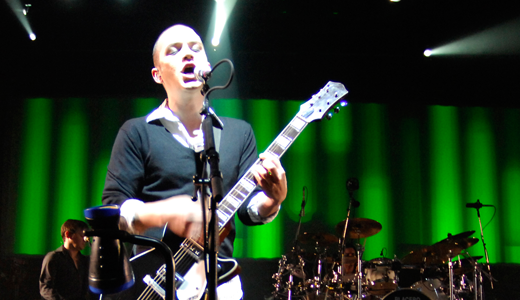
Brian Molko - eccentric front man from Placebo, © Ingo Kniest
Glamorous alternative stars Placebo have achieved longstanding success with a distinctive signature sound that combines elements of electronic styles with the power and straightforward attitude of a rock band. Topped off by the extraordinary voice of singer Brian Molko, the band delivers thrusting rock songs as well as epic, neo-romantic compositions. Placebo have been on tour almost constantly, taking breaks only to produce new material. GUITAR RIG and KONTAKT are both used heavily in the band's setups for songwriting, studio production, and playing live.
Bill Lloyd, the band's sound designer and additional live musician, took the time to give us an interview and share some inside knowledge from his creative work. As an expert sound designer and analytically-minded musician, Bill has been a part of the success story around Placebo for almost a decade by now. Analog synths got him started as a keyboard player and his sounds and snappy synth lines have helped shape the sound of the band's albums "Without You I'm nothing", "Black Market Music", "Sleeping With Ghosts", and the 2006 release "Meds". He is working closely with the three core band members in songwriting sessions and sound design. During Placebo's extensive world tours of the past couple of years, Bill has stepped into the spotlight and contributed as additional instrumentalist, playing bass, guitar, and keyboards.

Bill, you've been a part of the Placebo live show for quite some time, and rumor has it that you play an important role in the studio as well. Could you elaborate a little on your function within Placebo?
I was with Placebo since the beginning, like ten years ago. I saw Brian, Steve and Stefan in a pub and started to go around with them. I worked for a record company at that time, so I passed their tapes around and that's how their management got a hold of their music. I had a van, so I drove them around a lot. Then they started doing bigger gigs and they wanted someone to do sound, so I did that and the backline as well.
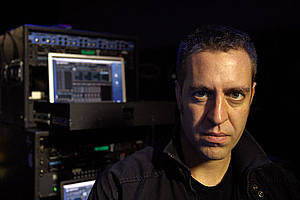
Bill Lloyd
Things got bigger, and they asked me to play about six years ago. That was the first time I was in the studio with them, at the beginning and the end of the second album. On that tour, I played bass and keyboards, using an old analog synth.
Then, on the next album, I was in the studio with them the whole time. Actually, I did the writing session as well, it was the first thing I did for that album. We held up in an old basement studio in London called Matrix, which doesn't exist anymore. We just set up a small multitrack, mainly playing live to DAT but multitracking a few things on an old 8-track machine. I did the mixing on that setup and helped them get the right sounds. I also played some bass parts, sampled sounds, cut loops, and did some equalizing. Essentially, my part has always been that of the band's own sound designer.
And you mainly used analog gear at that time?
It was analog gear for the most part, but some hardware samplers as well. We had a lot of old synths like the Korg Poly 800 and Mini 700, and a sampling keyboard which we distorted the hell out of to make it sound cool. We also used a lot of delay on these sounds.
Are you active in any other projects right now, or are you with Placebo full-time?
It's a full-time job, yes, I am constantly on the road with the band. So, I don't have much time to do anything else. When I'm not on tour I'm helping the others with home-recording and doing stuff in the studio.
Which are your responsibilities in the live show?
I used to play guitar, but we've got a second guitarist now, so he is backing up with the guitar. I just play keyboards and bass.
From your point of view as long-time sound designer of the band, how has Placebo's sound evolved over the years?
It certainly has more electronics involved, which happened gradually from the second album ["Without You I'm Nothing"] on. It already had a few keyboard and synth lines on it, then on the third album ["Black Market Music"] there was more and on the fourth ["Sleeping with Ghosts"] even more than that. It became really electronic then. The last album ["Meds"] was quite simple, but there are a few loops and synth lines, and a few old keyboards on it as well. I think this album is certainly more raw, but the one before this one had definitely a lot more electronics involved. But I don't think anybody would say that Placebo is an electronic band or even an electronic rock band for that matter, it's still just a rock band that incorporates electronics and synths.
Nevertheless, I always felt that your sound was very much influenced by electronic music as compared to bands with, for example, a strict punk attitude. Even on a more raw album like "Meds", Placebo is still an electronic-sounding band in my opinion.
Interesting that you think that.
Well, I think you can clearly hear that Placebo's recent productions were conducted with profound background knowledge of electronic music.
Yes, that is definitely the case. But the electronic elements are not too prominent, they're more like textures and other things that electronics are quite good at.
So, how did you come across Native Instruments software?
Well, I've used quite a few things from very early on, like the Pro-5 and other early NI products. I liked them a lot, especially the emulations.
After the production of "Meds", which has a lot of strings on it, we were looking for a live solution. The hardware sampler technology was getting a bit old, though it was very good and very roadworthy and didn't fail us very often. But, basically, the memory just wasn't up to scratch anymore for our purposes. Also, the load times were quite long, even on the newer models. If something went down, it would be a nightmare. And I wanted the versatility that a computer can have, basically having a lot of stuff going on at the same time.
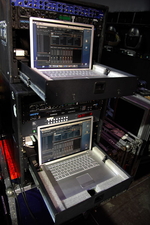
So I did some research as to what would be the best solution. What I wanted was just a sampler, without having to work within a sequencer program. Flood and Dimitri, the producers of the album, both recommended Kontakt, because they both used it. They told me that you could load up samples in multi mode, so that was a good start. I found it quite easy to use, too. I bought one copy to get started and get my head around it. I liked what it did, liked the user interface as well, so I stuck with it and gradually learned as I went along.
Do you use Kontakt mainly to reproduce the string sounds from the album?
No, I use it for synthesis as well! Actually, I don't have anything but Kontakt on my side, and on a couple of songs I play synth lines. I've got a little MIDI-controller with 49 keys and I have assigned its sliders to synth parameters like delay, cutoff, resonance, distortion etc. It works great as a synthesizer for me as well.
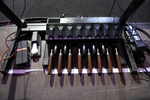
How do you organize your sounds for a live show?
Each song has got its own sound within a multi. I assign a sample to each key and then just have to remember which key plays which sample in the song. There are a few rather electronic songs where I hit a lot of loops in realtime, and I just have to remember where they are. The others are all one-shot samples. I also have pedals running the loops as well as clicks for the drummer. I can just toggle the loops with on/off pedal information. Additionally, I have assigned a volume pedal to the loops, so I can bring them in and out of the song when I need.
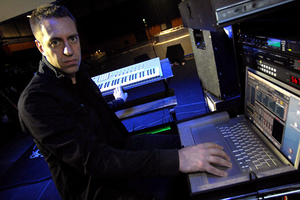
Have you also experimented with more complex modulation assignments in Kontakt, like envelopes on filters and the like?
Yes, definitely. I've got envelopes on nearly all the samples, to control timbre and release times, for example. Works quite well for me. The drummer actually has got drum triggers as well that are assigned to sounds in my program. Just one Kontakt runs all this, the loops, the synthesis, the drums, and I've got a piano in there as well.

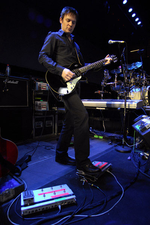
And you also use Guitar Rig with Placebo?
Yes, absolutely. I have used it in the writing sessions for "Meds" with Brian. We just put it on bass and guitar, and it worked great in that environment. We had a little setup on a barge in France. It was just a couple of guitars, one controller keyboard and a laptop. We used Kontakt quite a bit for samples and Guitar Rig on all the guitars. It was fantastic! I especially like the Plexi and the Tweed, they are very good. And the Bass PRO is pretty good on bass.
Do you usually start from scratch with your own presets?
Absolutely, yes, I love tweaking! I've got some templates that I use to start from, like clean, distortion, spacy sounds and such, and then I just go from there. It's fun, as it's so easy to add and subtract the modules.
Alex, the guy on the other side of the stage and the band's second guitarist, uses Guitar Rig live as well. It's his main system, actually. And it works really well! It's nice because Brian and Stefan have very hard, punky sounds, and it's good to be able to get different textures. I think the computer generated sounds add a nice texture. They have their own sound, it's just a bit different, probably more controlled.
What implications do you see using computers on stage or in the songwriting process?
It's for ease, really. You can do things in one application that used to take a few synths and samplers. And the laptops finally came up to speed as well. You couldn't have done it two years ago, but now you can.
What other Native Instruments software are you using?
I use Battery as well, mostly on demo productions. I love it, it's great! It's the best drum machine I've tried.
After all this extensive touring, will you have some time off later this year for songwriting and sound design and things like that?
Yes, we finish touring in September. There will be quite a big break hopefully. And then Brian wants to do some writing and studio work at the end of the year, so hopefully I will get a couple of months off. Also, I will set up Steve at his house electronics-wise. Stefan is pretty crewed up electronically, he doesn't really need my help. But I got him a Guitar Rig from you guys to use at home, so I'm sure he will have fun with that.
Sounds great! Thank you so very much for the interview and all the best for the tour and the break later this year.
Cool, no problem!
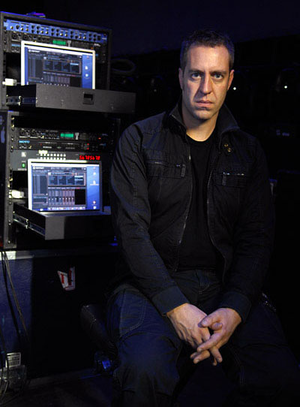
LOCO DICE

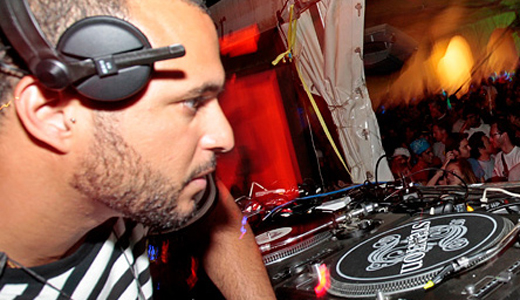
Do you remember the
first time that you
saw Traktor? What were
your initial thoughts?
It was 2007, and after
many gigs with Richie
Hawtin and Ali Dubfire
I saw the spectrum,
quality and stability
of Traktor. Finally in
2008, I made the
switch.
Tell me why you like
working with Traktor
Scratch so much today.
What feature do you
like best?
Traktor allows me to
experiment live with
different moods,
loops, a cappellas,
tools and effects.
Traktor is freedom and
allows me to do what I
want to do while
mixing. You save time
and have the chance to
experiment live. Also,
the snap mode allows
me to skip right to
the moment I want in
the track, so I don't
have to spend my time
editing the tracks in
advance!
NIC FANCIULLI
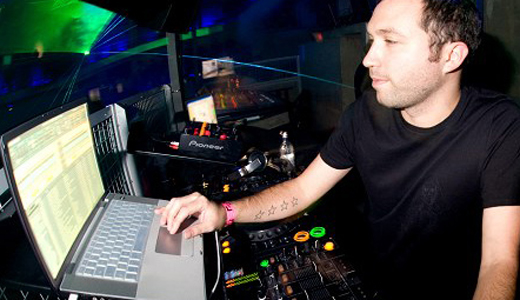
Do you
remember the
first time
that you saw
Traktor?
What were
your initial
thoughts?
I'd always
been a bit
nervous
about taking
the laptop
back on the
road with DJ
sets. I was
using
Ableton 4
with a MIDI
concept
mixer about
four years
ago and
there were
always
problems.
The mixer
was getting
knocked in
transit and
the laptop
always going
nuts on me
before I
started the
show. So I
decided to
go back to
CDs. But,
after a
while, you
find
yourself
spending
more of your
time burning
CDs than
actually
listening to
the music. I
remember
seeing
Richie using
it at Cocoon
in Ibiza a
few years
ago, doing
things that
just weren't
possible
before and
thinking,
"How is he
doing that?
I have to
make the
switch."
When did
you make the
transfer
over to it?
What caused
you to make
that shift?
I made the
transfer
just over a
year ago. I
remember
getting it
for
Christmas in
2007, and I
was just
using it at
home for the
first few
months. I
finally had
the guts to
use it on my
US tour a
few months
after that
and I
haven't
burned
another CD
since!
I think the
main reason
that I made
the switch
was that I
wanted to
spend more
time being
creative
with my
music, and a
lot of my
time was
being wasted
on burning
CDs. Not
only that,
but it was
hard to read
ten tracks
on one CD.
Traktor
allowed me
to DJ in the
style I was
used to
before, but
added great
sound
quality,
built in
EFX's and a
way of
utilizing
four
decks—allowing
for further
creative
expression.
Tell me
why you like
working with
Traktor
Scratch so
much today.
What feature
do you like
best?
I treat the
laptop as a
digital CD
wallet
basically. I
only look at
it to search
for tracks,
then I jump
back to
focusing on
the crowd.
Features
like the
effects,
looping and
hot cues are
all custom
assigned to
a MIDI
controller,
so it's like
having a
piece of
hardware
customized
to my needs
and allows
me to be
more
creative,
whilst still
allowing me
to DJ using
CDJs in the
same way
I've been
doing for
years.
Some say
something
essential is
lost when
you use DJ
software.
What's your
take?
I can
understand
that
comment, but
I don't
think its
valid for
2009. You
can use
turntables
or CDs or
even just
the laptop.
I still use
CDJs and a
Pioneer
DJM-800 in
the same way
I always
have. The
hardware
provides the
perfect
interface
for
controlling
whilst the
software
gives you
additional
depth and
features.
Together,
it's the
perfect
marriage.
So, really,
you haven't
lost any of
the
essentials:
It means you
bring your
whole music
collection
to the party
and don't
have to
stress about
it being
lost in
transit. You
can take
your set
exactly
where you'd
like it to
go and
aren't
limited in
your track
selection.
It's also
way easier
and quicker
to find
tracks!
People want
to hear good
music and be
entertained,
and using
your laptop
to control
your music
doesn't mean
you lose
that. This
is becoming
the future
of DJ
culture and
I can only
see it
getting
stronger and
stronger.
ON FIRE WITH TRAKTOR SCRATCH
Dubfire is one half of the Grammy Award winning and four-time nominated Deep Dish. The Washington based electronic duo achieved considerable mainstream success with a string of high profile remixes for artists such as Madonna, Michael Jackson and Tina Turner, yet balanced this with strong street credibility through genre-bending productions and collaborations with underground dons such as Carl Craig. Currently criss-crossing the globe on his own, Dubfire talks to Native Instruments about DJing, the Berlin minimal sound, his conversion to TRAKTOR SCRATCH, and what the future holds for him and Deep Dish.
For
years you've
been one half
of the US
underground
house duo Deep
Dish. Now
you're both
taking some
time to do
your own
things. What
brought about
this decision
and what kind
of new
freedoms has
this granted
you with
respect to
your
creativity in
production and
DJing?
Well, Deep
Dish has
always been a
shared vision
with many
compromises
made over the
years on both
sides. Having
gone solo
after 15 years
together has
given me the
freedom to
explore a
musical
direction or
idea that was
not
necessarily
appropriate
for Deep Dish.
The same holds
true for my
solo gigs. I
am able to
really put my
focus into
expressing my
own vision and
agenda and
that has been
very
liberating
after all
these years.
But I think
that it will
ultimately
make Deep Dish
a stronger
unit when we
are able to
come to the
table again in
the near
future with a
fresh
perspective on
how to up the
ante with our
music and
gigs.
Clearly
the Berlin
minimal scene
has had a
profound impact
on you lately.
When and how did
you discover
this sound and
what about it
drew you in so
much?
This music is
nothing new to
me and it has
always been a
part of my
influences and
DJ sets ever
since I can
remember. But
within the
musical
boundaries of
Deep Dish, i had
to keep my
personal
preferences in
check to a great
degree. German
electronic music
from the likes
of Kraftwerk,
Manuel
Gottsching,
Klaus Shultz,
Basic Channel,
etc. have always
been the
foundation of my
evolutionary
career path. But
I think that
within the
larger techno
genre of today,
the music has
appealed to me
more and more as
it has gotten
deeper, slower,
funkier and
generally
sexier.
Your
latest release,
"Emissions," was
signed to Richie
Hawtin's Minus
label and reached
the #1 spot on
Beatport's minimal
chart, in addition
to being played
all over Germany.
Did this quick
success in the
minimal scene
surprise you?
Was I pleasantly
surprised? Yes of
course! But I
never set out to
make a particular
genre of music.
Richie and I have
been friends for
years and i've
always supported
and respected his
music and vision
and just wanted to
do something
special for his
label in my
newfound solo
landscape. I never
expected it to
come out the way
it did and was
really overwhelmed
at the reaction;
not only to this
particular track,
but really the
overall body of
solo work I've
done this year.
It's just a great
feeling for a
producer to see
that this very
'underground'
style of music
appeals to so many
people out there.
When you
did "Emissions,"
were you inspired
by any particular
record? What were
you aiming to
achieve with this
track and how did
you use sounds and
FX to get this
across?
Well, "Emissions"
was written and
recorded in the
span of a day
which really
surprised me and
my engneer, Matt
Nordstrom, who's
my partner in
crime in all of
the solo work I've
done and the
majority of Deep
Dish's output over
the last seven
years. The groove
is very loop-based
and pretty sparse
and it's sort of
centered around my
wanting to
recreate those
thunderous cryogen
blasts you
sometimes get in
certain clubs.
There are only a
handful of clubs
with those and I
wanted to be able
to take that
experience
everywhere I went
by putting it into
a track. The three
"emissions" are
the glue that hold
the track
together.
As a DJ,
you played CDs for
many years and
started using a
laptop-based DJ
system a year or
so ago. What made
you decide this
was the way to go
and what would you
say to other DJs
who have yet to
embrace this
technology?
In a nutshell, I
just got tired of
burning CDs (or
getting read/write
errors when trying
to burn them!),
making labels,
maintaining my CD
book and lugging
it around from gig
to gig. Not to
mention the fact
that I always had
to carry a good
supply of blank
CDs. It just
seemed so much
more practical to
just maintain my
iTunes library. I
have personally
steered many of my
fellow DJ friends
towards this
technology and
continue to do so
as all are
extremely glad
they made the
switch!
How has
technology changed
or improved what
you can do in the
DJ booth versus
when you started
just playing
records? Do you
think having a
laptop in the DJ
booth takes away
from the art form
and would you ever
see yourself going
to a completely
software/controller-based
system when the
right technology
comes out?
I had always been
a vinyl junkie and
to this day,
really miss that
period of my life
when I would spend
hours wading
through the week's
newest releases.
But I miss the
cover art the
most; with laptop
DJing, I now have
to try and
remember all of
the names of the
hundreds of new
music I accumulate
every week. But as
an artist, I
believe that you
must constantly
evolve and with
electronic music,
it's important to
my career that I
embrace new
technologies which
allow me to be
more creative with
my performance in
the studio as well
as on the road.
Laptop DJing has
been a major
turning point for
me and has created
an entirely new
set of parameters
to work within.
Having said that,
I still enjoy the
marriage of
hardware and
software so I
still like using
the Pioneer CDJs
with Traktor.
You
recently switched
to Traktor
Scratch. How did
you hear about it
and what was the
transition from
your previous
system like?
Pablo La Rosa
(Native
Instruments
International
Director of
Marketing)
literally dragged
me to the NI booth
directly after my
Beatport pool
party set during
the 2007 Winter
Music Conference
in Miami and gave
me a five-minute
demo and I was
hooked from then
onwards. Although
learning all about
the Trakor at
first seemed very
daunting it only
took me a couple
of weeks of gigs
to really feel
comfortable with
the program.
What are
the main reasons
you switched to
Traktor Scratch?
Pretty simple
really: the easy
looping feature,
the multiple
screen views, the
ability to set up
"hot keys" for
virtually every
function as well
as the ability to
use external
controllers for
greater effect. I
LOVE the FX as
well, especially
the reverb and its
intensity - it
really helps to
create dramatic
peaks during
breakdowns and
even better is
using it to CREATE
your own
breakdowns! I also
love its simple
hookup.
How did
you like the
sound quality of
the software and
the Audio 8 DJ?
It was quite
obvious from the
first gig I used
Traktor that the
sound quality
was literally
the difference
between night
and day compared
to Serato! I had
always had
problems
following a DJ
who was playing
vinyl or CDs as
the sound of
Serato's box was
just so digital
and harsh and I
could never
quite match
levels. Trakor
really made my
320kbps MP3s
sounds more like
AIF or WAV
files.
You've
been touring with
Traktor Scratch
for the past month
or so. What are
some of the bigger
gigs you've played
and what do you
think of the
system's
reliability and
performance?
Well, the biggest
event I've done
had to have been
Creamfields Buenes
Aires where I
payed to about
10-12,000 people.
Traktor performed
beautifully and
really elevated
the kinds of sets
that I'd been
doing prior to
making the switch.
You
recently got
into the MIDI
assignment part
of Traktor
Scratch and have
a
custom-configured
setup for your
FaderFox
controller. Tell
us how you've
got it set up
and how this has
changed the way
you are able to
interact with
the software and
your crowd.
Having the
Faderfox DX2
controller has
made a huge
difference not
only in the way
I use all of
Traktor's FX,
but also the way
I perform and
interact with my
crowd. I love
its simple
setup,
color-coded
buttons as well
as its easy
layout. Laptop
DJs get
criticized all
the time for
focusing their
attention onto
their computer
screens for the
majority of
their sets which
can interrupt
that connection
or chemistry
with the crowd.
But the Faderfox
liberates you
from all of
that. And even
though it comes
with a few
presets, it was
a lot more fun
and useful to
create my own.
Have you
started using
Traktor 3.3
software with
Traktor Scratch
yet?
Well, up until
about two months
ago, I had been
a Serato user
for nearly two
years. And
towards the end,
I started to get
really bored
with its
limitations; it
seemed that the
company never
really took into
account the
needs of the
more
electronic-based
DJ,
predominantly
favoring hip-hop
or scratch DJs.
And so once I
began using
Traktor Scratch
I was completely
blown away, not
only by its
interface, but
by its
incorporation of
internal FX,
looping, true
waveform
display, and the
list goes on and
on. The other
thing I noticed
was how vastly
improved the
sound quality
was over my
Serato box. And
now that i've
gotten very
comfortable with
Traktor Scratch,
I'm actually
slowly testing
out Traktor
Studio,
especially for
its ability to
use four decks
and its
customizable
interface.
You
recently started a
new label"SCI+TEC.
Where can we find
your releases?
Well, initially
the releases were
exclusive to
Beatport and
iTunes but we've
recently inked a
deal with
German-based
digital
distributor
Zebralution so
they will be
available on
virtually every
download site in
the coming weeks.
What's
your favorite
club/city to play
in and why?
Probably Womb in
Japan although I
have had the
pleasure of
playing at some
amazing venues
this year. But the
Japanese crowds
are just on
another level; you
can really feel
the love in the
room and you know
that they're there
for the music
first and foremost
and that
ultimately ups my
game and makes me
play better.
What's
in your studio
these days
equipment-wise?
What NI plug-ins
do you use
regularly and
why?
I'm going to let
Matt answer this
one.
Matt: The heart
of the studio is
an Apple G5
running Logic
and Ableton.
Working
primarily in the
box, I rely on
the NI plug-ins
like Massive and
FM8 a lot. The
sound is amazing
and the
interfaces make
them very easy
to manipulate.
Battery has
always been a
mainstay for me
as well,
especially with
its incredible
sound library.
My hardware
setup is very
minimal but that
said, i couldn't
live with out my
Fatso.
The
minimal sound is
difficult to
achieve because
it's all about
making the track
sound big but with
just a few basic
elements. What's
the secret to
doing this?
I wish I knew!
LOL! It really
boils down to
picking the right
elements to fill
up that space. So
while the
production may be
sparse, you've got
just a few key
elements playing
off one another
and creating an
atmosphere. It can
be just as
complicated to
produce a
so-called
"minimal" track as
doing something
with layers upon
layers of parts.
Any new
mix compilations
coming out to
follow up your
recent Global
Underground
release?
There are no
specific plans
as of yet but I
have been in
talks with both
Global
Underground and
a certain German
label about
doing something
in the fall of
2008.
Right. Who wants a pint?
BUGGING OUT

Bugz In The Attic have been an integral part of the UK's music scene for more than a decade now. The Bugz In the Attic collective (and their numerous solo and side projects) are often cited as the leading exponents of the West London broken beat sound- a distinct sub-genre mashing up influences of soul, funk, house and drum'n'bass. Besides producing and remixing, Bugz In The Attic are also active live musicians and party promoters. They have taken their shows all around Europe, the US, Australia, and Asia. Daz-I-Kue is a founding member of the group and one of its musical masterminds alongside Orin "Afronaught" Walters and Kaidi Tatham. In this interview, Daz gives us an insight into how his love for music evolved from collecting records to starting his own soundsystem and getting into computer-based music production with a busy schedule of remix assignments.

Daz, you
told me
that you
have been
working on
remixes
over the
last
weekend.
How did
that go?
We
actually
just
finished
two
remixes
and tested
them at
the club
this
weekend.
On tune
was for
Fania
records,
the salsa
label that
is being
run by V2.
It is
called "Plastico"
by Rubйn
Blades,
and it
came out
really
nice. We
got all
the
original
parts from
when they
did the
tune. I
had to
chop them
up and
make sure
they all
run in
time to
match one
constant
beat. This
was a live
recording
and the
tempo just
varies by
a few bpm.
That was
the hard
work, and
once I had
done that
and
everything
was
perfect
bar by
bar, we
just
started
working
away on
the tune.
The next
tune we
remixed
was by SK
Radicals.
That tune
turned out
really
nice as
well. We
used a lot
of Native
Instruments
programs
on both
tunes, and
they have
been
working
great for
us.
Daz-I-Kue
How do you
approach a
remix? Do
you
usually
know a lot
about the
background
of the
original
piece?
No,
usually
not. I
don't like
having to
hear the
original
tune they
did
before,
because it
influences
you a lot
in what
you do
with it.
With the "Plastico"
remix it
was
different,
because I
had been
playing
the
original
for a long
time,
actually
played it
at every
gig for a
while. I
was so
excited to
do that
one,
because it
was one of
my
favourite
Fania
tunes. The
harmonic
changes in
that tune
are just
incredible.
The way
Bugz In
The Attic
approach a
remix is
that we
all take
the parts
away and
work on
them
separately.
We then
vote on
whoever
got the
best out
of each
element,
and we
continue
to work
with that
one. I did
the beats
for the
last few
tunes,
except for
the "Plastico"
project.
Orin did
those.
Usually
Kaidi
plays the
keyboard
parts, all
of us are
doing some
programming
or play
some extra
keys on
top of
what Kaidi
has done.
Then we
start
arranging
everything.
Orin is
really,
really
good at
creating
dope
arrangements.
One of the
things
that we do
make sure
is that
the
remixes
are
danceable,
so that
people can
really get
into it.
In that
respect,
we try to
make it
better
than the
original
piece
itself.
Then,
hopefully,
the focus
will come
on us
rather
than on
the
original
tune, and
people
will
recognize
it as a
tune by
Bugz In
The Attic.
So that's
what we
do, put
everything
under our
own
quality
control,
making
sure that
all the
elements
are
perfect.
Do
you have one
collective
studio for
Bugz In The
Attic where
you assemble
everything?
Yes, we have
our own
studio.
However, of
late we have
been working
in our own
environments
and been
communicating
through the
internet.
Back in the
days,
everything
used to be
in one room
and we all
would be
working on
one tune.
That was
great for
the time,
but
sometimes it
would get a
bit
claustrophobic
for me. But
it was one
of the best
times.
Nowadays,
people are
living in
different
areas of
London and
they are
busy with
their lives.
So we all
got our own
little
setups and
communicate
via iChat.
For example,
I would be
working with
Kaidi, have
the iChat on
and send
files back
and forth
and talk
about how we
should do
things.
Especially
for me
living
partly in
Atlanta,
this is the
only way I
can be
working with
Bugz In The
Attic. And
it has been
working out
really well.
I don't have
to go
anywhere and
spend money
travelling,
it just
saves the
planet!
How
did you get
involved
with music
technology
in the first
place?
From my
early days,
I have
always been
into music.
Even before
I was born,
when my
mother was
pregnant
with me, she
used to go
to all these
parties with
the American
GIs and they
would be
DJing really
good
American
music. When
I was about
five years
old, my
mother took
me to the
parties and
sit me next
to the DJ.
And I'd be
happy as
larry
sitting
there and
watching!
That's when
my love for
music
started.
I got my first record at that age, the Jackson Five's "The Love You Save". From then on, I have been slowly collecting all my records. I've got a small but nice collection, definitely not the biggest in the world, but very nice. Then, when I was sixteen years old, I started a soundsystem with some friends from school. We skipped classes and had our first gig at a girls school in Central London. We started to promote our own parties and managed to get all the big KissFM DJs before they were famous and got invited to the big parties.
One of my partners in the soundsystem went to the School of Audio Engineering, and so I wanted to learn more about my soundsystem as well. He recommended for me to go to this audio engineering course, which I did. This was in 1990/91. And from the time I first saw the Akai S950 sampler, I was hooked. Around that time, I was made redundant from my job and got a nice compensation, which I used to buy my first set of equipment. I teamed up with a guy I met at the SAE and we started making music and building our own studio. Eventually, we put our first release together. It was called "Sinclair Project Daz Jaz", and we were quite excited to get our own vinyl and go through this whole process we didn't know anything about. We struggled on end, but got it all worked out, and that was very enjoyable. I have not turned my back on music ever since. One day, a guy called Noodles took me down to Kickin' Records, and that's where I met all the guys, Orin and the whole crew. I started working with them as an engineer and that's how I got around meeting everybody.
Did
you start
out with a
computer
when you
bought your
first set of
equipment?
Yes, I
bought an
Atari with
Cubase and
the Akai
S950, a
Technics
SL1200
turntable
with a mixer
for sampling
purposes,
and a cheap
Mackie
mixer. We
basically
just plugged
everything
into our
HiFi system
and used its
speakers as
monitors.
That was my
first set of
equipment.
The computer
obviously
still is the
mainstay of
my work
today. I am
really
comfortable
working on
the digital
domain. I
have worked
with analog
gear, and I
can handle
it, but I
really know
my stuff
when I am
working on
the
computer.
There, I can
get the
sound I
need. Native
Instruments
plays a big
role in
that. I am a
long-time
user of
Battery, for
example. In
the last
remix for SK
Radicals I
used
Bandstand,
and I think
the sounds
are
incredible.
I have
virtually
used all the
Native
Instruments
software at
some point
in time.
Other than
that, I use
Waves
plugins.
Those are
the two
things that
are
essential in
my life in
terms of my
remixes. As
audio
interface, I
use the
AUDIO
KONTROL 1.
It's really
good for
vocals!
People can
just come up
to my house
and we'll do
the vocals
right there.
Plus it has
a
MIDI-interface,
so I can do
my thing
with a MIDI
keyboard I
am using to
play my
beats. That
is such a
neat box!
Do
you use the
controller
features of
the AUDIO
KONTROL 1 as
well?
I have not
properly
investigated
that yet,
but I will
be using it
more.
Because of
time, I have
been using
the basic
setups on
the AUDIO
KONTROL 1.
But I will
be looking
at that. It
seems to be
a phenomenal
way of doing
automation.
I am going
to check it
out over the
next few
weeks, do
some
experimentation
and see how
it all
rolls.
Do
you have a
different
live setup
than what
you work
with at
home?
The setup at
home is very
reduced, as
I wanted to
keep it
really,
really
small. I've
got a big,
powerful Mac
computer,
the AUDIO
KONTROL 1
and my
keyboard,
and that's
it. I'm
rolling
everything
from the
computer.
When we play
live, we
have loads
of
keyboards,
two to three
laptop
computers, a
hardware
sampler, and
triggers for
Matt Lord's
drums. We
actually
have sampled
drums in
addition to
the live
drums, both
being
triggered at
the same
time. It's
all about
recreating
the sound of
the Bugz In
The Attic
records, and
this has
been working
out really
well. It's a
revolution
how you can
create a
great studio
sound with
today's
software,
and also
play it live
as well.
Is
the typical
Bugz In The
Attic
synthesizer-sound
mostly
achieved
using
hardware
synthesizers,
or does
software
play a role
in that as
well?
It's a
mixture of
oldschool
analog
equipment
and software
instruments.
But the
software
synthesizers
have to
sound
authentic as
well, since
we are using
them to
recreate
what
oldschool
synthesizers
were
sounding
like. When
we produced
the last
album, we
made a
conscious
effort not
to use
anything
like the
Rhodes or
similar
vintage
keyboards.
That way,
you
automatically
create a
more
electronic
sound.
However, we
tried to
keep it very
soulful.
This was an
experiment
to see what
we could do
without the
Rhodes,
because we
usually use
it in every
tune. The
music that
came out of
this was
totally
different
compared to
a lot of the
stuff that
was going on
in the scene
at that
time, but we
kept the
soulfulness
of it right
on.
Have
you tried
any of the
Reaktor
ensembles
with more
advanced
synthesis
methods?
I am getting
into that.
On the next
few tunes I
am doing, I
will be
using all
that Reaktor
stuff, and
Massive as
well. I
really want
to start
using those
more modern
sounds. So
far, I have
been using
the Pro-53 a
lot. That
thing is
really,
really good!
It's a
phenomenon,
it really
gets you all
these
oldschool
sounds. It's
all there, I
don't need
to go
anywhere
else. But
now, I'd
like to
start using
other sounds
as well.
I have not
touched FM8
and Massive
yet, they
are very
scary to me
as they are
new
instruments,
and I don't
yet know how
to use them.
That
changes, of
course, as I
get into
them. The
only way I
can do this
is by
producing a
tune with
them. That's
exactly what
I will be
doing in the
next months.
What you
will
probably
hear is one
tune done
entirely
with Massive
and one that
is all FM8.
So watch out
for that,
Massive and
FM8 are
going to be
used a lot!
I'm having
fun
exploring
these
things,
learning
what my
abilities
are with
them. And
Native
Instruments
has already
changed my
sound,
putting new
elements
into it and
essentially
widening it
a great
amount.
Daz,
thanks for
these
answers, and
we are
really
looking
forward to
hear you new
songs!
You are
absolutely
welcome, and
you'll be
the first to
hear them!
THE UMFELD REAKTOR

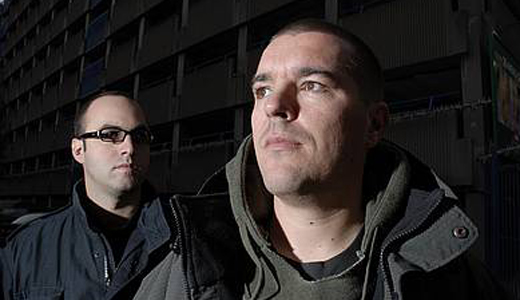
Speedy
J (front)
and Scott
Pagano
Jochem Paap,
otherwise
know as
Speedy J,
has a long
and
impressive
heritage in
techno
circles. The
Dutch
producer
released his
breakthrough
minimal
techno
track,
"Pullover",
in 1992,
with a
follow up
album
released on
Richie
Hawtin's
Plus 8 label
the
following
year. Since
then Jochem,
a long time
NI user, has
explored
more
experimental
areas of
electronic
music, not
least his
new project,
Umfeld TV,
which
provides a
platform for
an audio
visual
surround
sound
concept with
visual
artist Scott
Pagano. A
free version
of the DVD
can be
downloaded
from the
Umfeld TV
website.
Native
Instruments
recently
caught up
with Jochem
to find out
more….
What was
the
initial
idea
behind
creating
your new
DVD as a
surround
composition?
I felt
that the
surround
domain was
very
suitable
for
electronic
music, yet
there were
and still
are very
few
artists
who
actually
make use
of it.
Surround
sound has
been
around for
several
decades,
and in the
last
decade the
5.1 format
has become
a very
accessible
consumer
format.
However,
it is only
widely
used in
Hollywood,
on one end
of the
spectrum,
and in the
academic
world on
the other
side of
the
spectrum,
but not
much is
happening
in the
area of
modern
electronic
music.
I think
especially
this genre
is
perfectly
suited for
surround,
as it is
all about
the
experience,
and less
about song
structures.
Before I
started I
felt there
was
enormous
unexplored
territory,
as not
many
people
have tried
to find
out what
possibilities
surround
sound has
for
electronic
music.
Did you
work out
your own
compositional
rules for
the
surround
domain?
My rules
were
basically
defined as
the
project
developed.
I had some
ideas what
I wanted
to do;
things I
had missed
in the
surround
productions
I heard so
far. So I
tried to
incorporate
these
ideas into
the
project. I
quickly
found out
that many
things
were
simply
impossible
with the
available
tools.
Therefore,
I spent a
lot of
time
designing
new tools,
and
modifying
existing
ones, for
which I
used
Reaktor,
Plogue
Bidule and
Max/MSP. I
had some
help from
Telco
Systems
here in
Rotterdam,
they
helped
develop
some
surround
mixing
environments.
What I
find most
striking
watching
Umfeld was
that there
are
certain
very
organic
movements
that
correspond
very well
in audio
and video.
Did you
actually
compose
this
together?
In most
cases,
some early
audio
sketches
existed
before
Scott
started to
work on
the
visuals.
we did a
lot of
ping-ponging
back and
forth.
When I saw
what he
did in
particular
sections,
I often
went back
to the
sound of
that
section
and
tweaked it
so it
would work
together
more
smoothly.
It was
quite a
challenge
to make
such a
rather
long audio
visual
piece. You
have to
take good
care of
the arcs
and make
sure the
entire
piece
makes
sense as a
whole. I
was aware
that the
viewer was
going to
be
focusing
on the
screen in
certain
moments,
but I did
not
reflect
the
viewing
direction
too much
in the
audio. One
of the
things
that I
wanted to
experiment
with was
the
creation
of
environments
which have
no focal
point at
all. I did
a lot of
asymmetric
things and
diagonal
movements
etc. The
whole
piece
turned out
to be
quite an
intense
experience
because of
that,
there is a
lot of
information
going on
all the
time.
Also,
despite
the fact
that you
have all
the cool
rotation
tools
available
all the
time, I
tried to
stay away
from too
much
obvious
rotation
and
movement.
I tried to
create
spaces and
environments,
which
sometimes
change
abruptly
and very
smoothly
at other
instances.
There are
so many
layers, I
don't even
know
what's
going on
sometimes
when I
listen to
it now...

The DVD can be downloaded from Umfeld TV click to find out more...
How did
you gather
the
material
for this
project?
Did you
build your
own
archive?
Every bit
of audio
used in
this
project
was
designed
especially
for it. I
wanted to
build
everything
in
surround
from the
ground up.
So, even
the
samples I
created
were
already in
surround.
Normally,
surround
audio is
built up
from mono
and stereo
samples,
but then
you end up
placing
those
sounds in
a certain
space
only, and
maybe use
some
effects. I
have done
this with
a couple
of sounds
on Umfeld,
but most
sounds
were
developed
in
surround.
That way,
the
treatments
to it
would be
in true
surround
as well.
This means
that I
could get
much more
interesting
and
satisfying
textures
and
environments,
but it
also meant
I had to
develop
tools and
work out
methods as
most of
what I did
was not
possible
with
existing
tools.
Reaktor
has been
part of
your
working
environment
for a long
time. How
did you
involve it
in this
project?
Reaktor is
a great
tool to
use for
surround
work, as
you can
add as
many
inputs and
outputs to
an
instrument
as your
soundcard
allows you
to.
One trick
I used
often is a
very
simple but
effective
one: Any
instrument
can easily
be
modified
to have
more than
two
outputs by
just
copying
the
instrument
in its
entirety
within the
ensemble,
and then
connecting
the
outputs of
the copied
version to
the
outputs
which
resemble
the
surround
or center
speaker.
By making
variations
in the
sound on
each
output you
get a
spatialized
version of
that
particular
sound.
The same
trick
works in
stereo:
Pan one
sound to
hard left
/ hard
right and
then treat
them
differently
using EQ,
delay or
any other
modification.
This gives
you the
impression
of more
width in
the stereo
field, and
it works
very well
with more
than 2
channels.
How did
you
implement
this into
your sound
design
process?
Well, I
used a lot
of
granular
synth
based
instruments
which are
split up
across
multiple
channels
by the
described
method. I
fed these
multi
channel
granular
devices
with mono
samples
which were
part of 6
channel
audio
files that
already
had
spatial
information
in them -
kind of
surround
premixes.
By
skipping
through
the
waveforms
in a
controlled
way the
spatial
information
is kept
intact but
it skips
as well,
which
results in
some very
cool
robotic
movements.
Yes, I
could make
that out,
interesting
to know
how it was
achieved.
Which
material
did you
use
Kontakt
for?
I mostly
used
Kontakt to
spatialize
stereo
sound. The
panner is
capable of
some very
nice
automated
movements,
and they
can be
controlled
by
waveforms
or other
controllers.
It also
has some
great
algorithms
to make
the sound
appear
outside of
the
speaker
range, and
it can
enhance
the
impression
of
movement
using the
doppler
effect
etc...
Do
you think
the use of
surround
formats in
electronic
music will
become
more of a
regularity
in the
future?
I think
so, yes.
When I
started
this
project
three
years ago,
the
available
tools to
work in
surround
were very
limited
and
totally
geared
towards
the
typical
Hollywood
approach.
Over the
last few
years,
more
sequencers
and other
applications
have been
getting
surround
features,
which
allow a
more free
form
approach.
Most NI
apps are
surround
ready, and
Logic 8's
surround
features
have been
seriously
enhanced.
I would
love to
see more
people in
the field
of
electronic
music
giving it
a try! Now
that it
has become
more
accessible,
all you
need is a
multichannel
soundcard
and a
surround
speaker
system.
Surround
can add
very
inspiring
new
dimensions
to your
music as a
composer.
It also
raises
some
interesting
questions,
like what
the
relevance
of a work
in
surround
vs the
same work
in stereo
could be.
What does
it add to
the
listening
experience,
how much
of the
experience
is created
by the
fact that
the work
is in
surround,
and how
much by
the
composition?
What
feedback
have you
been
getting
from the
audiences?
Scott and
myself
have
screened
the DVD
around the
world, and
I can
confirm
that
surround
definitely
has a very
large
impact on
audiences.
It is a
very
complex
domain to
deal with
but for me
it has
definitely
been worth
it.
Besides
being a
surround
composition,
Umfeld
also is an
audio
visual
work. I
think
these
types of
works will
definitely
gain an
audience
in the
future.
Twenty
years ago
the
majority
of the
music fans
would
never
listen to
abstract
electronic
music, and
now the
entire
world is
dancing to
abstract
repetitive
non
narrative
electronic
music
performed
by guys
behind
laptops!
The
generations
that are
growing up
now will
all have
access to
any type
of audio
visual
work from
anywhere
they are.
It could
take on
many
forms, for
example
audiovisual
ringtones
or short
films,
whatever,
but I'm
sure we
will
become
more
accustomed
to
consuming
abstract
audiovisual
works the
way we got
used to
consuming
abstract
audio.

TECH TALK WITH GUY SIGSWORTH AND ANDY PAGE

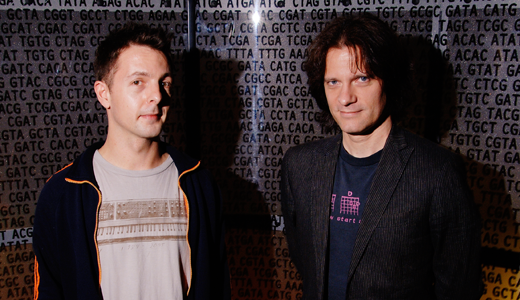
Andy
Page and
Guy
Sigsworth
As
one half
of famed
electronica
project "Frou
Frou" and
producer
of Seal,
Bjцrk, and
Lamb,
among
others,
Guy
Sigsworth
has earned
his spurs
in the
music
business
as a
highly
creative
mind
behind the
mixing
desk and
the
computer
screen.
Over the
course of
the past
year, Guy
has been
teaming up
with
guitar
player and
tech
wizard
Andy Page
to work
with
Alanis
Morissette
on her
forthcoming
album,
"Flavors
of
Entanglement". In
contrast
to Alanis'
previous
work, this
new album
will sound
much more
electronic,
yet
without
losing
sight of
its
organic
quality.
In this
interview,
Guy and
Andy give
us an
exclusive
insight
into their
quest for
musical
innovation,
for which
GUITAR RIG
and
REAKTOR
serve as
the
cornerstones.
Which
instrument
do you
turn
to
when
you
simply
want
to
sketch
out a
creative
idea
you
had?
Guy:
It
might
be as
lo-fi
as a
dictaphone
by the
bed,
or as
hi-fi
as a
Protools
HD
system,
or a
piano,
a
guitar,
or a
piece
of
software.
I've
written
songs
every
kind
of
way.
Some
of my
best
ideas
come
to me
when
there
are no
traditional
musical
instruments
available.
Andy:
I'm a
guitar
player,
and a
lot of
my ideas
come
from
that.
But
there
are
certain
times
when you
don't
want to
be
pressured
by a
particular
instrument
to write
a
certain
way.
Sometimes
just a
new
sound
can be
the
catalyst
for your
music.
Guy: I'd
agree
with
that.
I'm a
very
good
keyboard
player.
Sometimes
I trust
that,
but
other
times I
prefer
an
instrument
I'm not
so good
at,
because
there I
don't
have
familiar
patterns.
Do you
work
with
Reaktor
because
it
gives
you
this
kind
of
freedom?
Andy:
Working
with
Reaktor
can
open
up
many
new
possibilities.
It
gets
you
thinking
from a
perspective
of
just
sound,
rather
than
approaching
something
from a
melodic
or
harmonic
angle.
Guy: I
love
the
fact
that
every
day
there
are 20
new
ensembles
people
have
made,
and
they're
giving
you
them
for
free.
It's
all
part
of
this
web
generosity.
Andy:
We
mostly
use
pre-existing
Reaktor
ensembles
and
modify
them
to
suit
our
working
methods.
There
are so
many
fantastic
ones
to
choose
from.
But
some
of
them
actually
do too
much
for
us.
There
may be
a
granulator,
resonant
filter,
delay,
reverb
and
5-band
EQ all
built
into
an
ensemble.
What's
unique
is the
granulator.
The
other
elements
are
okay
but
not
unique.
So
we'll
strip
out
the
granulator,
discard
the
other
bits
and
have a
new
ensemble
with
just
that
unique
element.
Learning
how to
"hot-wire"
existing
ensembles
like
that
is
relatively
easy.
Unlike
with
hardware
it
doesn't
involve
a
soldering
iron
or the
wearing
of
protective
clothing!
Guy:
I've
always
come
at
music
more
from
the
sampler
than
the
synthesizer.
That
is, I
prefer
to
work
with
sounds
that
were
embodied
physically
to
start
with.
They
just
have
some
air
around
them
somewhere.
Although
I love
Kraftwerk,
I've
never
wanted
to
make
music
as
purely
electronic
as
that.
Maybe
it's
because
I got
a
sampler
before
I got
a
synth,
but
the
modification
and
morphing
of
acoustic
or
semi-acoustic
sources
just
excites
me
more.
That's
why
Reaktor
is
great
for
me,
because
I can
work
on
acoustic
sources.
Andy:
I fell
in
love
with
Reaktor
in
2001.
One of
the
things
that
appealed
to me
the
most
about
it was
the
fact
that
you
weren't
locked
in to
using
the
same
old
methods
of
synthesis,
namely
subtractive
synthesis.
I also
think
that
one of
the
most
exciting
applications
of
Reaktor
is the
convergance
of
acoustic
sounds
with
digital
manipulation,
taking
"normal"
sound
sources
like
pianos
and
guitars,
and
giving
them a
completely
different
spin.
Guy:
But if
you're
working
with a
singer
who
wants
to be
understood,
you
may
have
to be
very
subtle
with
this.
That's
why,
with
Alanis,
she
has to
"command"
the
song.
She is
the
focus.
We
still
play
with
unusual
delays,
reverbs,
and
other
treatments,
but
it's
really
important
that
people
can
hear
what
she's
saying.
Andy:
Nevertheless,
there
is
often
room
for us
to
experiment
with
how we
present
her
voice.
For
example,
we use
Spektral
Delay
quite
a bit,
because
we are
always
looking
for
new
ways
of
giving
parts
of a
mix a
special
ambience.
We use
it on
guitars,
synths,
drums,
vocals,
etc.
Speaking
of
guitars:
When did
you come
across
Guitar
Rig?
Guy:
During
this
album.
Since I
heard
it, I've
sold a
certain
rival
product.
It just
sounds
soooo
good!
The
models
are
really
"generous"
in their
frequency
response.
Andy:
When we
were
recording
the
guitars,
our
initial
plan was
to
record
through
a well
known
hardware
guitar
box, and
to
record a
DI
signal
as well,
with the
intention
of re-amping
later
on.
Guy: But
once we
heard
Guitar
Rig...
Andy:
...there
just was
no
looking
back!
Pretty
much all
the
guitars
were
recorded
with it.
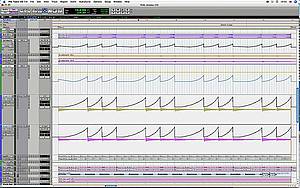
Automation in Protools
Which
amp
models
do you
use the
most?
Andy:
The Vox
Box, the
Twin,
and the
Gratifier.
But my
new
favourite
is the
Hi-Watt
model in
version
3! It
sounds
brilliant
-
especially
for
those
not
quite
"clean"
parts
that
require
just the
right
amount
of dirt.
Guy: We
really
layer
guitars
in odd
ways.
For
example,
I'm a
fan of
Holger
Czukay -
these
records
where he
played
the
guitar
at half
speed. I
love
this
"tuned
up"
sound.
Andy did
that
with
electrics
and
acoustics.
Andy: To
achieve
this, we
do a LOT
of
automation
in
Protools.
Using
Guitar
Rig fits
perfectly
into
that way
of
working
- we
really
celebrate
the fact
that one
can
automate
as many
parameters
as you
like.
Guy:
Live,
you'd
need six
people
with
their
hands on
every
dial on
the amp!
Andy: On
one of
the
tracks,
there
are
sustained
chords
that
happen
one per
bar. For
this, we
automated
the gain
on the
Hi-Watt
model.
So when
you hear
the
initial
attack
of each
chord,
the gain
is quite
low.
Then, as
the
chord
sustains,
the gain
is
increased
by quite
a bit -
increasing
the
distortion,
and
creating
a really
nice
"swell"
in each
chord.
This
kind of
thing
would
have
been
impossible
to do 10
years
ago.
Guy: One
other
element
we
really
got into
with
this
album
was
dynamics.
With
Protools,
we have
absurd
control
of
dynamics,
we can
shape
dynamics
in
unconventional
ways -
it's
more
than
just
compression.
We make
sounds
swell by
96dB in
a 16th
note!
Andy: In
fact, we
don't
really
use
compression
to
control
volume -
we use
compression
for the
"sound"
of it.
Okay,
so
it's a
lot
about
detailed
editing
then?
Guy:
Editing
is
everything!
Andy:
Yes!
Down
to the
subatomic
level
of
sound!
Guy:
But
Alanis
has to
sound
fantastic
at all
times.
If we
aren't
presenting
her as
well
as we
know
how,
we're
not
doing
our
job.
How did
you
communicate
with
Alanis
about
all the
editing
and
sound
design
you were
doing?
Was she
involved
in that
at all?
Guy:
Alanis
comes in
and
mostly
lets us
do what
we do.
She
doesn't
tell us
off very
often.
We're
good
boys,
after
all...
Andy:
She was
really
supportive.
I think
she
wanted
to go in
a
different
sonic
direction
with
this
album.
Guy: She
has a
clear
sense of
the
emotional
feel of
the
song. As
long as
we're
true to
that,
she
doesn't
mind if
we use
bizarre
sounds
to tell
the
story.
How did
the
songwriting
come
along? I
would
imagine
that
your
work had
a big
influence
on the
songs
themselves?
Guy:
Alanis
likes
DRAMA in
her
songs. I
wrote
all the
songs
with
her,
basically
one song
a day
until we
had 23
songs.
We
agreed
that we
wanted
the
songs to
take you
on a
journey.
Some
"geeky"
music
basically
has no
surprises
after
the
first
four
bars. We
liked
the idea
that the
instrumentation
might
suddenly
change,
or the
dynamics,
or the
chords.
And
vocally
she's so
good at
drama!
She can
go from
a
whisper
to a
scream.
Andy:
Alanis
is such
a
dynamic
singer
and
writer -
her
dynamic
range is
huge!
That
challenged
us to
make the
productions
as
exciting
and as
dynamic
as
possible.
Guy:
She's
also
very
much a
"take
one"
singer.
She gets
the feel
right at
the
start,
so don't
mess up
the
early
"demo"
recordings!
Which
guitars
did you
use for
the
recording?
Andy:
The two
main
electrics
used
were my
Tasmanian
made
Rizzolo
Guitar
and a
Fender
Jazzmaster,
with
smatterings
of
Rickenbacker,
Strat
and Les
Paul.
Acoustics
used
were a
Taylor
"Big
Baby", a
K.Yaira
"Parlour"
guitar,
and a
Guild
dreadnought.
Even a
very
dodgy
Hofner
bass
sounded
really
good
through
Guitar
Rig.
Actually,
the bass
amp
models
are just
as good!
We have
been
using it
on many
other
instruments
as well,
like
drums
and
synths.
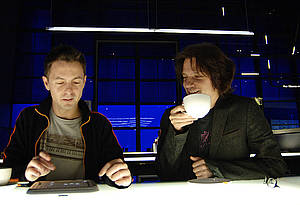
Did you
use
hardware
effects
and
guitar
amps at
all?
Andy:
Very
little,
since we
got
Guitar
Rig.
Guy:
We're
absolutely
not just
using
Guitar
Rig as a
budget
solution.
We want
it to do
what
"real"
amps
can't. I
hope
Guitar
Rig will
make
people
invent
new
approaches
to the
guitar.
That's
very
interesting!
So you
take
straightforward
guitar
sounds
to do
something
that's
technically
impossible
with the
original
model.
Andy:
Definitely.
You can
make a
mix so
much
more
exciting
and
dynamic,
just
with a
bit of
automation.
And it
just
sounds
so good!
Being a
programmer
and
sound
designer
as well
as being
a guitar
player -
it opens
up so
many
exciting
possibilities.
How did
you go
about
creating
the
specific
sound
for this
album?
Guy:
There's
one
song,
called
"Limbo
no More"
which I
think
has a
particularly
beautiful
sound.
For
this, we
layered
various
guitars
so that
the
result
sounds
between
mandolin,
Appalachian
Zither
and even
Indian
instruments.
But it's
actually
just
guitars!
Also,
there's
a
beautiful
riff
played
on a
Rickenbacker,
with the
fingers
mic'd
up, to
add an
"ethnic"
feel.
I've
always
been
inspired
by the
idea of
imaginary
ethnic
instruments:
Instruments
that
don't
really
exist,
but you
imagine
them.
Andy:
Sometimes,
we'd
also use
the old
"varispeed"
effect -
only in
digital
form. It
is
achieved
by
bouncing
a
section
of the
song,
pitching
it down
or up,
then
playing
the part
in a
different
key, and
then
transposing
the
result
back to
the key
of the
song.
The
formants
get
shifted
that
way.
Guy:
Yeah -
that
helps
change
the
feel.
Andy: A
standard
acoustic
guitar
can
become
something
like a
mandolin!
Guy: One
idea I
had for
this
album
was to
always
make
things
hybrid.
So if
it's
very
full of
guitars,
let's
put a
junglist
reese
synth
bass on
it, or
very
electronic
drums. I
wanted
to
always
counterbalance
things.
Andy:
Another
concept
we
worked
with
is a
"familiar
but
new"
approach.
For
some
of the
drum
programming,
sometimes
we
used
classic
old
sounds,
like
the
Oberheim
DMX,
but
processed
them
in new
ways
to
give
them a
different
spin -
often
with
unusual
ambiences
from
Spektral
Delay,
Laserbrew,
or
Springtank.
Guy: I
think
one
thing
we've
got
really
good
at is
making
our
"weird
noises"
tell a
story.
It's
easy
to
make
odd,
alien
noises,
but
what
we
want
to do
is fit
them
into a
song
narrative.
So
maybe
you
first
hear
an
instrument
you
recognize,
then
we
manipulate
it,
but
the
manipulations
still
preserve
enough
of the
original
that
you
can
tell.
It's
possible
to
twist
sounds
so
much
that
it
almost
doesn't
matter
what
the
source
sound
is.
But
that
doesn't
necessarily
"tell
a
story".
Andy:
The
trick
is to
make
those
sounds
sit in
the
context
of a
song.
Guy:
It's a
challenge
- and
one we
love!
Sounds
great!
Guy
and
Andy,
thank
you so
much
for
this
interview!
NI INCH NAILS

Six
years
after
the epic
soundscapes
of his
double
album
"The
Fragile",
Trent
Reznor
returns
with a
minimalist,
song
oriented
redefinition
of his
band
Nine
Inch
Nails.
The
crude
aggression
of his
album
"The
Downward
spiral"
from
1994
with its
labyrinthine
song
structures
has been
replaced
with
straightforward
tunes.
His
political
message
is just
as
uncompromising:
Just
recently,
Nine
Inch
Nails
dropped
out of
the 2005
MTV
Video
Movie
Awards
show
after a
disagreement
with MTV
over the
use of
an image
of
George
W. Bush
as a
backdrop
to the
band's
performance
of "The
Hand
That
Feeds".
NI
visited
Trent in
his
studio
in Los
Angeles
to talk
about
the
background
of the
latest
album,
his
longstanding
Reaktor
addiction
and his
future
plans.

In
contrast
to
your
earlier
albums,
the
new
Nine
Inch
Nails
album
presents
something
like
catchy
pop
songs.
What
would
you
say
is
the
biggest
difference
between
"With
Teeth"
and
the
rest
of
your
work?
I
went
at
it
with
the
mind
set
to
create
an
opposite
of
“Fragile”.
While
that
one
was
expansive
and
there
weren’t
really
any
rules
other
than
what
felt
right,
this
time
I
wanted
to
return
to
discipline
and
make
something
that
was
more
song
based.
By
this
I
don’t
mean
pop
songs
necessarily.
I
mean
structurally
more
in
the
world
of a
song,
with
its
melodies
and
hooks
and
the
format
being
more
rigid.
Sound
wise
I
wanted
to
make
it
as
minimal
as
possible,
without
bathing
everything
in
sound
and
without
layering
too
much
and
making
it
too
lush.
I
wanted
to
see
what
would
happen
if
what
had
to
be
in
such
a
song-format
was
in
there
as
an
experiment.
Did
the
re-orientation
towards
a
song
format
affect
the
recording
process?
For
this
record
I
went
back
to
the
concept
of
making
demos,
similar
to
when
I
did
my
first
album,
where
each
song
was
like
the
30th
revision:
It
would
go
from
demo
to
demo
until
the
album
was
done.
But
once
I
had
finally
gotten
some
money,
I
put
a
studio
together.
So I
found
when
it
was
time
to
write,
I
would
just
do
it
in
my
studio.
Pretty
soon
the
whole
concept
of a
demo
dissolved,
because
song
writing
and
production
and
sound
design
and
arranging
all
became
the
same
process:
a
song
would
evolve
out
of a
series
of
sounds,
drum
loops
or a
visual
abstract
idea.
And
potentially
I
might
fit
words
in.
This
time
around
I
wanted
to
approach
it
the
other
way
to
keep
myself
from
going
off
on
sound
design
or
on
some
concept
like
that,
which
I
find
myself
wanting
to
do,
when
I
should
sometimes
be
concentrating
on
other
things
that
I
feel
less
confident
about,
like
lyrics
and
the
actual
songwriting
part
of
it.
So
this
time
I
had
a
deadline
every
ten
days,
when
I
wanted
to
finish
each
song.
I
sat
down
with
Battery,
sometimes
also
Elektrik
Piano,
and
recorded
vocals
into
the
computer.
I
tried
to
keep
it
just
drums,
piano,
and
vocals.
After
four
to
five
months
I
wound
up
with
about
25
songs
that
I
thought
were
really
good,
but
that
felt
like
demos
and
weren’t
arranged.
When
I
had
those
demos
together,
we
went
through
them
and
picked
out
the
best
ones
that
worked
as
an
album.
Then
I
went
to
New
Orleans
studio
to
formally
record
them.
I
wanted
it
to
make
it
sound
performance-based.
I
was
using
live
drums,
most
of
the
tracks
have
live
drums
on
them.
A
lot
of
the
sounds
were
miked.
Even
if
it
was
a
synth
line,
it
might
go
through
a
speaker
cabinet
to
give
it
the
impression
of
it
being
played.
We
used
guitar
and
bass,
and
we
would
go
from
the
instruments
right
into
the
DI
box
and
then
into
Reaktor,
where
we
had
made
a
couple
of
patches
that
were
like
an
elaborate
guitar
switchboard
all
made
up
of
filters
and
various
types
of
different
distortions.
Very
few
things
were
chopped
up
in
Pro
Tools.
A
lot
of
it
was
entire
verses
or
phrases.
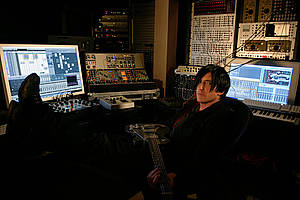
NI
software
seems
to be
at the
core
of
your
musical
work.
How
were
you
introduced
to it?
Around
the
time
we
were
working
on the
"Fragile"
record,
we
ended
up
getting
a PC
hooked
up
just
to run
Generator,
the
first
version
of
Reaktor.
It was
quite
a
battle
to get
the
right
interface
and to
get it
to
work,
so we
really
just
used
it as
an
occasional
sound
design
type
thing,
but it
seemed
like
the
most
amazing
tool
that
we'd
ever
come
across,
because
of
being
able
to go
to
levels
deeper
than
you
ever
imagined
you
could.
It
made a
lot of
the
things
that
we
were
messing
around
with
at the
time
seem
like
they
were
going
to be
obsolete.
For
the
last
two
albums
we
used
Battery
exclusively
as the
drum
sampler
because
I just
like
the
way it
works,
it's
set up
the
way I
think,
and
it's
an
easy
drag
and
drop
tool.
When
Kontakt
came
out, I
would
primarily
use
that
as a
sound
design
tool
less
than
for
the
meat
and
potatoes
of
sampling,
because
we had
already
started
in
another
format.
In
Kontakt
pretty
much
any
sound
will
sound
like a
really
interesting
sample
within
a
matter
of
minutes.
I
think
that
audio
software
really
has
come
into
its
own
right
and is
not
just
an
emulation
of
hardware,
but a
truly
great
musical
instrument
in
itself.
Guitars
and
distortion
have
always
been a
focus
of the
"Nine
Inch
Nails"
sound.
How
did
you
create
those
sounds
for
your
current
album?
For a
large
portion
of
what
we
did,
we
treated
Reaktor
like a
guitar
pedal,
like
the
ultimate
distortion
box.
Instead
of
having
an
array
of
pedals
on the
floor,
a lot
of the
pedals
became
virtual
in
Reaktor.
We
went
out of
Reaktor
into
the
amp
head
for
most
of the
record.
Running
it
through
a real
guitar
amp
and
miking
it up
brought
it
back
to
sounding
less
like
science
fiction
and
more
like
real
world.
Some
of the
sounds
were
like
"Wow,
I
haven't
used
it
that
way
before".
We had
a lot
of
flexibility
in the
tone.
You
chose
to use
Reaktor
rather
than
Guitar
Rig?
Well,
eventually
Guitar
Rig
worked
its
way
into
the
process.
Sometimes
we'd
make a
very
clean
patch
that
only
utilized
the
amp
simulators
or
different
arrays
of
speakers
and
then
take
whatever
we
might
be
using
as the
front
head
and
run it
through
the
amp
simulator
in
Guitar
Rig.
In the
studio
we had
two
Apple
G5's,
one
running
Pro
Tools
hosting
Guitar
Rig,
and
the
other
one
with
Logic
hosting
Reaktor,
so we
could
suck
as
much
horse
power
as we
needed
and
then
just
digitally
transfer
it to
the
computer
with
the
main
Pro
Tools
system.
We
didn't
swamp
the
computer
too
much,
but
those
were
two
instruments
that
kept
coming
back
up.
Even
most
of the
synths
on the
record
this
time
around
were
made
or
edited
with
these
tools.
What I
wanted
was a
low
tech
sound,
the
opposite
of
what
"Fragile"
was
loaded
with.
What
other
software
have
you
been
experimenting
with?
I have
gone
down
the
path
with
Spektral
Delay
a lot
and
really
like
messing
around
with
Vokator.
But
opposed
to my
first
album,
where
I only
had an
Emax
sampler
and
knew
every
possible
trick,
it’s
impossible
for me
to
keep
up at
that
level
with
everything
today.
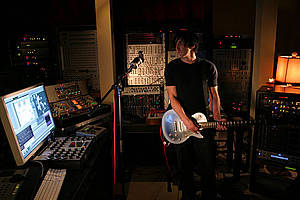
Generally,
do you
make
your
own
sounds
or
rather
the
ones
that
come
with
the
software?
Depends,
back
in the
older
days I
loved
getting
new
keyboards
which
now
means
getting
a new
piece
of
software.
There’s
always
some
inspiring
thing
in
there
that
has at
least
one or
two
songs
that
are
ready
to
come
out.
Once I
hear
it,
then
it’s
that
first
excitement
of
figuring
out
what
an
instrument
can do
and
learning
how to
manipulate
it and
play
it and
checking
how
musical
or
non-musical
it is.
What I
used
to do,
is
listen
to the
factory
patches
for a
minute,
then
erase
them
and
check
out
the
possibilities,
like
creating
some
random
things.
Then
you
could
see
how
you
could
edit
that
randomness
into
something
that
might
be
more
manageable
and
stumbling
into
what
the
instrument
could
do
that
way.
Rarely
would
I use
a
factory
patch.
But
these
days
there’s
so
many
things
out
that
have
so
much
depth,
most
of
which
you
guys
are
responsible
for,
that I
just
don’t
have
the
time
to
keep
up to
the
level
that I
remember
being
at
back a
hundred
years
ago.
You'll
be on
tour
for
about
a year
and
you're
half
way
through
your
next
album.
I
guess
this
means
the
next
album
will
have a
similar
vibe
as it
is
being
written
around
the
same
time?
Well,
I do
have
some
songs
left
over,
because
I
wanted
to
give
the
record
a
digestive
length.
But I
also
realized
I
wasn’t
through
the
writing
process
when I
finished
it.
There
were a
lot
more
ideas
that
seemed
to be
coming
out. I
could
imagine
that a
third
of
this
stuff
will
be
part
of the
next
record,
depending
on
what
feels
inspiring
to me
when
the
time
actually
gets
around.
"Bite
the
Hand
that
Feeds"
is
available
in the
iTunes
music
store
in a
format
that
actually
allows
people
to
download
it and
remix
it
themselves.
Can
you
explain
how
that
works
and
why
you
did
it?
When
"Fragile"
came
out,
some
people
expressed
interest
in
being
able
to
tinker
around
with
tracks
and to
create
remixes,
experiment,
embellish
or
destroy
what's
there,
something
I had
already
been
thinking
about.
So we
built
a tool
in
shockwave,
but it
sucked,
you
could
mix no
more
than
five
tracks.
Then I
realized
that
I'd
never
even
booted
up
Garage
Band.
I
didn’t
know
what
it was
at
that
time,
but it
dawned
on me
that
there
is a
multi-track
mini
audio
studio
that
everyone
has
got
for
free
on
their
computers
enlightened
enough
to
have a
Mac.
Then I
wondered
what
it
would
sound
like,
if I
just
bounced
the
whole
multi
track
of
"Hand
that
Feeds"
into
Garage
Band
format
so you
could
play
and
mix
all
the
single
tracks.
So I
converted
the
mix
that
we did
into
loops
to
make
things
a bit
smaller.
Much
to my
amazement
it's a
perfect
mix of
the
song,
broken
down
into
15 or
20
stereo
tracks.
What's fun about that software is that it’s set up to let anybody drag, drop and manipulate loops, while complicated technology stays hidden behind the scenes, making it pretty easy to use. You can just speed it up or slow it down for example, and suddenly it’s turned into a trip hop thing. I spent five hours remixing my own track. And then I thought it would be cool to just give it away on the internet. So I explained what I was doing to the record label and they understood. Just the other day, I saw a webpage with a couple hundred remixes of the track on there, surprisingly good.
Is
this
something
that
you
want
to do
regularly
with
your
music
in the
future?
Is it
to
allow
fans
or
listeners
to be
more
interactive
with
the
music
you
create?
Well
it
makes
the
creation
of
music
more
transparent,
and
I’m
not
losing
anything
by
doing
it.
It’s
fun
and
the
technology
is out
there
for
free.
Even
if I
wouldn’t
like a
certain
band
and
saw
you
can
download
their
single
on a
multi-track,
I
would
do it
anyway,
just
to
have
fun
with
it.
But
there
certainly
isn’t
any
master
plan
behind
our
remixing
platform,
in
terms
of
taking
over
the
world
or
trying
to get
rich
of it.
Is
there
anything
that
you
would
like
to see
from
NI in
the
future?
What
always
struck
me,
and
I'm
not
just
saying
this
because
I am
speaking
to you
right
now,
is
that
everything
that’s
come
out by
Native
Instruments
has
always
been
top
notch
quality
with a
depth
to it
that I
really
appreciate.
That’s
why I
would
not
ever
use a
pirate
copy,
because
the
price
that’s
paid
for
the
product
ultimately
keeps
it
alive.
And NI
products
are
worth
their
money.
When synthesizers went from $3500 to affordable software plug-ins, the overall sound almost seemed less important than the fact that it had maybe a shitty sounding synth, that sounded good only when it was layered and bathed in reverb and chorus, so you didn’t really notice that what was behind it is crap. Whereas the Native Instrument stuff always seemed to go into that extra detail, not only in terms of sound. You can tell that a lot of thought went into it. NI is listening to the needs of musicians, I can tell by the software you make. I rarely do an interview for a company. But in this case, I really feel NI is a great company with a great series of products, and it's not as in return for anything, it's just to get the word out.
CRAFTING THE HOURGLASS

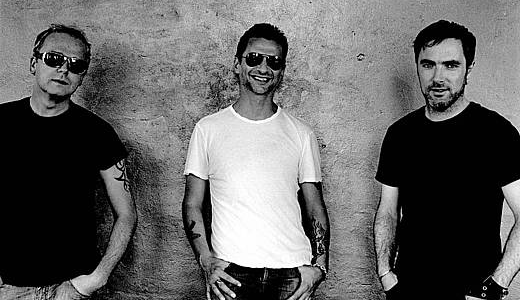
Dave Gahan, iconic frontman with Depeche Mode, needs no introduction. His instantly identifiable voice can be heard on some of the most definitive electronic/pop/rock songs of the 80s and 90s, including "Just Can't Get Enough", "People Are People" and "Personal Jesus". Andrew Phillpott is a long time collaborator with Depeche Mode as programmer, musical director and co-songwriter. In 2007 Phillpott worked together with Gahan on a new album, "Hourglass". Tech Talk took the opportunity to ask them a few questions about their working style, and found out how powerhouse NI synth MASSIVE has a crucial role in the sound of the record…
You have just released the album “Hourglass”. How long did the production process take, and what was the driving force behind it?
DG: We never actually had a plan to make an album. In March myself, Christian and Andrew decided to get together at my studio in NYC and do some writing together – very relaxed – we had a lot of fun and had a great creative flow going on. We would break for 2 weeks then get back together.
Then by the 3rd session Daniel Miller came into listen and basically said you guys seem to be making an album here, so we decided then just to keep going and produce it ourselves. I think the driving force was that we were just free to do what ever we wanted and as a result things just came really easily.
Could
you
elaborate
on
your
roles
in
the
studio?
AP:
Well
the
layout
of
Dave's
studio
is
simple
–
nice
large
control
room,
a
drum
room
and
a
large
“hang
out”
space.
So
I
set
up
in
the
control
room
and
Dave
and
Christian
set
up
in
the
other
room.
Usually
we
will
be
all
starting
ideas
either
on
the
computers
or
else
Christian
would
go
in
the
drum
room,
I’d
pick
up
the
bass
and
we’d
just
jam
away
recording
it
all
and
then
we
chop
out
the
nice
bits
and
start
playing
with
them.
Then the structuring process would begin which would involve Christian and Dave playing with lyric ideas, arrangements, keys etc. Then they will pass them onto me and I would start on the instrumentation and sounds. To be honest everyone’s been saying to me “I hear a good bit of Absynth in there” or “you must have used Reaktor a lot!” – but the truth is almost all the sounds on this album came from Massive – all started from scratch… and of course a mountain of plug-ins! And we would just pass ideas back and forth between the rooms so that within 8 weeks we almost had the whole thing written and ready for mixing – Tony Hoffer (Beck, Air etc) came to NYC and mixed it for us while we finished off the last bits of recording…
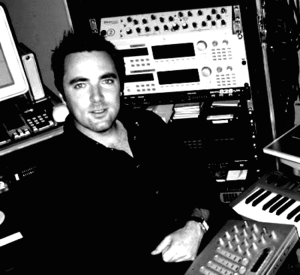
Andrew Phillpott
From
which
angle
did
you
normally
approach
a
new
song?
Did
you
lay
down
sketches
ahead
of
the
production?
The
format
would
be
different
almost
every
time
because
we
did
the
writing
as
we
recorded.
Sometimes
me
and
Christian
would
just
sit
down
at
the
keyboard
and
throw
around
chords,
or
Andrew
would
come
in
the
room
and
say
“come
check
this
out”
and
play
us
some
thing
he’d
be
working
on
or
else
the
boys
would
just
jam
away
–
be
it
bass
and
drums,
keys
and
drums
or
vocoder
and
bass
–
that’s
how
“Miracles”
happened.
We
just
recorded
it
all,
cut
it
up
and
started
creating
a
song…
In
your
own
experience,
how
has
the
process
of
producing
an
album
changed
over
the
years?
DG:
I
think
for
the
most
obvious
things
is
how
quickly
you
can
get
things
done
these
days.
No
more
sitting
around
the
Syclavier
for
days
on
end
sampling
things…
The
technology
has
become
so
much
more
user
friendly
it
lets
me
get
involved
in
a
way
I
couldn’t
years
ago..
And
that
keeps
momentum
and
creativity
flowing…
How
many
computers
did
you
have
in
the
studio,
and
what
did
you
use
them
for?
AP:
In
the
control
room
we
had
2
main
G5s,
one
running
Protools
which
purely
just
served
as
a
tape
machine
and
then
my
Logic
computer
in
which
I
do
all
the
sound
design,
synths
and
midi.Christian
and
Dave
had
a
basic
G5
setup
in
the
other
room
running
Logic
and
then
we
had
a
smaller
Protools
set
up
in
the
live
room
for
vocal
comping
–
our
friend
Kap10Kurt
came
in
towards
the
end
to
do
some
vocal
comping
to
make
time
for
us
as
we
had
a
lot
of
different
vocal
melodies
for
the
songs
and
it
was
nice
to
have
some
outside
help
with
that...
How
did
you
come
across
Native
Instruments?
AP:
It
was
one
of
the
very
early
versions
of
Reaktor
–
some
one
had
told
Martin(Gore)
about
it
so
we
decided
to
check
it
out
–
I
fell
in
love
with
it
instantly
and
haven't
looked
back!
You
guys
have
always
brought
out
consistent
quality
tools,
and
suddenly
we
weren't
having
to
drag
all
these
huge
synths
around!
Which
of
our
products
did
you
use
for
the
production
of
“Hourglass”?
AP:
Like
I
said
before
it
was
pretty
much
exclusively
Massive
–
only
for
the
reason
of
breaking
old
habits.
I
love
all
the
NI
stuff,
but
I
decided
to
limit
myself
to
one
synth
that
I
hadn't
really
explored
and
see
what
I
could
get
out
of
it
–
and
I
only
scratched
the
surface.
How
will
the
live
versions
of
the
songs
differ
from
the
studio
productions?
DG:
We
actually
aren’t
going
to
tour
this
album
for
various
reasons,
but
we
just
did
a
handful
of
radio
shows,
TVs
and
gigs
all
in
NYC
a
couple
of
weeks
ago
–
which
went
great.
We
had
Martyn
Lenoble
on
bass,
Christian
on
drums,
Andrew
on
keys
and
sequences,
Kap10Kurt
on
his
crazy
strap-on
SH101
and
Graham
Finn
on
guitar.
It
all
felt
really
organic
and
yet
we
didn’t
lose
the
electronic
feel
of
the
album…
AP:
We
ran
basic
sequences
in
Ableton
Live
from
a
Laptop
and
in
another
laptop
I
had
loaded
with
Logic
I
was
able
to
open
up
all
the
key
sounds
from
the
album
with
the
plug-ins
and
synced
it
to
Live
–
there
was
a
good
bit
of
side
chain
compression
and
gating
which
was
important
to
the
sounds…
K10K
had
his
modified
SH101
which
he
played
a
lot
of
the
driving
lead
sounds
on.
It
all
worked
out
really
well.
Have
you
already
found
your
perfect
setup
for
both
studio
and
stage
and
what
is
missing
from
your
ideal
musical
environment?
DG:
yes
–
my
microphone!
AP:
Simple
is
most
important
to
me
–
there’s
less
of
a
chance
for
disasters
happening.
But
its
ever
changing
which
I
like
because
its
so
easy
to
get
caught
in
a
repetitive
cycle
creatively,
so
change
is
good
–
as
for
things
missing
in
my
musical
environment..….just
time!